
Biology AS OCR
-
1-1-practical-skills-written-assessment AS7 主题
-
1-2-practical-skills-endorsement-assessment AS16 主题
-
1-2-1-practical-ethical-use-of-organisms as
-
1-2-2-practical-aseptic-techniques as
-
1-2-3-practical-dissection-of-gas-exchange-surfaces-in-fish-and-insects as
-
1-2-4-drawing-cells-from-blood-smears as
-
1-2-5-practical-investigating-biodiversity-using-sampling as
-
1-2-6-practical-data-loggers-and-computer-modelling as
-
1-2-7-practical-investigating-the-rate-of-diffusion as
-
1-2-8-practical-investigating-water-potential as
-
1-2-9-practical-factors-affecting-membrane-structure-and-permeability as
-
1-2-10-biochemical-tests-reducing-sugars-and-starch as
-
1-2-11-biochemical-tests-lipids as
-
1-2-12-biochemical-tests-proteins as
-
1-2-13-chromatography as
-
1-2-14-serial-dilutions as
-
1-2-15-practical-investigating-the-rate-of-transpiration as
-
1-2-16-practical-using-a-light-microscope as
-
1-2-1-practical-ethical-use-of-organisms as
-
2-1-cell-structure AS9 主题
-
2-1-2-using-a-microscope as
-
2-1-3-drawing-cells as
-
2-1-4-magnification-and-resolution as
-
2-1-5-eukaryotic-cells as
-
2-1-6-eukaryotic-cells-under-the-microscope as
-
2-1-7-organelles-and-the-production-of-proteins as
-
2-1-8-the-cytoskeleton as
-
2-1-9-prokaryotic-and-eukaryotic-cells as
-
2-1-1-studying-cells as
-
2-1-2-using-a-microscope as
-
2-2-biological-molecules AS17 主题
-
2-2-1-properties-of-water as
-
2-2-2-monomers-and-polymers as
-
2-2-3-monosaccharides as
-
2-2-4-the-glycosidic-bond as
-
2-2-5-polysaccharides as
-
2-2-6-biochemical-tests-reducing-sugars-and-starch as
-
2-2-7-lipids-and-ester-bonds as
-
2-2-8-lipids-structure-and-function as
-
2-2-9-biochemical-tests-lipids as
-
2-2-10-amino-acids-and-peptide-bonds as
-
2-2-11-protein-structure as
-
2-2-12-globular-proteins as
-
2-2-13-fibrous-proteins as
-
2-2-14-inorganic-ions as
-
2-2-15-biochemical-tests-proteins as
-
2-2-16-finding-the-concentration-of-a-substance as
-
2-2-17-chromatography as
-
2-2-1-properties-of-water as
-
2-3-nucleotides-and-nucleic-acids AS8 主题
-
2-4-enzymes AS9 主题
-
2-4-1-the-role-of-enzymes as
-
2-4-2-enzyme-action as
-
2-4-3-enzyme-activity-ph as
-
2-4-4-enzyme-activity-temperature as
-
2-4-5-enzyme-activity-enzyme-concentration as
-
2-4-6-enzyme-activity-substrate-concentration as
-
2-4-7-enzyme-activity-enzyme-inhibitors as
-
2-4-8-coenzymes-cofactors-and-prosthetic-groups as
-
2-4-9-practical-measuring-enzyme-activity as
-
2-4-1-the-role-of-enzymes as
-
2-5-biological-membranes AS9 主题
-
2-5-1-the-cell-surface-membrane as
-
2-5-2-membrane-structure-and-permeability as
-
2-5-3-diffusion-and-facilitated-diffusion as
-
2-5-4-practical-investigating-the-rate-of-diffusion as
-
2-5-5-active-transport as
-
2-5-6-endocytosis-and-exocytosis as
-
2-5-7-osmosis as
-
2-5-8-osmosis-in-animal-and-plant-cells as
-
2-5-9-practical-investigating-water-potential as
-
2-5-1-the-cell-surface-membrane as
-
2-6-cell-division-cell-diversity-and-cellular-organisation AS11 主题
-
2-6-1-the-cell-cycle as
-
2-6-2-the-stages-of-mitosis as
-
2-6-3-identifying-mitosis-in-plant-cells as
-
2-6-4-the-significance-of-mitosis as
-
2-6-5-the-stages-of-meiosis as
-
2-6-6-the-significance-of-meiosis as
-
2-6-7-specialised-cells as
-
2-6-8-the-organisation-of-cells as
-
2-6-9-stem-cells as
-
2-6-10-stem-cells-in-animals-and-plants as
-
2-6-11-the-use-of-stem-cells as
-
2-6-1-the-cell-cycle as
-
3-1-exchange-surfaces AS7 主题
-
3-2-transport-in-animals AS12 主题
-
3-2-1-the-need-for-transport-systems-in-animals as
-
3-2-2-circulatory-systems as
-
3-2-3-blood-vessels as
-
3-2-4-tissue-fluid as
-
3-2-5-the-mammalian-heart as
-
3-2-6-practical-mammalian-heart-dissection as
-
3-2-7-the-cardiac-cycle as
-
3-2-8-cardiac-output as
-
3-2-9-heart-action-initiation-and-control as
-
3-2-10-electrocardiograms-ecgs as
-
3-2-11-the-role-of-haemoglobin as
-
3-2-12-adult-and-fetal-haemoglobin as
-
3-2-1-the-need-for-transport-systems-in-animals as
-
3-3-transport-in-plants AS11 主题
-
3-3-1-the-need-for-transport-systems-in-plants as
-
3-3-2-the-xylem-and-phloem as
-
3-3-3-the-xylem as
-
3-3-4-the-phloem as
-
3-3-5-transverse-sections-stems-roots-and-leaves as
-
3-3-6-the-process-of-transpiration as
-
3-3-7-transpiration-in-plants as
-
3-3-8-practical-investigating-the-rate-of-transpiration as
-
3-3-9-translocation as
-
3-3-10-the-mass-flow-hypothesis as
-
3-3-11-the-adaptations-of-xerophytic-and-hydrophytic-plants as
-
3-3-1-the-need-for-transport-systems-in-plants as
-
4-1-communicable-diseases-disease-prevention-and-the-immune-system AS16 主题
-
4-1-1-common-pathogens-and-communicable-diseases as
-
4-1-2-transmission-of-communicable-pathogens as
-
4-1-3-plant-defences-against-pathogens as
-
4-1-4-non-specific-immune-responses as
-
4-1-5-phagocytes as
-
4-1-6-blood-cells as
-
4-1-7-the-t-lymphocyte-response as
-
4-1-8-the-b-lymphocyte-response as
-
4-1-9-primary-and-secondary-immune-responses as
-
4-1-10-antibodies as
-
4-1-11-opsonins-agglutinins-and-anti-toxins as
-
4-1-12-types-of-immunity as
-
4-1-13-autoimmune-diseases as
-
4-1-14-principles-of-vaccination as
-
4-1-15-sources-of-medicine as
-
4-1-16-antibiotics as
-
4-1-1-common-pathogens-and-communicable-diseases as
-
4-2-biodiversity AS10 主题
-
4-2-1-biodiversity as
-
4-2-2-sampling-to-determine-biodiversity as
-
4-2-3-practical-investigating-biodiversity-using-sampling as
-
4-2-4-measuring-species-richness-and-species-evenness as
-
4-2-5-simpsons-index as
-
4-2-6-genetic-diversity as
-
4-2-7-factors-affecting-biodiversity as
-
4-2-8-reasons-for-maintaining-biodiversity as
-
4-2-9-methods-of-maintaining-biodiversity as
-
4-2-10-conservation-agreements as
-
4-2-1-biodiversity as
-
4-3-classification-and-evolution AS15 主题
-
4-3-1-classification-of-species as
-
4-3-2-binomial-system as
-
4-3-3-classification-of-the-three-domains as
-
4-3-4-classification-of-the-five-kingdoms as
-
4-3-5-classification-and-phylogeny as
-
4-3-6-evidence-of-evolution as
-
4-3-7-types-of-variation as
-
4-3-8-standard-deviation as
-
4-3-9-variation-t-test-method as
-
4-3-10-variation-t-test-worked-example as
-
4-3-11-spearmans-rank-correlation as
-
4-3-12-adaptation as
-
4-3-13-natural-selection as
-
4-3-14-evolution-of-resistance as
-
4-3-15-consequences-of-resistance as
-
4-3-1-classification-of-species as
2-6-7-specialised-cells as
Exam code:H020
Specialised Cells
-
In complex multicellular organisms, eukaryotic cells become specialised for specific functions
-
These specialised eukaryotic cells have specific adaptations to help them carry out their functions
-
For example, the structure of a cell is adapted to help it carry out its function (this is why specialised eukaryotic cells can look extremely different from each other)
-
Structural adaptations include:
-
The shape of the cell
-
The organelles the cell contains (or doesn’t contain)
-
-
For example:
-
Cells that make large amounts of proteins will be adapted for this function by containing many ribosomes (the organelle responsible for protein production)
-
Erythrocytes (Red blood cells)

The biconcave shape of erythrocytes increases the surface area available for oxygen absorption.
-
Function: transport oxygen around the body and carbon dioxide to the lungs
-
Adaptations:
-
They are biconcave in shape which increases the surface area over which oxygen can be absorbed
-
The cytoplasm contains high amounts of the pigment haemoglobin which can readily bind to oxygen
-
No nucleus is present which makes more space inside the cell for haemoglobin molecules for maximum oxygen-carrying capacity
-
Elastic membrane allows the cell to be flexible and change shape as it squeezes through narrow capillaries
-
Neutrophils

The flexible cell membrane and nuclear membrane allow neutrophils to exit capillaries and enter infected tissues.
-
Function: destroy pathogens by phagocytosis and the secretion of enzymes
-
Adaptations:
-
Neutrophils have a very flexible shape that allows them to squeeze through cell junctions in the capillary wall
-
Their flexibility also enables them to form pseudopodia (cytoplasmic projections) that engulf microorganisms
-
There is a large number of lysosomes present in the cell. These digestive enzymes help to digest and destroy invading cells
-
A flexible nuclear membrane further helps the cell to penetrate cell junctions. It is thought that this flexibility is what causes the characteristic lobed nucleus
-
Sperm cells

Sperm cells are motile – their tail helps propel them forward in search of an egg to fertilise.
-
Function: reproduction – to fuse with an egg, initiate the development of an embryo and pass on fathers genes
-
Adaptations:
-
The head contains a nucleus that contains half the normal number of chromosomes (haploid, no chromosome pairs)
-
The acrosome in the head contains digestive enzymes that can break down the outer layer of an egg cell so that the haploid nucleus can enter to fuse with the egg’s nucleus
-
The mid-piece is packed with mitochondria to release energy (via respiration) for the tail movement
-
The tail rotates, propelling the sperm cell forwards and allowing it to move towards the egg
-
Root hair cells
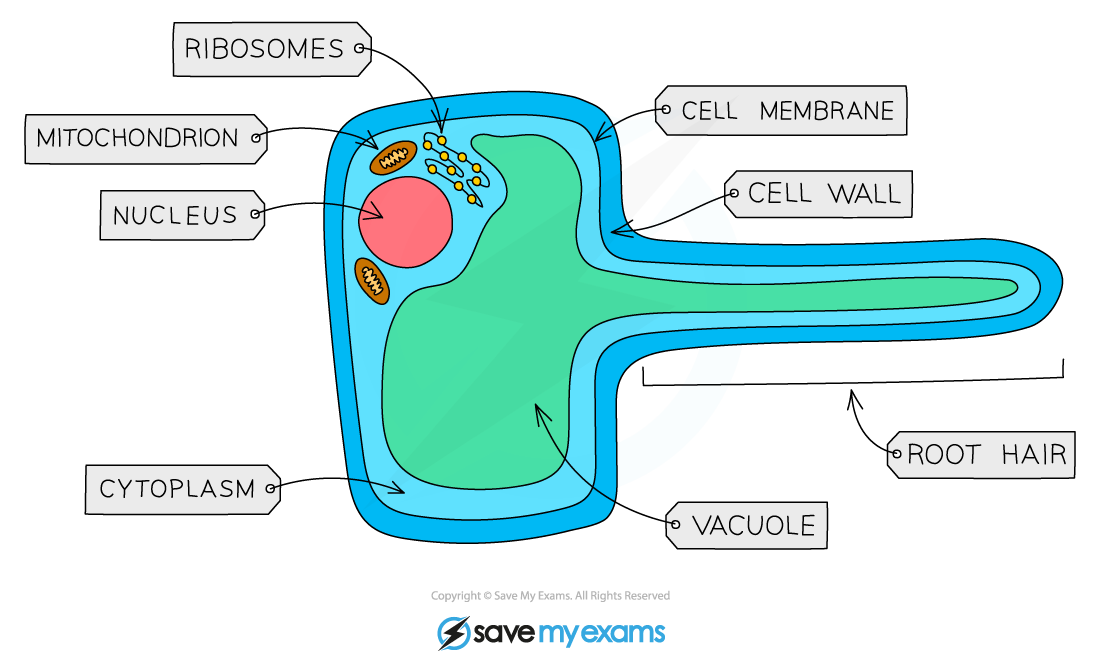
The root hair is an extension of the cytoplasm, increasing the surface area of the cell in contact with the soil to maximise absorption of water and minerals.
-
Function: absorption of water and mineral ions from soil
-
Adaptations:
-
Root hair to increase surface area (SA) so the rate of water uptake by osmosis is greater (can absorb more water and ions than if SA were lower)
-
Thinner walls than other plant cells so that water can move through easily (due to shorter diffusion distance)
-
Permanent vacuole contains cell sap which is more concentrated than soil water, maintaining a water potential gradient
-
Mitochondria for active transport of mineral ions
-
Remember that chloroplasts are not found in these cells – there’s no light for photosynthesis underground!
-
Ciliated epithelium
The cilia move in a coordinated way to push dirt and microbes away from the lungs
-
Function: moving substances across the surface of a tissue
-
Adaptations:
-
Have cilia (hair-like structures), which beat in a coordinated way to shift material along the surface of the epithelium tissue
-
Goblet cells secrete mucus which helps to trap dust, dirt and microorganisms – preventing them from entering vital organs where they may cause infection
-
Squamous epithelium

The structure of squamous epithelium
-
Function: provide a surface covering or outer layer. Found on a variety of organs and structures e.g. blood vessels and alveoli
-
Adaptations:
-
Squamous epithelium consists of a single layer of flattened cells on a basement membrane
-
The layer of cells forms a thin cross-section which reduces the distance that substances have to move to pass through – it shortens the diffusion pathway
-
It is permeable, allowing for the easy diffusion of gases
-
Palisade cells
The tall and thin palisade cells are densely packed together for the maximum absorption of light.
-
Function: carry out photosynthesis to produce glucose and oxygen
-
Adaptations:
-
A large number of chloroplasts (the site of photosynthesis) are present in the cytoplasm to maximise the absorption of light for photosynthesis
-
The tall and thin shape of the cells allows light to penetrate deeper before encountering another cell wall (cell walls absorb/reflect light) and for many cells to be densely packed together
-
Guard cells
When the guard cells are turgid the stoma is open, when they are flaccid the stoma is closed.
-
Function: control the opening of the stomata to regulate water loss and gas exchange
-
Adaptations:
-
Inner cell walls are thicker (those facing the air outside the leaf) while the outer cell walls are thinner (those facing adjacent epidermal cells). The difference in the thickness of the cell walls allows the cell to bend when turgid
-
The cytoplasm has a high density of chloroplasts and mitochondria. Scientists think that these organelles may play a role in the opening of the stomata
-
Responses