
Biology AS OCR
-
1-1-practical-skills-written-assessment AS7 主题
-
1-2-practical-skills-endorsement-assessment AS16 主题
-
1-2-1-practical-ethical-use-of-organisms as
-
1-2-2-practical-aseptic-techniques as
-
1-2-3-practical-dissection-of-gas-exchange-surfaces-in-fish-and-insects as
-
1-2-4-drawing-cells-from-blood-smears as
-
1-2-5-practical-investigating-biodiversity-using-sampling as
-
1-2-6-practical-data-loggers-and-computer-modelling as
-
1-2-7-practical-investigating-the-rate-of-diffusion as
-
1-2-8-practical-investigating-water-potential as
-
1-2-9-practical-factors-affecting-membrane-structure-and-permeability as
-
1-2-10-biochemical-tests-reducing-sugars-and-starch as
-
1-2-11-biochemical-tests-lipids as
-
1-2-12-biochemical-tests-proteins as
-
1-2-13-chromatography as
-
1-2-14-serial-dilutions as
-
1-2-15-practical-investigating-the-rate-of-transpiration as
-
1-2-16-practical-using-a-light-microscope as
-
1-2-1-practical-ethical-use-of-organisms as
-
2-1-cell-structure AS9 主题
-
2-1-2-using-a-microscope as
-
2-1-3-drawing-cells as
-
2-1-4-magnification-and-resolution as
-
2-1-5-eukaryotic-cells as
-
2-1-6-eukaryotic-cells-under-the-microscope as
-
2-1-7-organelles-and-the-production-of-proteins as
-
2-1-8-the-cytoskeleton as
-
2-1-9-prokaryotic-and-eukaryotic-cells as
-
2-1-1-studying-cells as
-
2-1-2-using-a-microscope as
-
2-2-biological-molecules AS17 主题
-
2-2-1-properties-of-water as
-
2-2-2-monomers-and-polymers as
-
2-2-3-monosaccharides as
-
2-2-4-the-glycosidic-bond as
-
2-2-5-polysaccharides as
-
2-2-6-biochemical-tests-reducing-sugars-and-starch as
-
2-2-7-lipids-and-ester-bonds as
-
2-2-8-lipids-structure-and-function as
-
2-2-9-biochemical-tests-lipids as
-
2-2-10-amino-acids-and-peptide-bonds as
-
2-2-11-protein-structure as
-
2-2-12-globular-proteins as
-
2-2-13-fibrous-proteins as
-
2-2-14-inorganic-ions as
-
2-2-15-biochemical-tests-proteins as
-
2-2-16-finding-the-concentration-of-a-substance as
-
2-2-17-chromatography as
-
2-2-1-properties-of-water as
-
2-3-nucleotides-and-nucleic-acids AS8 主题
-
2-4-enzymes AS9 主题
-
2-4-1-the-role-of-enzymes as
-
2-4-2-enzyme-action as
-
2-4-3-enzyme-activity-ph as
-
2-4-4-enzyme-activity-temperature as
-
2-4-5-enzyme-activity-enzyme-concentration as
-
2-4-6-enzyme-activity-substrate-concentration as
-
2-4-7-enzyme-activity-enzyme-inhibitors as
-
2-4-8-coenzymes-cofactors-and-prosthetic-groups as
-
2-4-9-practical-measuring-enzyme-activity as
-
2-4-1-the-role-of-enzymes as
-
2-5-biological-membranes AS9 主题
-
2-5-1-the-cell-surface-membrane as
-
2-5-2-membrane-structure-and-permeability as
-
2-5-3-diffusion-and-facilitated-diffusion as
-
2-5-4-practical-investigating-the-rate-of-diffusion as
-
2-5-5-active-transport as
-
2-5-6-endocytosis-and-exocytosis as
-
2-5-7-osmosis as
-
2-5-8-osmosis-in-animal-and-plant-cells as
-
2-5-9-practical-investigating-water-potential as
-
2-5-1-the-cell-surface-membrane as
-
2-6-cell-division-cell-diversity-and-cellular-organisation AS11 主题
-
2-6-1-the-cell-cycle as
-
2-6-2-the-stages-of-mitosis as
-
2-6-3-identifying-mitosis-in-plant-cells as
-
2-6-4-the-significance-of-mitosis as
-
2-6-5-the-stages-of-meiosis as
-
2-6-6-the-significance-of-meiosis as
-
2-6-7-specialised-cells as
-
2-6-8-the-organisation-of-cells as
-
2-6-9-stem-cells as
-
2-6-10-stem-cells-in-animals-and-plants as
-
2-6-11-the-use-of-stem-cells as
-
2-6-1-the-cell-cycle as
-
3-1-exchange-surfaces AS7 主题
-
3-2-transport-in-animals AS12 主题
-
3-2-1-the-need-for-transport-systems-in-animals as
-
3-2-2-circulatory-systems as
-
3-2-3-blood-vessels as
-
3-2-4-tissue-fluid as
-
3-2-5-the-mammalian-heart as
-
3-2-6-practical-mammalian-heart-dissection as
-
3-2-7-the-cardiac-cycle as
-
3-2-8-cardiac-output as
-
3-2-9-heart-action-initiation-and-control as
-
3-2-10-electrocardiograms-ecgs as
-
3-2-11-the-role-of-haemoglobin as
-
3-2-12-adult-and-fetal-haemoglobin as
-
3-2-1-the-need-for-transport-systems-in-animals as
-
3-3-transport-in-plants AS11 主题
-
3-3-1-the-need-for-transport-systems-in-plants as
-
3-3-2-the-xylem-and-phloem as
-
3-3-3-the-xylem as
-
3-3-4-the-phloem as
-
3-3-5-transverse-sections-stems-roots-and-leaves as
-
3-3-6-the-process-of-transpiration as
-
3-3-7-transpiration-in-plants as
-
3-3-8-practical-investigating-the-rate-of-transpiration as
-
3-3-9-translocation as
-
3-3-10-the-mass-flow-hypothesis as
-
3-3-11-the-adaptations-of-xerophytic-and-hydrophytic-plants as
-
3-3-1-the-need-for-transport-systems-in-plants as
-
4-1-communicable-diseases-disease-prevention-and-the-immune-system AS16 主题
-
4-1-1-common-pathogens-and-communicable-diseases as
-
4-1-2-transmission-of-communicable-pathogens as
-
4-1-3-plant-defences-against-pathogens as
-
4-1-4-non-specific-immune-responses as
-
4-1-5-phagocytes as
-
4-1-6-blood-cells as
-
4-1-7-the-t-lymphocyte-response as
-
4-1-8-the-b-lymphocyte-response as
-
4-1-9-primary-and-secondary-immune-responses as
-
4-1-10-antibodies as
-
4-1-11-opsonins-agglutinins-and-anti-toxins as
-
4-1-12-types-of-immunity as
-
4-1-13-autoimmune-diseases as
-
4-1-14-principles-of-vaccination as
-
4-1-15-sources-of-medicine as
-
4-1-16-antibiotics as
-
4-1-1-common-pathogens-and-communicable-diseases as
-
4-2-biodiversity AS10 主题
-
4-2-1-biodiversity as
-
4-2-2-sampling-to-determine-biodiversity as
-
4-2-3-practical-investigating-biodiversity-using-sampling as
-
4-2-4-measuring-species-richness-and-species-evenness as
-
4-2-5-simpsons-index as
-
4-2-6-genetic-diversity as
-
4-2-7-factors-affecting-biodiversity as
-
4-2-8-reasons-for-maintaining-biodiversity as
-
4-2-9-methods-of-maintaining-biodiversity as
-
4-2-10-conservation-agreements as
-
4-2-1-biodiversity as
-
4-3-classification-and-evolution AS15 主题
-
4-3-1-classification-of-species as
-
4-3-2-binomial-system as
-
4-3-3-classification-of-the-three-domains as
-
4-3-4-classification-of-the-five-kingdoms as
-
4-3-5-classification-and-phylogeny as
-
4-3-6-evidence-of-evolution as
-
4-3-7-types-of-variation as
-
4-3-8-standard-deviation as
-
4-3-9-variation-t-test-method as
-
4-3-10-variation-t-test-worked-example as
-
4-3-11-spearmans-rank-correlation as
-
4-3-12-adaptation as
-
4-3-13-natural-selection as
-
4-3-14-evolution-of-resistance as
-
4-3-15-consequences-of-resistance as
-
4-3-1-classification-of-species as
2-6-1-the-cell-cycle as
Exam code:H020
The Cell Cycle
-
Mitosis is part of a precisely controlled process known as the cell cycle
-
The cell cycle is the regulated sequence of events that occurs between one cell division and the next
-
The cell cycle has three phases:
-
interphase
-
nuclear division (mitosis)
-
cell division (cytokinesis)
-
-
The length of the cell cycle is very variable depending on environmental conditions, the cell type and the organism
-
For example, onion root tip cells divide once every 20 hours (roughly) but human intestine epithelial cells divide once every 10 hours (roughly)
-
-
The movement from one phase to another is triggered by chemical signals called cyclins
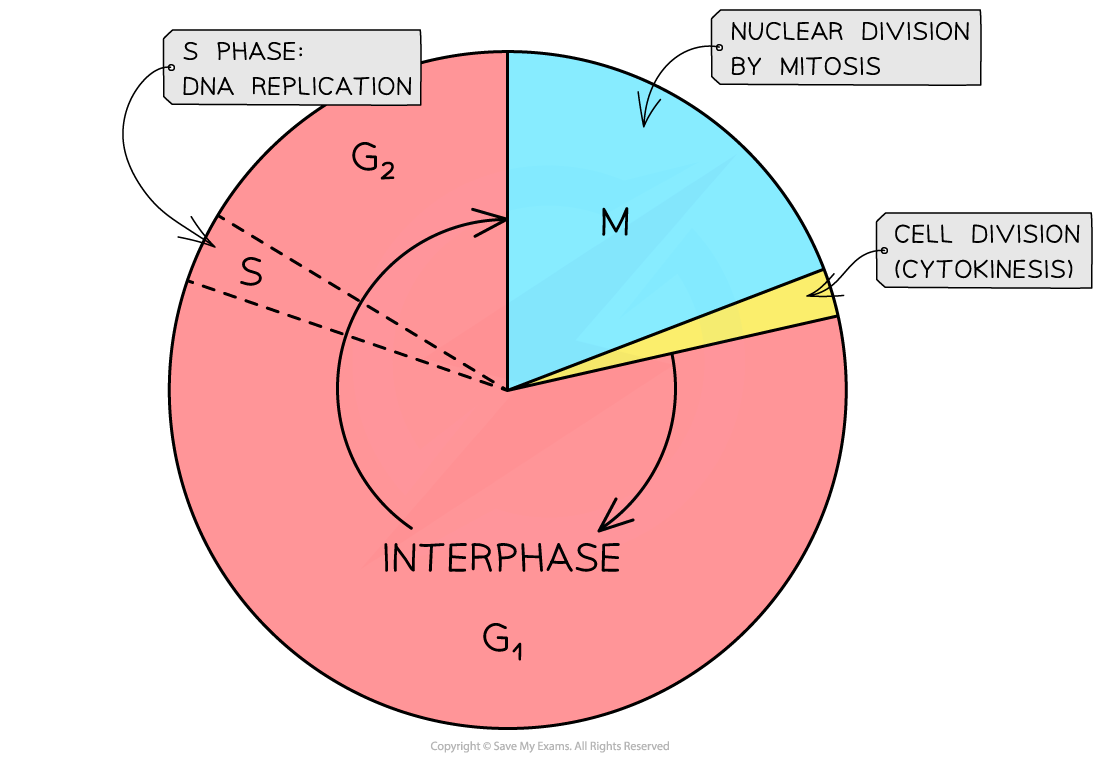
The cell cycle. S = synthesis (of DNA); G = growth; M = mitosis
Interphase
-
During Interphase the cell increases in mass and size and carries out its normal cellular functions (eg. synthesising proteins and replicating its DNA ready for mitosis)
-
Interphase consists of three phases:
-
G1 phase
-
S phase
-
G2 phase
-
-
It is at some point during the G1 phase a signal is received telling the cell to divide again
-
The DNA in the nucleus replicates (resulting in each chromosome consisting of two identical sister chromatids)
-
This phase of the interphase stage of the cell cycle is called the S phase – S stands for synthesis (of DNA)
-
The S phase is relatively short
-
-
The gap between the previous cell division and the S phase is called the G1 phase – G stands for growth
-
Cells make the RNA, enzymes and other proteins required for growth during the G1 phase
-
-
Between the S phase and next cell division event the G2 phase occurs
-
During the G2 phase, the cell continues to grow and the new DNA that has been synthesised is checked and any errors are usually repaired
-
Other preparations for cell division are made (eg. production of tubulin protein, which is used to make microtubules for the mitotic spindle)
-
-
Interphase = G1 + S + G2
Nuclear division (mitosis)
-
Follows interphase
-
Referred to as the M phase – M stands for mitosis
-
Cell growth stops during the M phase
Cytokinesis
-
Follows M phase
-
Once the nucleus has divided into two genetically identical nuclei, the whole cell divides and one nucleus moves into each cell to create two genetically identical daughter cells
-
In animal cells, cytokinesis involves constriction of the cytoplasm between the two nuclei and in plant cells, a new cell wall is formed

Flow cytometry can be used to measure the mass of DNA in a sample of cells throughout a cell cycle.
Examiner Tips and Tricks
Make sure you know the order of the phases of the cell cycle but also what specifically occurs during the different phases. Don’t forget, interphase is itself made up of three distinct stages (G1, S and G2) and you need to know what happens during each of these.For example, an exam question might ask you to identify the stage of the cell cycle during which a cell would be producing the most mRNA molecules and explain why. The correct answer would be the G1 phase, as this is when protein synthesis is occurring and the production of mRNA occurs during transcription (the first part of protein synthesis).
Regulation of the Cell Cycle
-
It is essential that the DNA within new cells is accurate in order for them to carry out their function
-
When the DNA is replicated (during the S phase) errors can occur
-
There are several checkpoints throughout the cell cycle where the genetic information contained within the replicated DNA is checked for any possible errors
-
Specific proof-reading enzymes and repair enzymes are involved in this checking process
-
When possible enzymes will repair the error but in some cases the cell may destroy itself to prevent passing on harmful mutations
-
There are four checkpoints in the cell cycle:
-
During G1 phase – chromosomes are checked for damage. If damage is detected then the cell does not advance into the S phase until repairs have been made
-
During S phase – chromosomes are checked to ensure they have been replicated. If all the chromosomes haven’t been successfully replicated then the cell cycle stops
-
During G2 phase – an additional check for DNA damage occurs after the DNA has been replicated. The cell cycle will be delayed until any necessary repairs are made
-
During metaphase – the final check determines whether the chromosomes are correctly attached to the spindle fibres prior to anaphase
Responses