
Biology AS OCR
-
1-1-practical-skills-written-assessment AS7 主题
-
1-2-practical-skills-endorsement-assessment AS16 主题
-
1-2-1-practical-ethical-use-of-organisms as
-
1-2-2-practical-aseptic-techniques as
-
1-2-3-practical-dissection-of-gas-exchange-surfaces-in-fish-and-insects as
-
1-2-4-drawing-cells-from-blood-smears as
-
1-2-5-practical-investigating-biodiversity-using-sampling as
-
1-2-6-practical-data-loggers-and-computer-modelling as
-
1-2-7-practical-investigating-the-rate-of-diffusion as
-
1-2-8-practical-investigating-water-potential as
-
1-2-9-practical-factors-affecting-membrane-structure-and-permeability as
-
1-2-10-biochemical-tests-reducing-sugars-and-starch as
-
1-2-11-biochemical-tests-lipids as
-
1-2-12-biochemical-tests-proteins as
-
1-2-13-chromatography as
-
1-2-14-serial-dilutions as
-
1-2-15-practical-investigating-the-rate-of-transpiration as
-
1-2-16-practical-using-a-light-microscope as
-
1-2-1-practical-ethical-use-of-organisms as
-
2-1-cell-structure AS9 主题
-
2-1-2-using-a-microscope as
-
2-1-3-drawing-cells as
-
2-1-4-magnification-and-resolution as
-
2-1-5-eukaryotic-cells as
-
2-1-6-eukaryotic-cells-under-the-microscope as
-
2-1-7-organelles-and-the-production-of-proteins as
-
2-1-8-the-cytoskeleton as
-
2-1-9-prokaryotic-and-eukaryotic-cells as
-
2-1-1-studying-cells as
-
2-1-2-using-a-microscope as
-
2-2-biological-molecules AS17 主题
-
2-2-1-properties-of-water as
-
2-2-2-monomers-and-polymers as
-
2-2-3-monosaccharides as
-
2-2-4-the-glycosidic-bond as
-
2-2-5-polysaccharides as
-
2-2-6-biochemical-tests-reducing-sugars-and-starch as
-
2-2-7-lipids-and-ester-bonds as
-
2-2-8-lipids-structure-and-function as
-
2-2-9-biochemical-tests-lipids as
-
2-2-10-amino-acids-and-peptide-bonds as
-
2-2-11-protein-structure as
-
2-2-12-globular-proteins as
-
2-2-13-fibrous-proteins as
-
2-2-14-inorganic-ions as
-
2-2-15-biochemical-tests-proteins as
-
2-2-16-finding-the-concentration-of-a-substance as
-
2-2-17-chromatography as
-
2-2-1-properties-of-water as
-
2-3-nucleotides-and-nucleic-acids AS8 主题
-
2-4-enzymes AS9 主题
-
2-4-1-the-role-of-enzymes as
-
2-4-2-enzyme-action as
-
2-4-3-enzyme-activity-ph as
-
2-4-4-enzyme-activity-temperature as
-
2-4-5-enzyme-activity-enzyme-concentration as
-
2-4-6-enzyme-activity-substrate-concentration as
-
2-4-7-enzyme-activity-enzyme-inhibitors as
-
2-4-8-coenzymes-cofactors-and-prosthetic-groups as
-
2-4-9-practical-measuring-enzyme-activity as
-
2-4-1-the-role-of-enzymes as
-
2-5-biological-membranes AS9 主题
-
2-5-1-the-cell-surface-membrane as
-
2-5-2-membrane-structure-and-permeability as
-
2-5-3-diffusion-and-facilitated-diffusion as
-
2-5-4-practical-investigating-the-rate-of-diffusion as
-
2-5-5-active-transport as
-
2-5-6-endocytosis-and-exocytosis as
-
2-5-7-osmosis as
-
2-5-8-osmosis-in-animal-and-plant-cells as
-
2-5-9-practical-investigating-water-potential as
-
2-5-1-the-cell-surface-membrane as
-
2-6-cell-division-cell-diversity-and-cellular-organisation AS11 主题
-
2-6-1-the-cell-cycle as
-
2-6-2-the-stages-of-mitosis as
-
2-6-3-identifying-mitosis-in-plant-cells as
-
2-6-4-the-significance-of-mitosis as
-
2-6-5-the-stages-of-meiosis as
-
2-6-6-the-significance-of-meiosis as
-
2-6-7-specialised-cells as
-
2-6-8-the-organisation-of-cells as
-
2-6-9-stem-cells as
-
2-6-10-stem-cells-in-animals-and-plants as
-
2-6-11-the-use-of-stem-cells as
-
2-6-1-the-cell-cycle as
-
3-1-exchange-surfaces AS7 主题
-
3-2-transport-in-animals AS12 主题
-
3-2-1-the-need-for-transport-systems-in-animals as
-
3-2-2-circulatory-systems as
-
3-2-3-blood-vessels as
-
3-2-4-tissue-fluid as
-
3-2-5-the-mammalian-heart as
-
3-2-6-practical-mammalian-heart-dissection as
-
3-2-7-the-cardiac-cycle as
-
3-2-8-cardiac-output as
-
3-2-9-heart-action-initiation-and-control as
-
3-2-10-electrocardiograms-ecgs as
-
3-2-11-the-role-of-haemoglobin as
-
3-2-12-adult-and-fetal-haemoglobin as
-
3-2-1-the-need-for-transport-systems-in-animals as
-
3-3-transport-in-plants AS11 主题
-
3-3-1-the-need-for-transport-systems-in-plants as
-
3-3-2-the-xylem-and-phloem as
-
3-3-3-the-xylem as
-
3-3-4-the-phloem as
-
3-3-5-transverse-sections-stems-roots-and-leaves as
-
3-3-6-the-process-of-transpiration as
-
3-3-7-transpiration-in-plants as
-
3-3-8-practical-investigating-the-rate-of-transpiration as
-
3-3-9-translocation as
-
3-3-10-the-mass-flow-hypothesis as
-
3-3-11-the-adaptations-of-xerophytic-and-hydrophytic-plants as
-
3-3-1-the-need-for-transport-systems-in-plants as
-
4-1-communicable-diseases-disease-prevention-and-the-immune-system AS16 主题
-
4-1-1-common-pathogens-and-communicable-diseases as
-
4-1-2-transmission-of-communicable-pathogens as
-
4-1-3-plant-defences-against-pathogens as
-
4-1-4-non-specific-immune-responses as
-
4-1-5-phagocytes as
-
4-1-6-blood-cells as
-
4-1-7-the-t-lymphocyte-response as
-
4-1-8-the-b-lymphocyte-response as
-
4-1-9-primary-and-secondary-immune-responses as
-
4-1-10-antibodies as
-
4-1-11-opsonins-agglutinins-and-anti-toxins as
-
4-1-12-types-of-immunity as
-
4-1-13-autoimmune-diseases as
-
4-1-14-principles-of-vaccination as
-
4-1-15-sources-of-medicine as
-
4-1-16-antibiotics as
-
4-1-1-common-pathogens-and-communicable-diseases as
-
4-2-biodiversity AS10 主题
-
4-2-1-biodiversity as
-
4-2-2-sampling-to-determine-biodiversity as
-
4-2-3-practical-investigating-biodiversity-using-sampling as
-
4-2-4-measuring-species-richness-and-species-evenness as
-
4-2-5-simpsons-index as
-
4-2-6-genetic-diversity as
-
4-2-7-factors-affecting-biodiversity as
-
4-2-8-reasons-for-maintaining-biodiversity as
-
4-2-9-methods-of-maintaining-biodiversity as
-
4-2-10-conservation-agreements as
-
4-2-1-biodiversity as
-
4-3-classification-and-evolution AS15 主题
-
4-3-1-classification-of-species as
-
4-3-2-binomial-system as
-
4-3-3-classification-of-the-three-domains as
-
4-3-4-classification-of-the-five-kingdoms as
-
4-3-5-classification-and-phylogeny as
-
4-3-6-evidence-of-evolution as
-
4-3-7-types-of-variation as
-
4-3-8-standard-deviation as
-
4-3-9-variation-t-test-method as
-
4-3-10-variation-t-test-worked-example as
-
4-3-11-spearmans-rank-correlation as
-
4-3-12-adaptation as
-
4-3-13-natural-selection as
-
4-3-14-evolution-of-resistance as
-
4-3-15-consequences-of-resistance as
-
4-3-1-classification-of-species as
2-4-2-enzyme-action as
Exam code:H020
Mechanism of Enzyme Action
-
Enzymes have an active site where specific substrates bind forming an enzyme-substrate complex
-
The active site of an enzyme has a specific shape to fit a specific substrate
-
Extremes of heat or pH can change the shape of the active site, preventing substrate binding – this is called denaturation (the enzyme is said to be denatured)
-
Substrates collide with the enzymes active site and this must happen at the correct orientation and speed in order for a reaction to occur

The active site of an enzyme has a specific shape to fit a specific substrate (when the substrate binds an enzyme-substrate complex is formed)
Enzyme specificity
-
The specificity of an enzyme is a result of the complementary nature between the shape of the active site on the enzyme and its substrate(s)
-
The shape of the active site (and therefore the specificity of the enzyme) is determined by the complex tertiary structure of the protein that makes up the enzyme:
-
Proteins are formed from chains of amino acids held together by peptide bonds
-
The order of amino acids determines the shape of an enzyme
-
If the order is altered, the resulting three-dimensional shape changes
-

An example of enzyme specificity – the enzyme catalase can bind to its substrate hydrogen peroxide as they are complementary in shape, whereas DNA polymerase is not
The enzyme-substrate complex
-
An enzyme-substrate complex forms when an enzyme and its substrate join together
-
The enzyme-substrate complex is only formed temporarily before the enzyme catalyses the reaction and the product(s) are released

The temporary formation of an enzyme-substrate complex
The lock-and-key hypothesis
-
Enzymes are globular proteins
-
This means their shape (as well as the shape of the active site of an enzyme) is determined by the complex tertiary structure of the protein that makes up the enzyme and is therefore highly specific
-
In the 1890’s the first model of enzyme activity was described by Emil Fischer:
-
He suggested that both enzymes and substrates were rigid structures that locked into each other very precisely, much like a key going into a lock
-
This is known as the ‘lock-and-key hypothesis’
-

The lock-and-key hypothesis
The induced-fit hypothesis
-
The lock-and-key model was later modified and adapted to our current understanding of enzyme activity, permitted by advances in techniques in the molecular sciences
-
The modified model of enzyme activity (first proposed in 1959) is known as the ‘induced-fit hypothesis’
-
Although it is very similar to the lock and key hypothesis, in this model the enzyme and substrate interact with each other:
-
The enzyme and its active site (and sometimes the substrate) can change shape slightly as the substrate molecule enters the enzyme
-
These changes in shape are known as conformational changes
-
The conformational changes ensure an ideal binding arrangement between the enzyme and substrate is achieved
-
This maximises the ability of the enzyme to catalyse the reaction
-
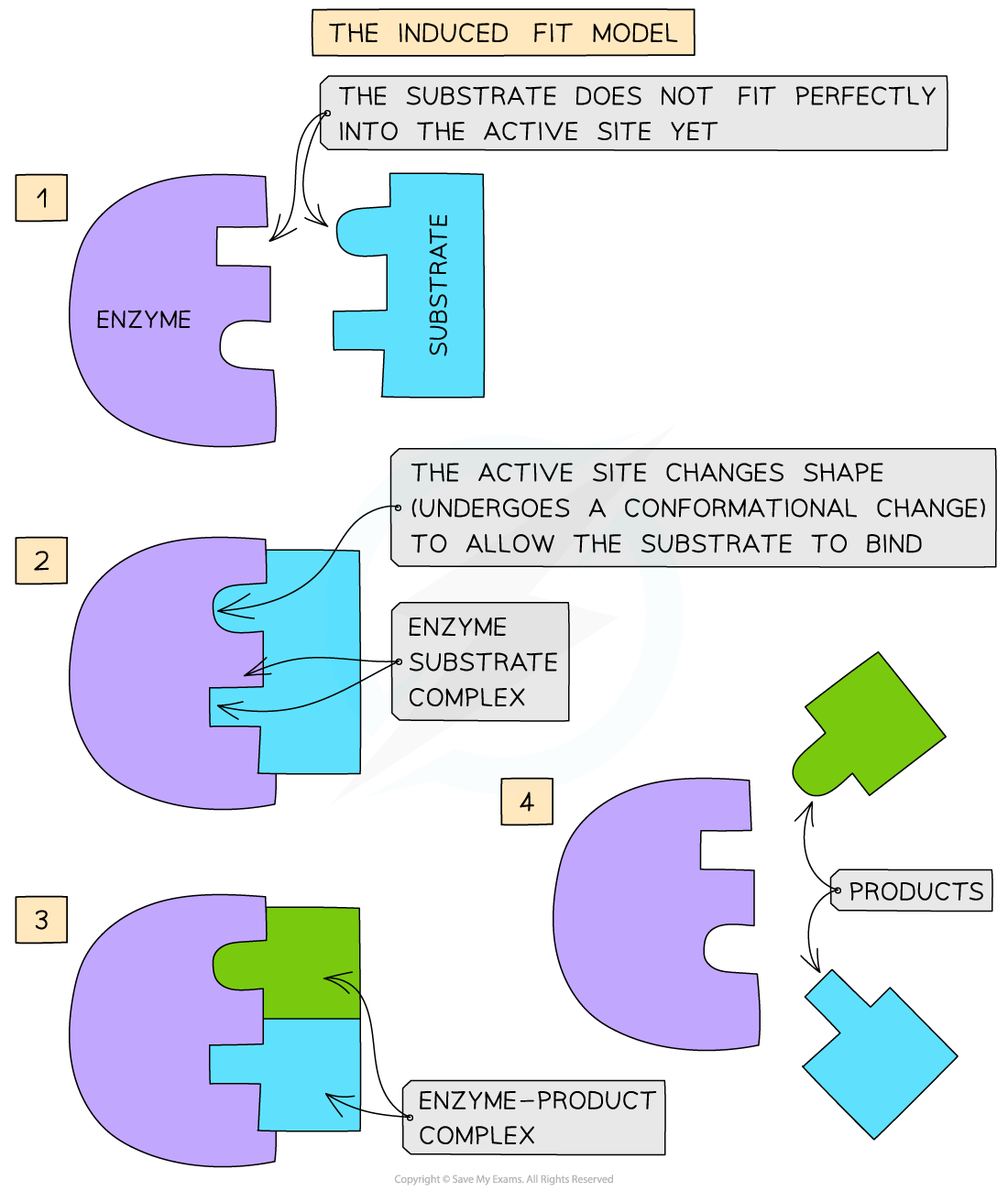
The induced-fit hypothesis
Enzymes and the lowering of activation energy
-
All chemical reactions are associated with energy changes
-
For a reaction to proceed there must be enough activation energy
-
Activation energy is the amount of energy needed by the substrate to become just unstable enough for a reaction to occur and for products to be formed
-
Enzymes speed up chemical reactions because they reduce the stability of bonds in the reactants
-
The destabilisation of bonds in the substrate makes it more reactive
-
-
Rather than lowering the overall energy change of the reaction, enzymes work by providing an alternative energy pathway with a lower activation energy
-
Without enzymes, extremely high temperatures or pressures would be needed to reach the activation energy for many biological reactions
-
Enzymes avoid the need for these extreme conditions (that would otherwise kill cells)
-

The activation energy of a chemical reaction is lowered by the presence of a catalyst (i.e. an enzyme)
Responses