
Biology AS OCR
-
1-1-practical-skills-written-assessment AS7 主题
-
1-2-practical-skills-endorsement-assessment AS16 主题
-
1-2-1-practical-ethical-use-of-organisms as
-
1-2-2-practical-aseptic-techniques as
-
1-2-3-practical-dissection-of-gas-exchange-surfaces-in-fish-and-insects as
-
1-2-4-drawing-cells-from-blood-smears as
-
1-2-5-practical-investigating-biodiversity-using-sampling as
-
1-2-6-practical-data-loggers-and-computer-modelling as
-
1-2-7-practical-investigating-the-rate-of-diffusion as
-
1-2-8-practical-investigating-water-potential as
-
1-2-9-practical-factors-affecting-membrane-structure-and-permeability as
-
1-2-10-biochemical-tests-reducing-sugars-and-starch as
-
1-2-11-biochemical-tests-lipids as
-
1-2-12-biochemical-tests-proteins as
-
1-2-13-chromatography as
-
1-2-14-serial-dilutions as
-
1-2-15-practical-investigating-the-rate-of-transpiration as
-
1-2-16-practical-using-a-light-microscope as
-
1-2-1-practical-ethical-use-of-organisms as
-
2-1-cell-structure AS9 主题
-
2-1-2-using-a-microscope as
-
2-1-3-drawing-cells as
-
2-1-4-magnification-and-resolution as
-
2-1-5-eukaryotic-cells as
-
2-1-6-eukaryotic-cells-under-the-microscope as
-
2-1-7-organelles-and-the-production-of-proteins as
-
2-1-8-the-cytoskeleton as
-
2-1-9-prokaryotic-and-eukaryotic-cells as
-
2-1-1-studying-cells as
-
2-1-2-using-a-microscope as
-
2-2-biological-molecules AS17 主题
-
2-2-1-properties-of-water as
-
2-2-2-monomers-and-polymers as
-
2-2-3-monosaccharides as
-
2-2-4-the-glycosidic-bond as
-
2-2-5-polysaccharides as
-
2-2-6-biochemical-tests-reducing-sugars-and-starch as
-
2-2-7-lipids-and-ester-bonds as
-
2-2-8-lipids-structure-and-function as
-
2-2-9-biochemical-tests-lipids as
-
2-2-10-amino-acids-and-peptide-bonds as
-
2-2-11-protein-structure as
-
2-2-12-globular-proteins as
-
2-2-13-fibrous-proteins as
-
2-2-14-inorganic-ions as
-
2-2-15-biochemical-tests-proteins as
-
2-2-16-finding-the-concentration-of-a-substance as
-
2-2-17-chromatography as
-
2-2-1-properties-of-water as
-
2-3-nucleotides-and-nucleic-acids AS8 主题
-
2-4-enzymes AS9 主题
-
2-4-1-the-role-of-enzymes as
-
2-4-2-enzyme-action as
-
2-4-3-enzyme-activity-ph as
-
2-4-4-enzyme-activity-temperature as
-
2-4-5-enzyme-activity-enzyme-concentration as
-
2-4-6-enzyme-activity-substrate-concentration as
-
2-4-7-enzyme-activity-enzyme-inhibitors as
-
2-4-8-coenzymes-cofactors-and-prosthetic-groups as
-
2-4-9-practical-measuring-enzyme-activity as
-
2-4-1-the-role-of-enzymes as
-
2-5-biological-membranes AS9 主题
-
2-5-1-the-cell-surface-membrane as
-
2-5-2-membrane-structure-and-permeability as
-
2-5-3-diffusion-and-facilitated-diffusion as
-
2-5-4-practical-investigating-the-rate-of-diffusion as
-
2-5-5-active-transport as
-
2-5-6-endocytosis-and-exocytosis as
-
2-5-7-osmosis as
-
2-5-8-osmosis-in-animal-and-plant-cells as
-
2-5-9-practical-investigating-water-potential as
-
2-5-1-the-cell-surface-membrane as
-
2-6-cell-division-cell-diversity-and-cellular-organisation AS11 主题
-
2-6-1-the-cell-cycle as
-
2-6-2-the-stages-of-mitosis as
-
2-6-3-identifying-mitosis-in-plant-cells as
-
2-6-4-the-significance-of-mitosis as
-
2-6-5-the-stages-of-meiosis as
-
2-6-6-the-significance-of-meiosis as
-
2-6-7-specialised-cells as
-
2-6-8-the-organisation-of-cells as
-
2-6-9-stem-cells as
-
2-6-10-stem-cells-in-animals-and-plants as
-
2-6-11-the-use-of-stem-cells as
-
2-6-1-the-cell-cycle as
-
3-1-exchange-surfaces AS7 主题
-
3-2-transport-in-animals AS12 主题
-
3-2-1-the-need-for-transport-systems-in-animals as
-
3-2-2-circulatory-systems as
-
3-2-3-blood-vessels as
-
3-2-4-tissue-fluid as
-
3-2-5-the-mammalian-heart as
-
3-2-6-practical-mammalian-heart-dissection as
-
3-2-7-the-cardiac-cycle as
-
3-2-8-cardiac-output as
-
3-2-9-heart-action-initiation-and-control as
-
3-2-10-electrocardiograms-ecgs as
-
3-2-11-the-role-of-haemoglobin as
-
3-2-12-adult-and-fetal-haemoglobin as
-
3-2-1-the-need-for-transport-systems-in-animals as
-
3-3-transport-in-plants AS11 主题
-
3-3-1-the-need-for-transport-systems-in-plants as
-
3-3-2-the-xylem-and-phloem as
-
3-3-3-the-xylem as
-
3-3-4-the-phloem as
-
3-3-5-transverse-sections-stems-roots-and-leaves as
-
3-3-6-the-process-of-transpiration as
-
3-3-7-transpiration-in-plants as
-
3-3-8-practical-investigating-the-rate-of-transpiration as
-
3-3-9-translocation as
-
3-3-10-the-mass-flow-hypothesis as
-
3-3-11-the-adaptations-of-xerophytic-and-hydrophytic-plants as
-
3-3-1-the-need-for-transport-systems-in-plants as
-
4-1-communicable-diseases-disease-prevention-and-the-immune-system AS16 主题
-
4-1-1-common-pathogens-and-communicable-diseases as
-
4-1-2-transmission-of-communicable-pathogens as
-
4-1-3-plant-defences-against-pathogens as
-
4-1-4-non-specific-immune-responses as
-
4-1-5-phagocytes as
-
4-1-6-blood-cells as
-
4-1-7-the-t-lymphocyte-response as
-
4-1-8-the-b-lymphocyte-response as
-
4-1-9-primary-and-secondary-immune-responses as
-
4-1-10-antibodies as
-
4-1-11-opsonins-agglutinins-and-anti-toxins as
-
4-1-12-types-of-immunity as
-
4-1-13-autoimmune-diseases as
-
4-1-14-principles-of-vaccination as
-
4-1-15-sources-of-medicine as
-
4-1-16-antibiotics as
-
4-1-1-common-pathogens-and-communicable-diseases as
-
4-2-biodiversity AS10 主题
-
4-2-1-biodiversity as
-
4-2-2-sampling-to-determine-biodiversity as
-
4-2-3-practical-investigating-biodiversity-using-sampling as
-
4-2-4-measuring-species-richness-and-species-evenness as
-
4-2-5-simpsons-index as
-
4-2-6-genetic-diversity as
-
4-2-7-factors-affecting-biodiversity as
-
4-2-8-reasons-for-maintaining-biodiversity as
-
4-2-9-methods-of-maintaining-biodiversity as
-
4-2-10-conservation-agreements as
-
4-2-1-biodiversity as
-
4-3-classification-and-evolution AS15 主题
-
4-3-1-classification-of-species as
-
4-3-2-binomial-system as
-
4-3-3-classification-of-the-three-domains as
-
4-3-4-classification-of-the-five-kingdoms as
-
4-3-5-classification-and-phylogeny as
-
4-3-6-evidence-of-evolution as
-
4-3-7-types-of-variation as
-
4-3-8-standard-deviation as
-
4-3-9-variation-t-test-method as
-
4-3-10-variation-t-test-worked-example as
-
4-3-11-spearmans-rank-correlation as
-
4-3-12-adaptation as
-
4-3-13-natural-selection as
-
4-3-14-evolution-of-resistance as
-
4-3-15-consequences-of-resistance as
-
4-3-1-classification-of-species as
2-2-13-fibrous-proteins as
Exam code:H020
Fibrous Proteins
-
Fibrous proteins are long strands of polypeptide chains that have cross-linkages due to hydrogen bonds
-
These proteins have little or no tertiary structure
-
Due to a large number of hydrophobic R groups, fibrous proteins are insoluble in water
-
Fibrous proteins have a limited number of amino acids with the sequence usually being highly repetitive
-
The highly repetitive sequence creates very organised structures that are strong and this along with their insolubility property, makes fibrous proteins very suitable for structural roles
-
Examples of fibrous proteins:
-
Keratin makes up hair, nails, horns and feathers (it is a very tough fibrous protein)
-
Elastin is found in connective tissue, tendons, skin and bone (it can stretch and then return to its original shape)
-
Collagen is a connective tissue found in skin, tendons and ligaments
-
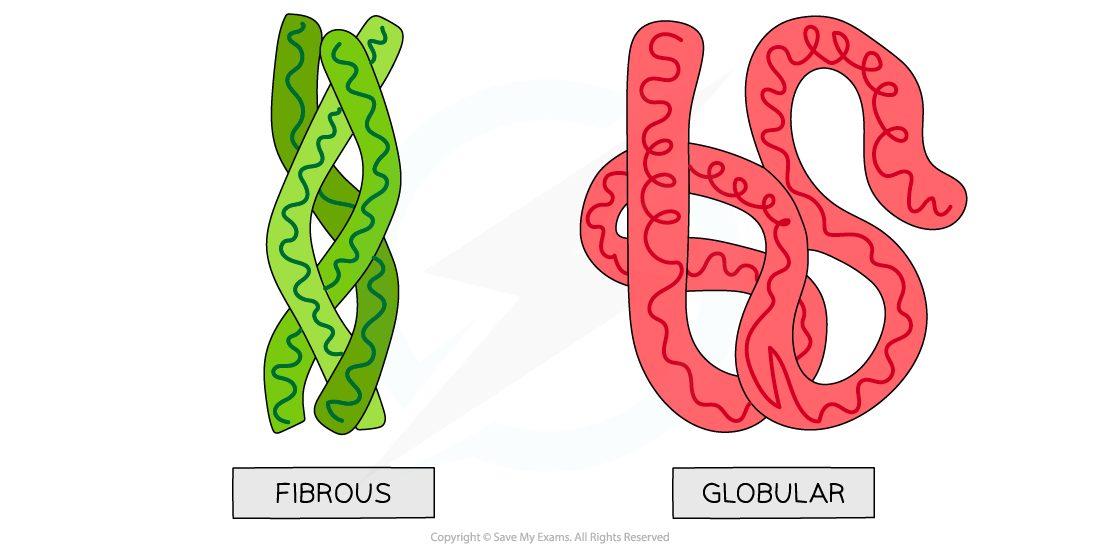
Globular and fibrous protein models illustrating the roughly spherical shape of globular proteins and the long, stranded shape of fibrous proteins
Comparison of Globular & Fibrous Tertiary Proteins Table

Collagen
-
Collagen is the most common structural protein found in vertebrates
-
It provides structural support
-
In vertebrates it is the component of connective tissue which forms:
-
Tendons
-
Cartilage
-
Ligaments
-
Bones
-
Teeth
-
Skin
-
Walls of blood vessels
-
Cornea of the eye
-
Function of collagen
-
Collagen is a flexible structural protein forming connective tissues
-
The presence of the many hydrogen bonds within the triple helix structure of collagen results in great tensile strength. This enables collagen to be able to withstand large pulling forces without stretching or breaking
-
The staggered ends of the collagen molecules within the fibrils provide strength
-
Collagen is a stable protein due to the high proportion of proline and hydroxyproline amino acids present. These amino acids increase stability as their R groups repel each other
-
The length of collagen molecules means they take too long to dissolve in water (making it insoluble in water)
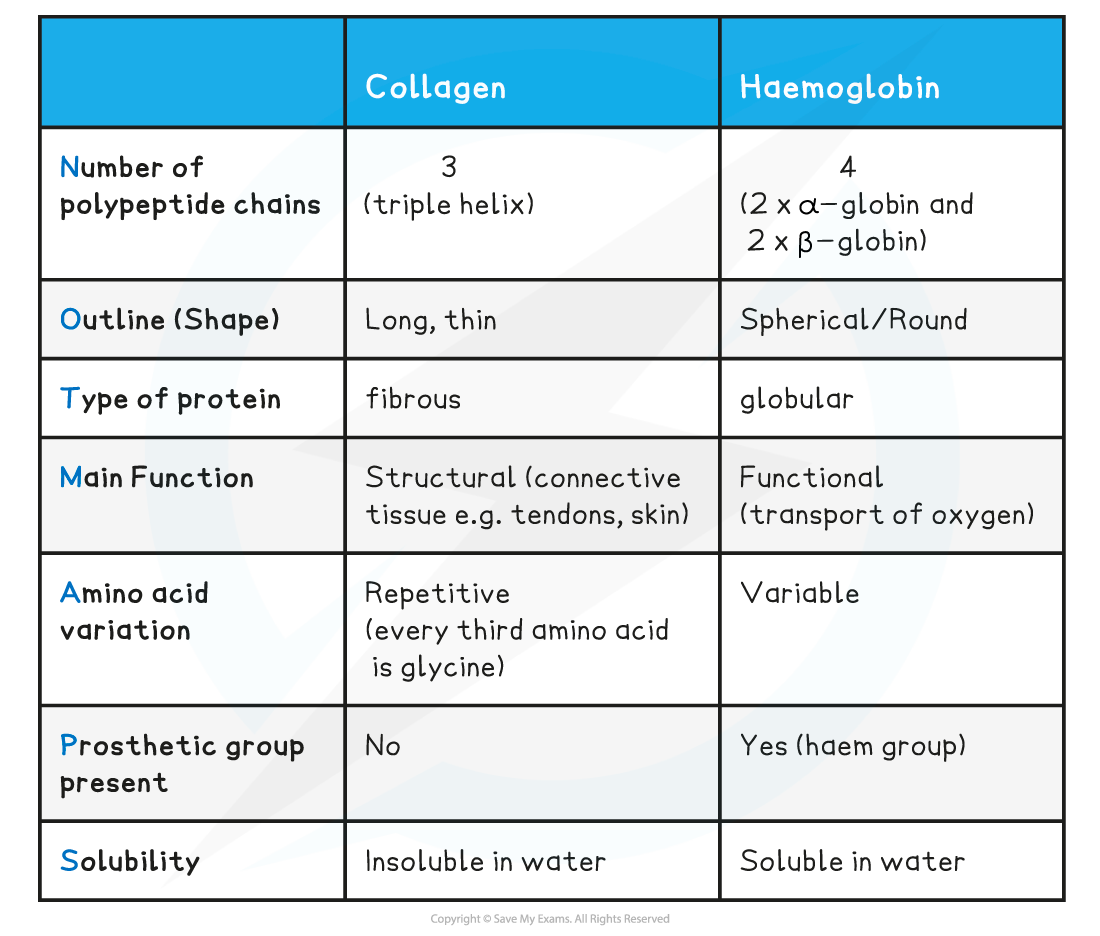
Comparison between Collagen & Haemoglobin Table
Examiner Tips and Tricks
To distinguish between proteins, learn SAFES (Shape, Amino acid sequence, Function, Examples and Solubility).You may also be asked to compare the structure and function of haemoglobin and collagen in the exam.
Responses