
Biology AS AQA
-
1-1-biological-molecules-carbohydrates11 主题
-
1-1-1-biological-molecules-key-terms
-
1-1-2-biological-molecules-reactions
-
1-1-3-monosaccharides
-
1-1-4-glucose
-
1-1-5-the-glycosidic-bond
-
1-1-6-chromatography-monosaccharides
-
1-1-7-disaccharides
-
1-1-8-starch-and-glycogen
-
1-1-9-cellulose
-
1-1-10-biochemical-tests-sugars-and-starch
-
1-1-11-finding-the-concentration-of-glucose
-
1-1-1-biological-molecules-key-terms
-
1-2-biological-molecules-lipids3 主题
-
1-3-biological-molecules-proteins5 主题
-
1-4-proteins-enzymes12 主题
-
1-4-1-many-proteins-are-enzymes
-
1-4-2-enzyme-specificity
-
1-4-3-how-enzymes-work
-
1-4-4-required-practical-measuring-enzyme-activity
-
1-4-5-drawing-a-graph-for-enzyme-rate-experiments
-
1-4-6-using-a-tangent-to-find-initial-rate-of-reaction
-
1-4-7-limiting-factors-affecting-enzymes-temperature
-
1-4-8-limiting-factors-affecting-enzymes-ph
-
1-4-10-limiting-factors-affecting-enzymes-enzyme-concentration
-
1-4-11-limiting-factors-affecting-enzymes-substrate-concentration
-
1-4-12-limiting-factors-affecting-enzymes-inhibitors
-
1-4-14-control-of-variables-and-uncertainty
-
1-4-1-many-proteins-are-enzymes
-
1-5-nucleic-acids-structure-and-dna-replication8 主题
-
1-5-2-nucleotide-structure-and-the-phosphodiester-bond
-
1-5-3-dna-structure-and-function
-
1-5-4-rna-structure-and-function
-
1-5-5-ribosomes
-
1-5-6-the-origins-of-research-on-the-genetic-code
-
1-5-8-the-process-of-semi-conservative-replication
-
1-5-9-calculating-the-frequency-of-nucleotide-bases
-
1-5-10-the-watson-crick-model
-
1-5-2-nucleotide-structure-and-the-phosphodiester-bond
-
1-6-atp-water-and-inorganic-ions4 主题
-
2-1-cell-structure7 主题
-
2-2-the-microscope-in-cell-studies4 主题
-
2-3-cell-division-in-eukaryotic-and-prokaryotic-cells8 主题
-
2-4-cell-membranes-and-transport9 主题
-
2-4-1-the-structure-of-cell-membranes
-
2-4-3-the-cell-surface-membrane
-
2-4-4-diffusion
-
2-4-5-osmosis
-
2-4-7-osmosis-in-animal-cells
-
2-4-9-required-practical-investigating-water-potential
-
2-4-10-active-transport-and-co-transport
-
2-4-11-adaptations-for-rapid-transport
-
2-4-13-required-practical-factors-affecting-membrane-permeability
-
2-4-1-the-structure-of-cell-membranes
-
2-5-cell-recognition-and-the-immune-system7 主题
-
2-6-vaccines-disease-and-monoclonal-antibodies6 主题
-
3-1-adaptations-for-gas-exchange6 主题
-
3-2-human-gas-exchange14 主题
-
3-2-5-the-alveolar-epithelium
-
3-2-1-the-human-gas-exchange-system
-
3-2-2-dissecting-the-gas-exchange-system
-
3-2-3-microscopy-and-gas-exchange-surfaces
-
3-2-4-investigating-gas-exchange
-
3-5-5-investigating-heart-rate
-
3-5-6-blood-vessels
-
3-5-7-capillaries-and-tissue-fluid
-
3-5-8-cardiovascular-disease-data
-
3-2-10-risk-factor-data
-
3-2-11-correlations-and-causal-relationships
-
3-2-6-ventilation-and-gas-exchange
-
3-2-8-the-effects-of-lung-disease
-
3-2-9-pollution-and-smoking-data
-
3-2-5-the-alveolar-epithelium
-
3-3-digestion-and-absorption5 主题
-
3-4-mass-transport-in-animals6 主题
-
3-5-the-circulatory-system-in-animals4 主题
-
3-6-mass-transport-in-plants6 主题
-
4-1-dna-genes-and-chromosomes10 主题
-
4-2-dna-and-protein-synthesis3 主题
-
4-3-genetic-diversity-mutations-and-meiosis7 主题
-
4-4-genetic-diversity-and-adaptation6 主题
-
4-5-species-and-taxonomy4 主题
-
4-6-biodiversity9 主题
4-3-1-genetic-mutations
Exam code:7401
Genetic mutations
-
A gene mutation is a change in the sequence of base pairs in a DNA molecule that may result in an altered polypeptide
-
Mutations occur continuously and at random
-
The DNA base sequence determines the sequence of amino acids that make up a protein; therefore, mutations in a gene can sometimes lead to a change in the polypeptide that the gene codes for
-
Most mutations do not alter the polypeptide, or only alter it slightly, so that its structure or function is not changed
-
This is because the genetic code is degenerate
-
-
There are different ways that a mutation in the DNA base sequence can occur:
Deletion of nucleotides
-
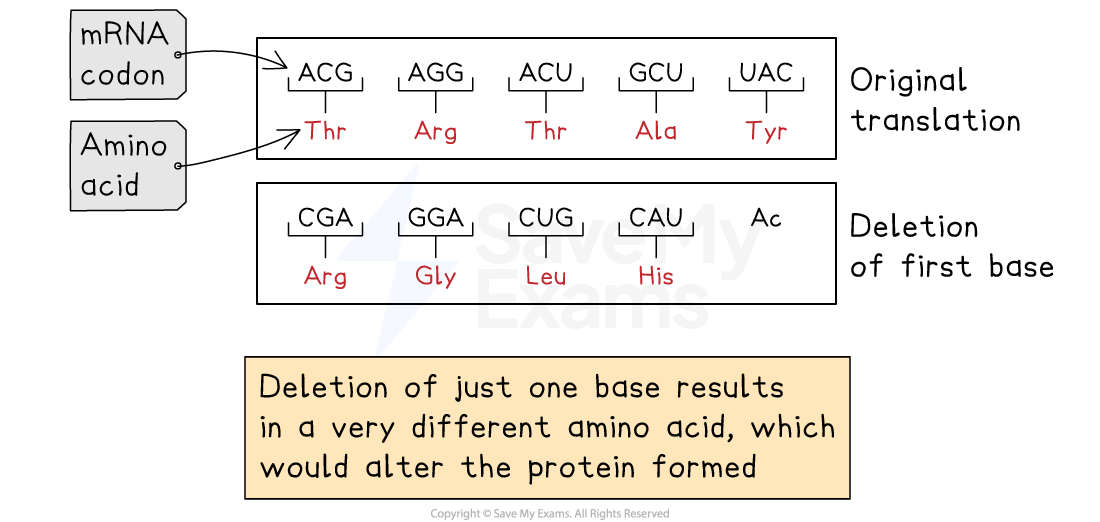
A deletion mutation occurs when a nucleotide (and therefore its base) is randomly deleted from the DNA sequence
-
A deletion mutation changes the amino acid that would have been coded for
-
These mutations have a knock-on effect by changing the triplets of three bases further on in the DNA sequence
-
This is sometimes known as a frameshift mutation
-
-
This may dramatically change the amino acid sequence produced from this gene and therefore the ability of the polypeptide to function
Substitution of nucleotides
-
A mutation that occurs when a base in the DNA sequence is randomly swapped for a different base
-
Unlike a deletion mutation, a substitution mutation will only change the amino acid for the triplet in which the mutation occurs; it will not have a knock-on effect
-
Substitution mutations may result in three possible outcomes:
-
The mutation may be silent if it does not alter the amino acid sequence of the polypeptide because many codons code for the same amino acid as the genetic code is degenerate
-
The mutation may alter a single amino acid in the polypeptide chain (e.g., sickle cell anaemia is a disease caused by a single substitution mutation changing a single amino acid in the sequence)
-
The mutation creates a premature STOP codon, causing the polypeptide chain produced to be incomplete and therefore affecting the final protein structure and function (e.g., cystic fibrosis is a disease caused by a nonsense mutation, although this is not always the only cause)
-

The effect of gene mutations on polypeptides
-
Most mutations do not alter the polypeptide or only alter it slightly, so that its appearance or function is not changed
-
However, a small number of mutations code for a significantly altered polypeptide with a different shape
-
This may affect the ability of the protein to perform its function. For example:
-
if the shape of the active site on an enzyme changes, the substrate may no longer be able to bind to the active site
-
a structural protein (like collagen) may lose its strength if its shape changes
-
Mutagenic agents
-
There are natural mechanisms that take place within cells to ensure the accuracy of DNA replication
-
These mechanisms involve proofreading and repairing damaged DNA
-
-
When the mutation rate of a cell rises to above a normal (usually low) rate, then these mechanisms become ineffective
-
Mutagenic agents are environmental factors that increase the mutation rate of cells
-
Examples include:
-
high-energy radiation such as UV light
-
ionising radiation such as X-rays
-
toxic chemicals such as peroxides
-
Responses