
Biology AS AQA
-
1-1-biological-molecules-carbohydrates11 主题
-
1-1-1-biological-molecules-key-terms
-
1-1-2-biological-molecules-reactions
-
1-1-3-monosaccharides
-
1-1-4-glucose
-
1-1-5-the-glycosidic-bond
-
1-1-6-chromatography-monosaccharides
-
1-1-7-disaccharides
-
1-1-8-starch-and-glycogen
-
1-1-9-cellulose
-
1-1-10-biochemical-tests-sugars-and-starch
-
1-1-11-finding-the-concentration-of-glucose
-
1-1-1-biological-molecules-key-terms
-
1-2-biological-molecules-lipids3 主题
-
1-3-biological-molecules-proteins5 主题
-
1-4-proteins-enzymes12 主题
-
1-4-1-many-proteins-are-enzymes
-
1-4-2-enzyme-specificity
-
1-4-3-how-enzymes-work
-
1-4-4-required-practical-measuring-enzyme-activity
-
1-4-5-drawing-a-graph-for-enzyme-rate-experiments
-
1-4-6-using-a-tangent-to-find-initial-rate-of-reaction
-
1-4-7-limiting-factors-affecting-enzymes-temperature
-
1-4-8-limiting-factors-affecting-enzymes-ph
-
1-4-10-limiting-factors-affecting-enzymes-enzyme-concentration
-
1-4-11-limiting-factors-affecting-enzymes-substrate-concentration
-
1-4-12-limiting-factors-affecting-enzymes-inhibitors
-
1-4-14-control-of-variables-and-uncertainty
-
1-4-1-many-proteins-are-enzymes
-
1-5-nucleic-acids-structure-and-dna-replication8 主题
-
1-5-2-nucleotide-structure-and-the-phosphodiester-bond
-
1-5-3-dna-structure-and-function
-
1-5-4-rna-structure-and-function
-
1-5-5-ribosomes
-
1-5-6-the-origins-of-research-on-the-genetic-code
-
1-5-8-the-process-of-semi-conservative-replication
-
1-5-9-calculating-the-frequency-of-nucleotide-bases
-
1-5-10-the-watson-crick-model
-
1-5-2-nucleotide-structure-and-the-phosphodiester-bond
-
1-6-atp-water-and-inorganic-ions4 主题
-
2-1-cell-structure7 主题
-
2-2-the-microscope-in-cell-studies4 主题
-
2-3-cell-division-in-eukaryotic-and-prokaryotic-cells8 主题
-
2-4-cell-membranes-and-transport9 主题
-
2-4-1-the-structure-of-cell-membranes
-
2-4-3-the-cell-surface-membrane
-
2-4-4-diffusion
-
2-4-5-osmosis
-
2-4-7-osmosis-in-animal-cells
-
2-4-9-required-practical-investigating-water-potential
-
2-4-10-active-transport-and-co-transport
-
2-4-11-adaptations-for-rapid-transport
-
2-4-13-required-practical-factors-affecting-membrane-permeability
-
2-4-1-the-structure-of-cell-membranes
-
2-5-cell-recognition-and-the-immune-system7 主题
-
2-6-vaccines-disease-and-monoclonal-antibodies6 主题
-
3-1-adaptations-for-gas-exchange6 主题
-
3-2-human-gas-exchange14 主题
-
3-2-5-the-alveolar-epithelium
-
3-2-1-the-human-gas-exchange-system
-
3-2-2-dissecting-the-gas-exchange-system
-
3-2-3-microscopy-and-gas-exchange-surfaces
-
3-2-4-investigating-gas-exchange
-
3-5-5-investigating-heart-rate
-
3-5-6-blood-vessels
-
3-5-7-capillaries-and-tissue-fluid
-
3-5-8-cardiovascular-disease-data
-
3-2-10-risk-factor-data
-
3-2-11-correlations-and-causal-relationships
-
3-2-6-ventilation-and-gas-exchange
-
3-2-8-the-effects-of-lung-disease
-
3-2-9-pollution-and-smoking-data
-
3-2-5-the-alveolar-epithelium
-
3-3-digestion-and-absorption5 主题
-
3-4-mass-transport-in-animals6 主题
-
3-5-the-circulatory-system-in-animals4 主题
-
3-6-mass-transport-in-plants6 主题
-
4-1-dna-genes-and-chromosomes10 主题
-
4-2-dna-and-protein-synthesis3 主题
-
4-3-genetic-diversity-mutations-and-meiosis7 主题
-
4-4-genetic-diversity-and-adaptation6 主题
-
4-5-species-and-taxonomy4 主题
-
4-6-biodiversity9 主题
3-3-2-enzymes-in-digestion
Exam code:7401
Enzymes in digestion
-
Digestive enzymes are extracellular enzymes, meaning that they function outside the body cells
-
There are three main types of digestive enzymes:
-
carbohydrases
-
lipases
-
proteases
-
Carbohydrate digestion
-
Carbohydrase enzymes are a group of enzymes involved in carbohydrate digestion; examples include:
-
amylase
-
maltase
-
lactase
-
-
The process of digesting starch into simple carbohydrates is as follows:
-
Amylase hydrolyses starch into the disaccharide maltose
-
Amylase is made in the salivary glands, the pancreas and the small intestine
-
-
Maltose is then hydrolysed into the monosaccharide glucose by maltase
-

-
Maltase is a membrane-bound disaccharidase, meaning that it:
-
is attached to the cell-surface membranes of the epithelial cells lining the small intestine
-
breaks down disaccharides into monosaccharides
-

Lipid digestion
-
Lipid digestion involves the action of:
-
lipase enzymes
-
bile salts
-
-
The process of lipid digestion is as follows:
-
emulsification
-
Partially digested food arrives in the small intestine and mixes with bile
-
Bile salts bind to large lipid droplets and breaks them into smaller droplets; this is emulsification
-
The resulting small lipid droplets have a large surface area on which lipase enzymes can act
-
-
Lipase enzymes in the lumen of the small intestine break down lipids to glycerol, monoglycerides and fatty acids
-

Examiner Tips and Tricks
Be aware that the action of bile is not chemical digestion; bile is not an enzyme and does not carry out chemical breakdown of lipids.
Protein digestion
-
Protein digestion involves the action of different types of protease enzymes:
-
endopeptidases
-
exopeptidases, including dipeptidases
-
-
Protein digestion involves the following:
-
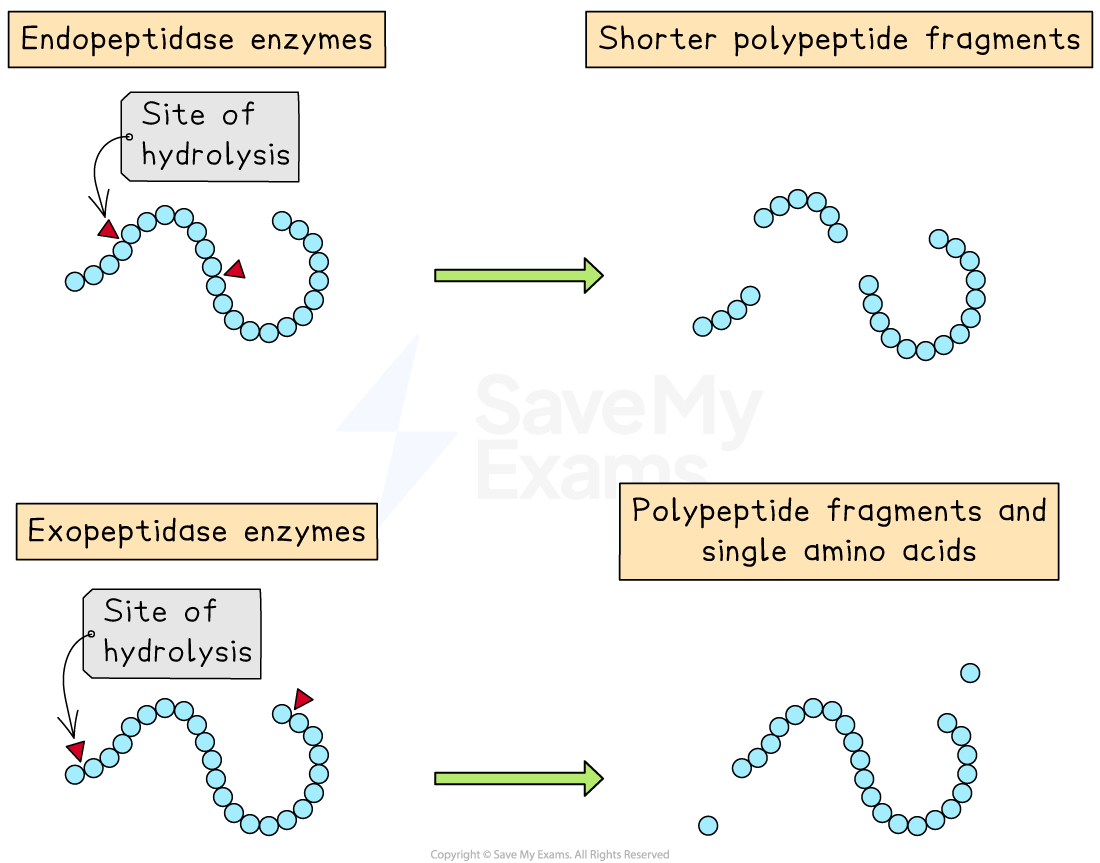
Endopeptidase enzymes in the stomach and small intestine hydrolyse peptide bonds within polypeptides, creating shorter polypeptide chains
-
Exopeptidases hydrolyse peptide bonds at the ends of polypeptide chains, producing single amino acids
-
Dipeptidases are a type of exopeptidase that break down dipeptides into individual amino acids
-
-
-
Membrane-bound dipeptidases are attached to the cell surface membrane of epithelial cells in the small intestine

Examiner Tips and Tricks
Remember that:
-
endo = within
-
exo = outside
So, endopeptidases act in the middle of polypeptides, and exopeptidases work around the outside.
Responses