
Biology AS AQA
-
1-1-biological-molecules-carbohydrates11 主题
-
1-1-1-biological-molecules-key-terms
-
1-1-2-biological-molecules-reactions
-
1-1-3-monosaccharides
-
1-1-4-glucose
-
1-1-5-the-glycosidic-bond
-
1-1-6-chromatography-monosaccharides
-
1-1-7-disaccharides
-
1-1-8-starch-and-glycogen
-
1-1-9-cellulose
-
1-1-10-biochemical-tests-sugars-and-starch
-
1-1-11-finding-the-concentration-of-glucose
-
1-1-1-biological-molecules-key-terms
-
1-2-biological-molecules-lipids3 主题
-
1-3-biological-molecules-proteins5 主题
-
1-4-proteins-enzymes12 主题
-
1-4-1-many-proteins-are-enzymes
-
1-4-2-enzyme-specificity
-
1-4-3-how-enzymes-work
-
1-4-4-required-practical-measuring-enzyme-activity
-
1-4-5-drawing-a-graph-for-enzyme-rate-experiments
-
1-4-6-using-a-tangent-to-find-initial-rate-of-reaction
-
1-4-7-limiting-factors-affecting-enzymes-temperature
-
1-4-8-limiting-factors-affecting-enzymes-ph
-
1-4-10-limiting-factors-affecting-enzymes-enzyme-concentration
-
1-4-11-limiting-factors-affecting-enzymes-substrate-concentration
-
1-4-12-limiting-factors-affecting-enzymes-inhibitors
-
1-4-14-control-of-variables-and-uncertainty
-
1-4-1-many-proteins-are-enzymes
-
1-5-nucleic-acids-structure-and-dna-replication8 主题
-
1-5-2-nucleotide-structure-and-the-phosphodiester-bond
-
1-5-3-dna-structure-and-function
-
1-5-4-rna-structure-and-function
-
1-5-5-ribosomes
-
1-5-6-the-origins-of-research-on-the-genetic-code
-
1-5-8-the-process-of-semi-conservative-replication
-
1-5-9-calculating-the-frequency-of-nucleotide-bases
-
1-5-10-the-watson-crick-model
-
1-5-2-nucleotide-structure-and-the-phosphodiester-bond
-
1-6-atp-water-and-inorganic-ions4 主题
-
2-1-cell-structure7 主题
-
2-2-the-microscope-in-cell-studies4 主题
-
2-3-cell-division-in-eukaryotic-and-prokaryotic-cells8 主题
-
2-4-cell-membranes-and-transport9 主题
-
2-4-1-the-structure-of-cell-membranes
-
2-4-3-the-cell-surface-membrane
-
2-4-4-diffusion
-
2-4-5-osmosis
-
2-4-7-osmosis-in-animal-cells
-
2-4-9-required-practical-investigating-water-potential
-
2-4-10-active-transport-and-co-transport
-
2-4-11-adaptations-for-rapid-transport
-
2-4-13-required-practical-factors-affecting-membrane-permeability
-
2-4-1-the-structure-of-cell-membranes
-
2-5-cell-recognition-and-the-immune-system7 主题
-
2-6-vaccines-disease-and-monoclonal-antibodies6 主题
-
3-1-adaptations-for-gas-exchange6 主题
-
3-2-human-gas-exchange14 主题
-
3-2-5-the-alveolar-epithelium
-
3-2-1-the-human-gas-exchange-system
-
3-2-2-dissecting-the-gas-exchange-system
-
3-2-3-microscopy-and-gas-exchange-surfaces
-
3-2-4-investigating-gas-exchange
-
3-5-5-investigating-heart-rate
-
3-5-6-blood-vessels
-
3-5-7-capillaries-and-tissue-fluid
-
3-5-8-cardiovascular-disease-data
-
3-2-10-risk-factor-data
-
3-2-11-correlations-and-causal-relationships
-
3-2-6-ventilation-and-gas-exchange
-
3-2-8-the-effects-of-lung-disease
-
3-2-9-pollution-and-smoking-data
-
3-2-5-the-alveolar-epithelium
-
3-3-digestion-and-absorption5 主题
-
3-4-mass-transport-in-animals6 主题
-
3-5-the-circulatory-system-in-animals4 主题
-
3-6-mass-transport-in-plants6 主题
-
4-1-dna-genes-and-chromosomes10 主题
-
4-2-dna-and-protein-synthesis3 主题
-
4-3-genetic-diversity-mutations-and-meiosis7 主题
-
4-4-genetic-diversity-and-adaptation6 主题
-
4-5-species-and-taxonomy4 主题
-
4-6-biodiversity9 主题
2-1-3-specialisation-of-eukaryotic-cells
Exam code:7401
Adaptations of eukaryotic cells
-
In multicellular organisms, eukaryotic cells become specialised to perform specific functions
-
Their structure is adapted to their role, which explains why different cell types can look very different
-
Structural adaptations may include:
-
Cell shape
-
Presence or absence of specific organelles
Examples:
-
Red blood cells are biconcave and lack a nucleus, creating more space for oxygen transport
-
Protein-producing cells contain many ribosomes to support high levels of protein synthesis
-
-
Other examples include:
Neurones (nerve cells)
-
Function: Conduction of nerve impulses
-
Adaptations:
-
Cell body contains most organelles and is the site of protein synthesis
-
Dendrites receive signals; axons transmit them to other cells
-
Long axon (up to 1m) enables fast, long-distance transmission
-
Myelin sheath insulates axon and increases speed of impulse conduction
-

Muscle cells
-
Function: Contraction for movement
-
Adaptations:
-
Three types in animals: skeletal, smooth, and cardiac
-
Protein filaments (actin and myosin) slide over each other to cause contraction
-
High density of mitochondria for ATP production via respiration
-
Skeletal muscle cells fuse during development to form multinucleated fibres
-

Sperm cells
-
Function: Fertilisation of the egg and delivery of the father’s DNA
-
Adaptations:
-
Head contains haploid nucleus with genetic material
-
Acrosome contains digestive enzymes to penetrate the egg
-
Mid-piece packed with mitochondria to provide energy for movement
-
Tail rotates to propel the sperm towards the egg
-

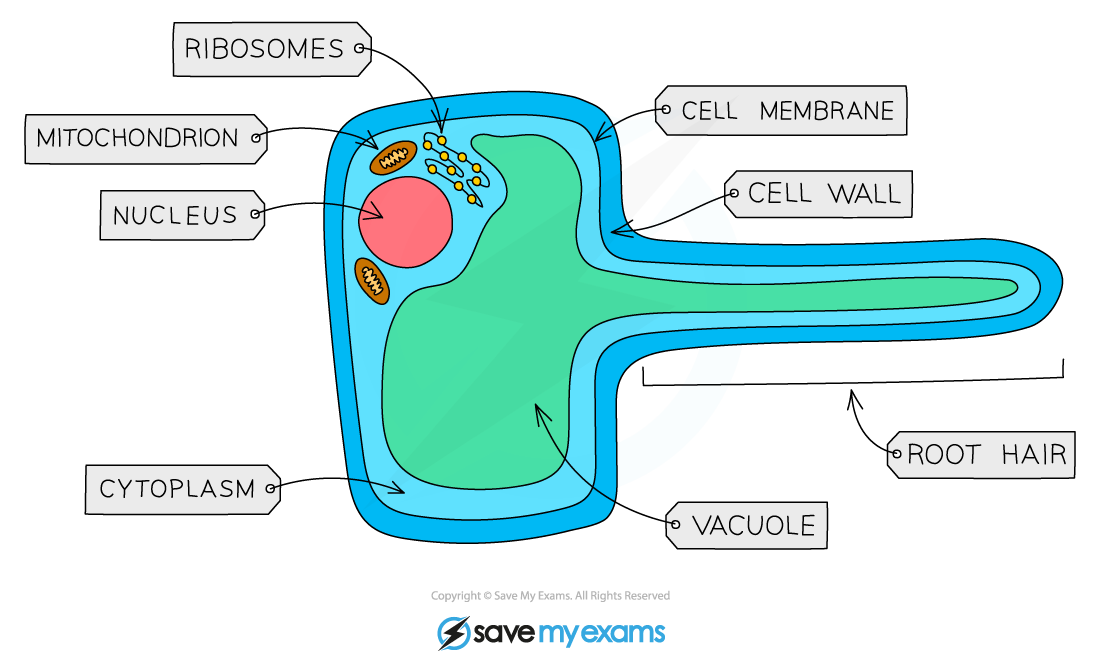
Root hair cells
-
Function: Absorption of water and mineral ions from the soil
-
Adaptations:
-
Root hair increases surface area to maximise absorption
-
Thin cell wall reduces diffusion distance
-
Vacuole contains concentrated cell sap to maintain a water potential gradient
-
Mitochondria provide ATP for active transport of mineral ions
-
No chloroplasts as they are found underground and not exposed to light
-
Xylem vessel cells
-
Function: Transport of water and dissolved mineral ions
-
Adaptations:
-
No end walls between cells forming a continuous tube
-
Cells are dead and lack organelles for unimpeded water flow
-
Walls thickened with lignin for strength and structural support
-

Phloem vessel cells
-
Function: Transport of sugars and amino acids (translocation)
-
Adaptations:
-
Living cells joined end-to-end with sieve plates for solute flow
-
Few subcellular structures to aid transport
-
Companion cells provide ATP and regulate transport processes
-

Examiner Tips and Tricks
In the exam, you might be asked to explain how a specialised cell is adapted to its function based on its organelles or structure
To answer these questions, think about what the cell needs to do its job and which organelles would help with that (e.g. a cell that photosynthesises will need lots of chloroplasts)
Responses