
Exam code:0452 & 0985
Introduction to depreciation
What is depreciation?
-
Depreciation is applied to non-current assets to represent the reduction in their value
-
Depreciation is the financial measure of how the value of an asset decreases over time
-
The value of a non-current asset depreciates due to:
-
Wear and tear of the asset
-
The asset becoming outdated or obsolete
-
The reduction in the expected useful lifetime of the asset
-
The asset being used up or depleted
-
-
Depreciation is an expense that accounts for the estimated loss in value of an asset during a given period
-
It is an expense that does not involve spending money
-
-
It is used to spread the cost of the assets over their expected useful life
-
You need to know three methods to calculate depreciation
-
Straight-line method
-
Reducing balance method
-
Revaluation method
-
-
The accounting principle of consistency states that when a business chooses a method of depreciation for a type of non-current asset, it must use that method each year unless there is a valid reason to change to a different method
-
Different methods can be used for different types of non-current assets
-
Why are non-current assets depreciated?
-
Depreciation is used so that the business adheres to the following accounting principles:
-
Matching
-
The capital expenditure of a non-current asset is matched against the income that it has contributed to
-
Suppose that a business buys a vehicle for $30 000 and expects it to be useful for 8 years
-
The full $30 000 should not be charged as an expense straightaway
-
Instead, the expense should be spread out over the 8 years that it is contributing to income
-
-
-
Prudence
-
The value of the assets should not be overstated
-
Depreciation allows the business to report a more realistic estimation for the valuation of its assets
-
-
Is depreciation charged in the years of purchase and sale?
-
Different businesses will have different policies for dealing with depreciation for the year in which the asset is purchased and the year in which the asset is sold or disposed of
-
The business could:
-
Charge a full year’s worth of depreciation
-
Charge no depreciation
-
Charge a proportion of the full year’s worth of depreciation
-
-
The exam question will specify which rules should be used
Straight-line depreciation
What is the straight-line method of depreciation?
-
The straight-line method of depreciation assumes that a non-current asset loses value at a constant rate over its useful life
-
This means that the expense for its depreciation is the same each year
-
The net book value can reach $0
-
This is when the asset is fully depreciated
-
-
-
You could be given the depreciation rate as a percentage of its original value
-
E.g. depreciation could be charged at 20% of its original cost
-
-
Or you could be expected to calculate the depreciation using:
-
The number of years that the non-current asset will be used
-
The expected value of the non-current asset at the end of its working life
-
This value could be $0
-
The expected value is also called the residual value
-
-
-
This method is usually used when the asset will be equally valuable for each year of its use
-
For example, fixtures and fittings, equipment, etc
-

How do I calculate depreciation using the straight-line method?
-
If you are given the percentage for the depreciation
-
Find the percentage of the original amount
-
This will be the yearly depreciation charge
-
-
If you are not given the percentage
-
Calculate the expected loss in value during the expected life of the non-current asset
-
The original value minus the expected value at the end of its life
-
-
Divide the loss by the number of years it will be used
-
This will be the yearly depreciation charge
-
format('truetype')%3Bfont-weight%3Anormal%3Bfont-style%3Anormal%3B%7D%3C%2Fstyle%3E%3C%2Fdefs%3E%3Ctext%20font-family%3D%22Times%20New%20Roman%22%20font-size%3D%2218%22%20text-anchor%3D%22middle%22%20x%3D%2246.5%22%20y%3D%2230%22%3EDepreciation%3C%2Ftext%3E%3Ctext%20font-family%3D%22math143f4d31b04031e49f5eb18baba%22%20font-size%3D%2216%22%20text-anchor%3D%22middle%22%20x%3D%22101.5%22%20y%3D%2230%22%3E%3D%3C%2Ftext%3E%3Cline%20stroke%3D%22%23000000%22%20stroke-linecap%3D%22square%22%20stroke-width%3D%221%22%20x1%3D%22112.5%22%20x2%3D%22338.5%22%20y1%3D%2223.5%22%20y2%3D%2223.5%22%2F%3E%3Ctext%20font-family%3D%22Times%20New%20Roman%22%20font-size%3D%2218%22%20text-anchor%3D%22middle%22%20x%3D%22142.5%22%20y%3D%2216%22%3Eoriginal%3C%2Ftext%3E%3Ctext%20font-family%3D%22Times%20New%20Roman%22%20font-size%3D%2218%22%20text-anchor%3D%22middle%22%20x%3D%22193.5%22%20y%3D%2216%22%3Evalue%3C%2Ftext%3E%3Ctext%20font-family%3D%22math143f4d31b04031e49f5eb18baba%22%20font-size%3D%2216%22%20text-anchor%3D%22middle%22%20x%3D%22221.5%22%20y%3D%2216%22%3E%26%23x2212%3B%3C%2Ftext%3E%3Ctext%20font-family%3D%22Times%20New%20Roman%22%20font-size%3D%2218%22%20text-anchor%3D%22middle%22%20x%3D%22262.5%22%20y%3D%2216%22%3Eexpected%3C%2Ftext%3E%3Ctext%20font-family%3D%22Times%20New%20Roman%22%20font-size%3D%2218%22%20text-anchor%3D%22middle%22%20x%3D%22317.5%22%20y%3D%2216%22%3Evalue%3C%2Ftext%3E%3Ctext%20font-family%3D%22Times%20New%20Roman%22%20font-size%3D%2218%22%20text-anchor%3D%22middle%22%20x%3D%22195.5%22%20y%3D%2241%22%3Enumber%3C%2Ftext%3E%3Ctext%20font-family%3D%22Times%20New%20Roman%22%20font-size%3D%2218%22%20text-anchor%3D%22middle%22%20x%3D%22234.5%22%20y%3D%2241%22%3Eof%3C%2Ftext%3E%3Ctext%20font-family%3D%22Times%20New%20Roman%22%20font-size%3D%2218%22%20text-anchor%3D%22middle%22%20x%3D%22265.5%22%20y%3D%2241%22%3Eyears%3C%2Ftext%3E%3C%2Fsvg%3E)
Examiner Tips and Tricks
The straight-line method is similar to simple interest calculations used in maths.
Worked Example
Abi purchases machinery for $18 000. Machinery is depreciated at 15% per annum using the straight-line method.
Calculate the net book value of the machinery after 3 years.
Answer
-
Calculate the yearly expense due to depreciation
-
15% ✕ $18 000 = $2 700
-
-
Calculate the total depreciation after 3 years
-
3 ✕ $2 700 = $8 100
-
-
Subtract the depreciation from the original value
-
$18 000 – $8 100 = $9 900
-
Worked Example
Taiki purchases a vehicle for $30 000. He expects to use the vehicle for 3 years, after which he estimates that it will have a value of $12 000.
Calculate the yearly expense due to the depreciation of the vehicle.
Answer
-
Calculate the loss in value over the 3 years
-
$30 000 – $12 000 = $18 000
-
-
Divide this by the number of years
-
$18 000 ÷ 3 = $6 000
-
Reducing balance depreciation
What is the reducing balance method of depreciation?
-
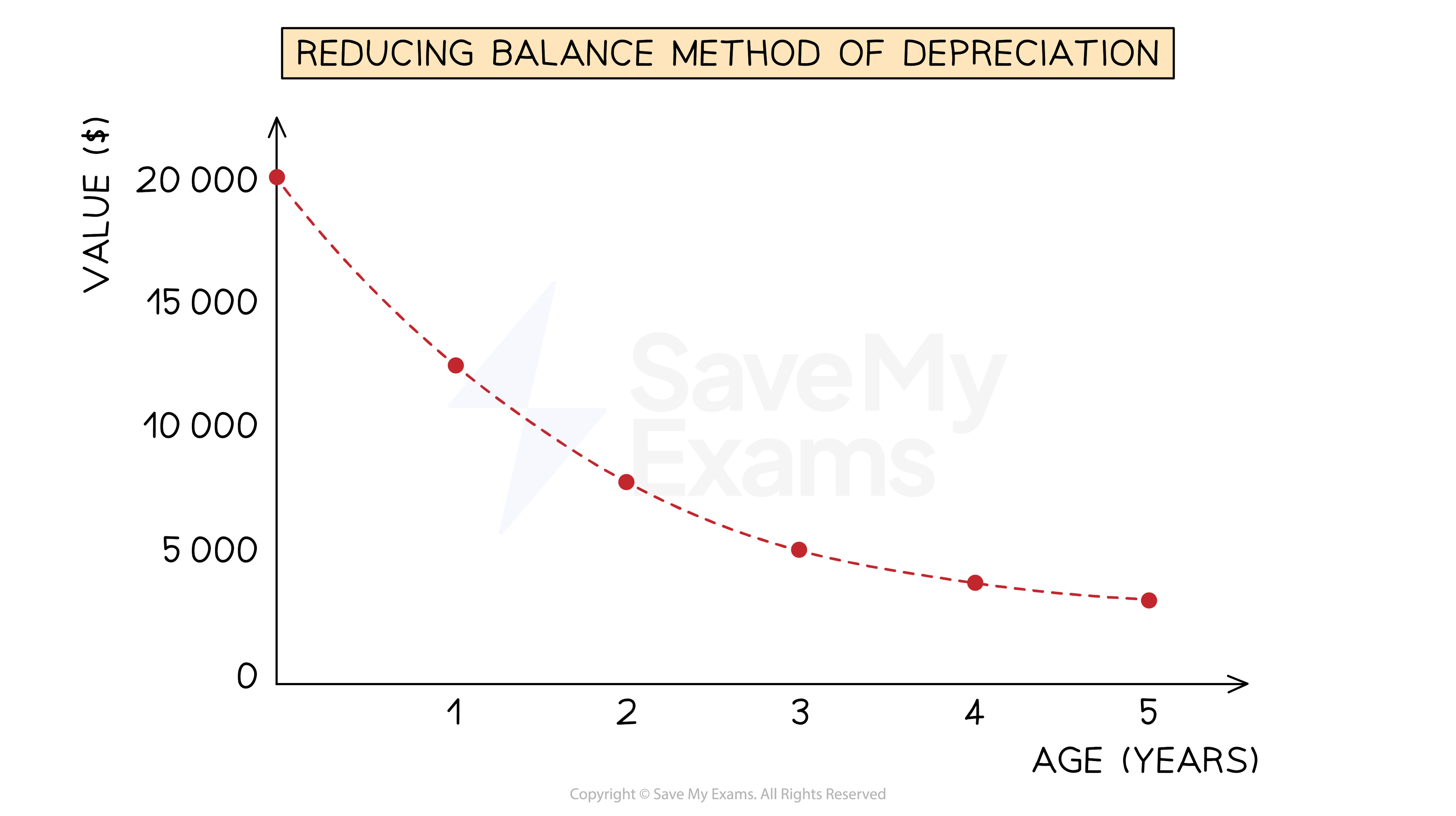
The reducing balance method of depreciation assumes that the non-current asset loses value at a rate proportional to its current value
-
This means that the expense for its depreciation gets smaller each year as the current value decreases
-
-
You will be told the percentage of the current value to use for depreciation
-
This method is usually used when a non-current asset initially loses value at a fast rate
How do I calculate depreciation using the reducing balance method?
-
Find the percentage of the current net book value
-
This will be the depreciation charge for that year
-
-
If you need to calculate the depreciation for multiple years, then calculate one year at a time
-
Find the depreciation charge for one year using the net book value at that start of the year
-
Subtract this amount from the net book value at the start of the year to find the new net book value
-
Find the depreciation charge for the next year using the net book value at the start of that year
-
Continue this process
-
-
If you just need to find the current net book value then you can use some maths skills
-
Subtract the percentage from 100%
-
Write this as a decimal
-
Raise this to the power of the number of years
-
Multiply this by the original value
-
Examiner Tips and Tricks
The reducing balance method is similar to compound interest calculations used in maths.
Amounts should always be given to the nearest dollar in exams.
Worked Example
Abi purchases a vehicle for $16 000. Machinery is depreciated at 25% per annum using the reducing balance method.
Calculate the net book value of the machinery after 3 years.
Answer
<span data-type=”commenta
Responses