
Maths Gcse Wjec-Eduqas Higher
-
Scatter-Graphs-And-Correlation Wjec-Eduqas Higher2 主题
-
Cumulative-Frequency-And-Box-Plots Wjec-Eduqas Higher4 主题
-
Histograms Wjec-Eduqas Higher3 主题
-
Statistical-Diagrams- Wjec-Eduqas Higher6 主题
-
Averages-Ranges-And-Data Wjec-Eduqas Higher8 主题
-
Questionnaires Wjec-Eduqas Higher
-
Population-And-Sampling Wjec-Eduqas Higher
-
Comparing-Data-Sets Wjec-Eduqas Higher
-
Range-And-Interquartile-Range Wjec-Eduqas Higher
-
Averages-From-Grouped-Data Wjec-Eduqas Higher
-
Averages-From-Tables- Wjec-Eduqas Higher
-
Calculations-With-The-Mean Wjec-Eduqas Higher
-
Mean-Median-And-Mode Wjec-Eduqas Higher
-
Questionnaires Wjec-Eduqas Higher
-
Combined-And-Conditional-Probability Wjec-Eduqas Higher3 主题
-
Tree-Diagrams- Wjec-Eduqas Higher1 主题
-
Simple-Probability-Diagrams- Wjec-Eduqas Higher3 主题
-
Introduction-To-Probability Wjec-Eduqas Higher3 主题
-
Transformations Wjec-Eduqas Higher5 主题
-
Vectors Wjec-Eduqas Higher6 主题
-
3D-Pythagoras-And-Trigonometry Wjec-Eduqas Higher1 主题
-
Sine-Cosine-Rule-And-Area-Of-Triangles- Wjec-Eduqas Higher4 主题
-
Pythagoras-And-Trigonometry Wjec-Eduqas Higher4 主题
-
Area-And-Volume-Of-Similar-Shapes Wjec-Eduqas Higher1 主题
-
Congruence-Similarity-And-Geometrical-Proof Wjec-Eduqas Higher5 主题
-
Volume-And-Surface-Area- Wjec-Eduqas Higher3 主题
-
Circles-Arcs-And-Sectors- Wjec-Eduqas Higher2 主题
-
Area-And-Perimeter- Wjec-Eduqas Higher4 主题
-
Circle-Theorems Wjec-Eduqas Higher7 主题
-
Circle-Theorem-Proofs Wjec-Eduqas Higher
-
The-Alternate-Segment-Theorem Wjec-Eduqas Higher
-
Angles-In-The-Same-Segment Wjec-Eduqas Higher
-
Angles-In-Cyclic-Quadrilaterals Wjec-Eduqas Higher
-
Theorems-With-Chords-And-Tangents Wjec-Eduqas Higher
-
Angle-In-A-Semicircle Wjec-Eduqas Higher
-
Angles-At-Centre-And-Circumference Wjec-Eduqas Higher
-
Circle-Theorem-Proofs Wjec-Eduqas Higher
-
Bearings-Scale-Drawing-Constructions-And-Loci Wjec-Eduqas Higher5 主题
-
Angles-In-Polygons-And-Parallel-Lines Wjec-Eduqas Higher3 主题
-
Symmetry-And-Shapes Wjec-Eduqas Higher6 主题
-
Exchange-Rates-And-Best-Buys Wjec-Eduqas Higher2 主题
-
Standard-And-Compound-Units- Wjec-Eduqas Higher5 主题
-
Direct-And-Inverse-Proportion- Wjec-Eduqas Higher2 主题
-
Problem-Solving-With-Ratios Wjec-Eduqas Higher2 主题
-
Ratios Wjec-Eduqas Higher3 主题
-
Sequences Wjec-Eduqas Higher4 主题
-
Transformations-Of-Graphs- Wjec-Eduqas Higher2 主题
-
Graphing-Inequalities- Wjec-Eduqas Higher2 主题
-
Solving-Inequalities- Wjec-Eduqas Higher2 主题
-
Real-Life-Graphs Wjec-Eduqas Higher4 主题
-
Estimating-Gradients-And-Areas-Under-Graphs Wjec-Eduqas Higher2 主题
-
Equation-Of-A-Circle- Wjec-Eduqas Higher2 主题
-
Graphs-Of-Functions Wjec-Eduqas Higher6 主题
-
Linear-Graphs Wjec-Eduqas Higher4 主题
-
Quadratic-Equations Wjec-Eduqas Higher4 主题
-
Linear-Equations- Wjec-Eduqas Higher1 主题
-
Algebraic-Proof Wjec-Eduqas Higher1 主题
-
Rearranging-Formulae Wjec-Eduqas Higher2 主题
-
Coordinate-Geometry- Wjec-Eduqas Higher4 主题
-
Functions Wjec-Eduqas Higher3 主题
-
Forming-And-Solving-Equations Wjec-Eduqas Higher3 主题
-
Iteration Wjec-Eduqas Higher2 主题
-
Simultaneous-Equations Wjec-Eduqas Higher2 主题
-
Algebraic-Fractions- Wjec-Eduqas Higher4 主题
-
Completing-The-Square Wjec-Eduqas Higher1 主题
-
Factorising Wjec-Eduqas Higher6 主题
-
Expanding-Brackets Wjec-Eduqas Higher3 主题
-
Algebraic-Roots-And-Indices Wjec-Eduqas Higher1 主题
-
Introduction-To-Algebra Wjec-Eduqas Higher4 主题
-
Using-A-Calculator Wjec-Eduqas Higher1 主题
-
Surds Wjec-Eduqas Higher2 主题
-
Rounding-Estimation-And-Bounds Wjec-Eduqas Higher2 主题
-
Fractions-Decimals-And-Percentages Wjec-Eduqas Higher3 主题
-
Simple-And-Compound-Interest-Growth-And-Decay Wjec-Eduqas Higher4 主题
-
Percentages Wjec-Eduqas Higher3 主题
-
Fractions Wjec-Eduqas Higher4 主题
-
Powers-Roots-And-Standard-Form Wjec-Eduqas Higher4 主题
-
Prime-Factors-Hcf-And-Lcm- Wjec-Eduqas Higher4 主题
-
Number-Operations Wjec-Eduqas Higher10 主题
-
Product-Rule-For-Counting Wjec-Eduqas Higher
-
Systematic-Lists Wjec-Eduqas Higher
-
Related-Calculations- Wjec-Eduqas Higher
-
Multiplication-And-Division Wjec-Eduqas Higher
-
Addition-And-Subtraction Wjec-Eduqas Higher
-
Money-Calculations- Wjec-Eduqas Higher
-
Negative-Numbers- Wjec-Eduqas Higher
-
Irrational-Numbers Wjec-Eduqas Higher
-
Order-Of-Operations-Bidmasbodmas Wjec-Eduqas Higher
-
Mathematical-Symbols Wjec-Eduqas Higher
-
Product-Rule-For-Counting Wjec-Eduqas Higher
Comparing-Statistical-Diagrams Wjec-Eduqas Higher
Exam code:C300
Comparing statistical diagrams
How do I compare statistical diagrams?
-
You may be given two graphs for two different data sets with the same context
-
Compare trends in the graphs
-
Increases, decreases, maximum points
-
Steepness of the change
-
-
Comment on differences and similarities
-
Explain clearly which part of the graph you are talking about
-
Use numbers from each data set in your comparisons
-
Comment on any extreme values (outliers)
-
Calculate means, medians or modes to compare averages
-
Calculate ranges to compare the spread of values
Examiner Tips and Tricks
-
Always relate numbers and calculations back to the context of the question
-
If you don’t, you won’t score all the marks!
-
Worked Example
The number of books bought during the opening week of a new bookshop is shown below.
The shopkeeper wants to investigate shopping patterns between male and female customers.
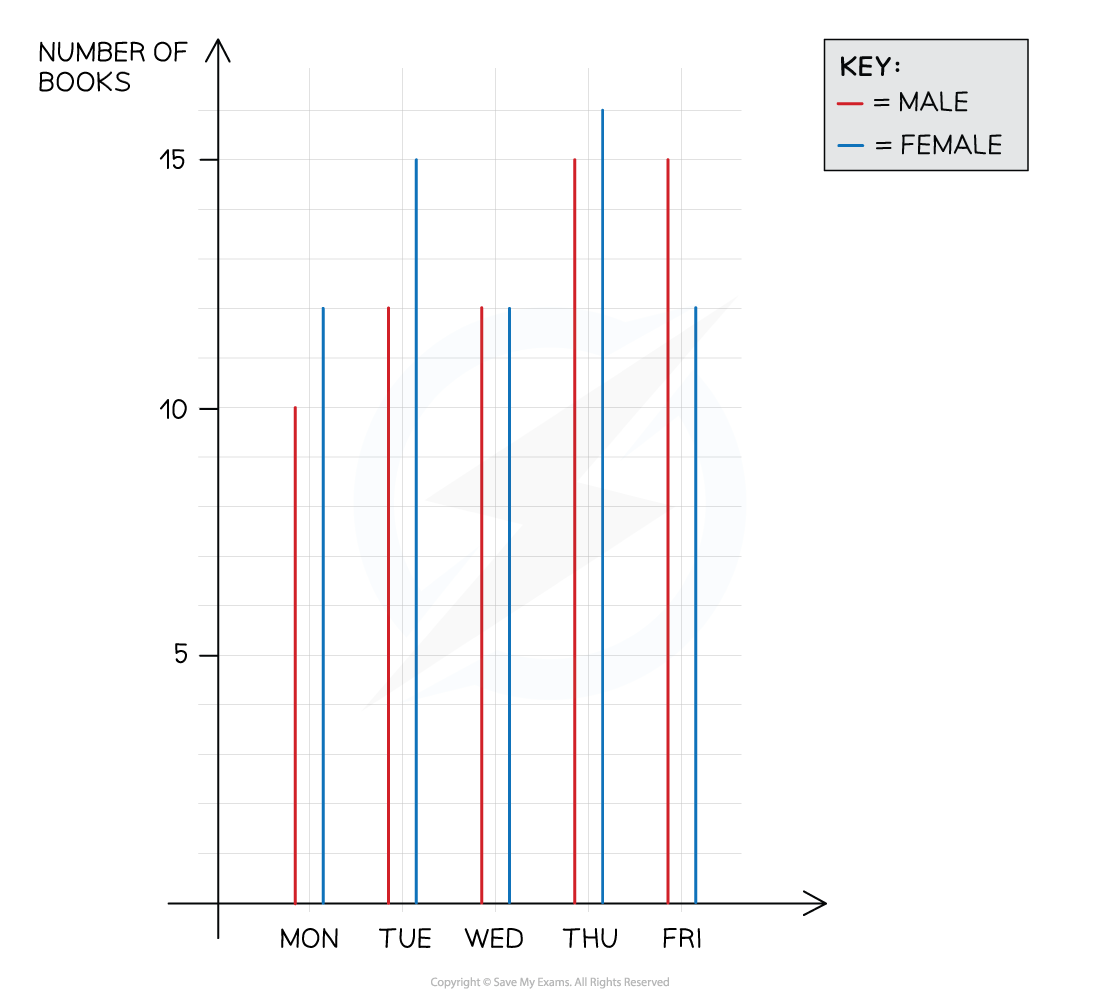
(a) Briefly summarise the overall trend in the number of books bought by male customers.
Look at the heights of the red lines
Comment on how they increase (‘briefly’ means you do not have to talk about every point)
Use numbers from the graph and exact phrases from the question
The number of books bought by male customers increases
from 10 on Monday up to 15 on both Thursday and Friday
(b) The shopkeeper says that the changes in the blue lines suggest that the amount of books bought by females varies more than males.
By comparing a suitable statistical measure, show that this is not necessarily true.
Variations refers to the spread of data, so compare their ranges
For male and female, subtract the smallest value from the biggest value
Male range is 15 – 10 = 5
Female range is 16 – 12 = 4
Compare the numbers
Explain how this relates to the spread of the data
State how your findings do not agree with the shopkeeper
The range of male customers is greater than that of female customers, 5 > 4
This suggests male customers have a greater spread (variability) in books bought
This is the opposite of what the shopkeeper said
(c) Give one reason as to why the shopkeeper should not use the data shown to draw conclusions about shopping patterns.
Reread the sentences at the beginning
This data is for the opening week of the bookshop only
State that this is unrepresentative of a normal week
Give a specific real life example
The data shown is for the opening week of the bookshop
It is unlikely to be representative of a normal week
The numbers may increase as the bookshop becomes more popular
Or decrease if the customers lose interest
(Any reasonable example would work)
Responses