
Business GCSE AQA
-
The Purpose And Nature Of Businesses Aqa6 主题
-
Business Ownership Aqa4 主题
-
Setting Business Aims And Objectives Aqa3 主题
-
Stakeholders Aqa1 主题
-
Business Location Aqa1 主题
-
Business Planning Aqa1 主题
-
Expanding A Business Aqa2 主题
-
Technology Aqa1 主题
-
Ethical And Environmental Considerations Aqa3 主题
-
The Economic Climate Aqa1 主题
-
Globalisation Aqa2 主题
-
Legislation Aqa1 主题
-
Competitive Environment Aqa2 主题
-
Production Processes Aqa2 主题
-
The Role Of Procurement Aqa3 主题
-
The Concept Of Quality Aqa3 主题
-
Good Customer Service Aqa2 主题
-
Organisational Structures Aqa2 主题
-
Recruitment And Selection Of Employees Aqa4 主题
-
Motivating Employees Aqa1 主题
-
Training Aqa2 主题
-
Identifying And Understanding Customers Aqa1 主题
-
Segmentation Aqa1 主题
-
The Purpose And Methods Of Market Research Aqa3 主题
-
The Elements Of The Marketing Mix Aqa9 主题
-
Sources Of Finance Aqa2 主题
-
Cash Flow Aqa3 主题
-
Financial Terms And Calculations Aqa4 主题
-
Analysing The Financial Performance Of A Business Aqa5 主题
Sectors Of Industry aqa
Exam code:8132
An introduction to the sectors of industry
-
Businesses can be classified according to the industrial sector in which they operate
-
This aids comparisons between firms in the same sector
-
However, it does not capture the full complexity of the business world
-
Some businesses operate across more than one sector of industry
-
E.g. Large oil companies such as Shell extract (primary), refine (secondary) and sell (tertiary) fuel through a large network of gas stations
-
-
The main sectors of industry
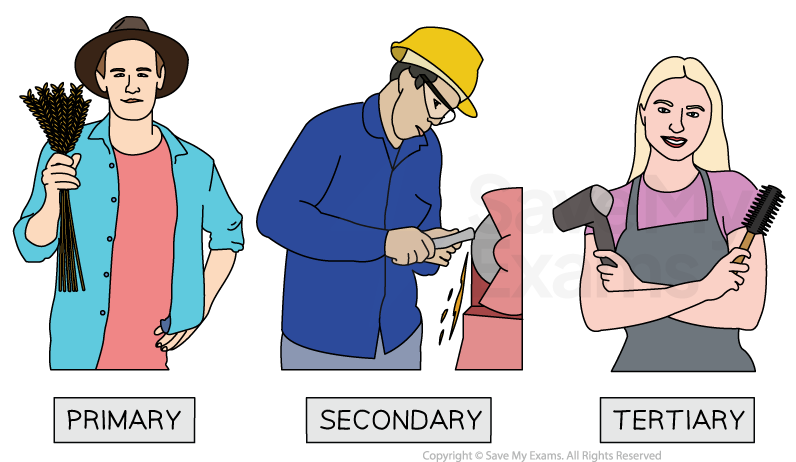
Primary sector
-
The primary sector is concerned with the extraction of raw materials from land, sea or air
-
Examples include farming, mining, forestry and fishing
-
-
In the UK, around 2% of the working population is employed in businesses in the primary sector
-
Less developed economies are primarily focused on the primary sector, with most people employed in agriculture and the production of food
-
There has been a global trend away from employment in primary sector industries over the last two decades
-
Only in the least developed nations is the proportion of the workforce employed in the primary sector consistently high
-
This is partly as a result of lower participation rates in education and a lack of infrastructure to support manufacturing or service provision
-
-
Some developed economies, such as Australia (viticulture or wine production) and Norway (forestry and oil extraction), continue to have significant primary sectors
Employment in primary industries in some countries since 1991

Graph analysis
-
Malawi retains the highest proportion of employment in the primary sector
-
China has seen a significant decrease in primary sector activity since 1991
-
Germany has a small primary sector with an economy focused on manufacturing and services well before 1991
Secondary sector
-
The secondary sector is concerned with the processing of raw materials and components
-
Examples include oil refinement and the manufacture of goods such as vehicles
-
-
In the UK, around 22% of the working population is employed in businesses in the secondary sector
-
In emerging economies, improved technology enables less labour to be needed in the primary sector and more workers to be employed in the secondary sector
-
The proportion of workers employed in manufacturing has risen over the last few decades
-
Many businesses have relocated production facilities to take advantage of the lower average wage rates in these economies
-
Employment in secondary industries in some countries since 1991

Graph analysis
-
China has the highest proportion of employment in the secondary sector, though it is declining
-
Ghana and India have seen significant increases in secondary sector activity since 1991
-
Brazil and Turkey’s secondary sectors have remained relatively stable over the period 1991 to 2019
Tertiary sector
-
The tertiary sector is concerned with the provision of a wide range services for consumers and other businesses such as leisure, banking or hospitality
-
It includes a sub-sector called the quaternary sector, which is concerned with the provision of knowledge-focused services related to IT technology, consultancy or research
-
-
In the UK, around 76% of the working population is employed in businesses in the tertiary sector
-
Emerging economies have experienced growth in the tertiary and quaternary sectors in recent years, with many businesses now focused on the provision of consumer services
-
The most developed economies have a very high proportion of the workforce employed in the provision of services, increasing focus on the quaternary sector
-
Developed economies use their wealth to fund advanced education and higher-level skills training, which further supports the growth of these industries
-
Employment in tertiary industries in some countries since 1991

Graph analysis
-
Highly-developed economies such as the US and Germany have the highest proportion of their workforces employed in the service industry
-
Thailand’s service sector employs twice as many employees in 2019 as it did in 1991
-
Around half of Ecuador’s workforce is now employed in service delivery
Examiner Tips and Tricks
Make sure that you can define and identify examples within each sector. This is a common focus for ‘state’ and multiple-choice questions.
Responses