
Exam code:8291
Sampling Techniques
Open Frame & Grid Quadrats
-
Quadrats are square frames made of wood, plastic or wire
-
They can be in the form of a single open frame or a frame with a grid inside it
-
-
They can be a variety of sizes eg. 0.25 m² or 1 m²
-
They are placed on the ground and the organisms within them are recorded
-
Non-motile organisms such as plants species are commonly studied using quadrats to measure or estimate their abundance
-
Quadrats can be used to measure abundance by recording:
-
The number of organisms: e.g. the total number of plants
-
The number of an individual species: the total number of individuals of a single species (e.g. daisies) is recorded
-
Species richness: the total number of different species (but not the number of individuals of each species) is recorded
-
Percentage cover: the approximate percentage of the quadrat area in which an individual species is found is recorded (this method is often used when it is difficult to count individuals of the plant species being recorded e.g. grass or moss)
-
-
Advantages:
-
Easy, quick and cheap
-
-
Disadvantages:
-
Estimates (e.g. of percentage cover) may result in miscalculation and unreliable data
-
It can be easy to miss individual organisms when counting in a quadrat, especially if they are covered by a different species
-
Identifying plant species requires training and skill
-

Point Quadrats
-
A point quadrat is a vertical frame with holes across the top through which pins are lowered
-
This is useful in areas with dense plant cover as the ground may be difficult to study using a frame quadrat
-
Point quadrats can be placed in a habitat randomly, e.g. using random coordinates, or systematically, e.g. along a transect
-
-
When a lowered pin touches a species, that species is recorded as being present
-
If several species are touching the pin then all of those species are recorded
-
-
Point quadrats can be used to measure abundance in the following ways:
-
The number of individuals of a species present: each individual that touches a pin is recorded
-
Percentage cover of a species: the number of pins touched by a species is divided by the total number of pins used
-
Most point quadrats have ten pins, so if all the pins are used then a species touching one pin counts as 10 percent cover
-
-
-
Advantages:
-
Easy, quick and cheap
-
-
Disadvantages:
-
If repeat sampling is required, the points are not easy to relocate
-
Identifying plant species requires training and skill
-

Pitfall Traps
-
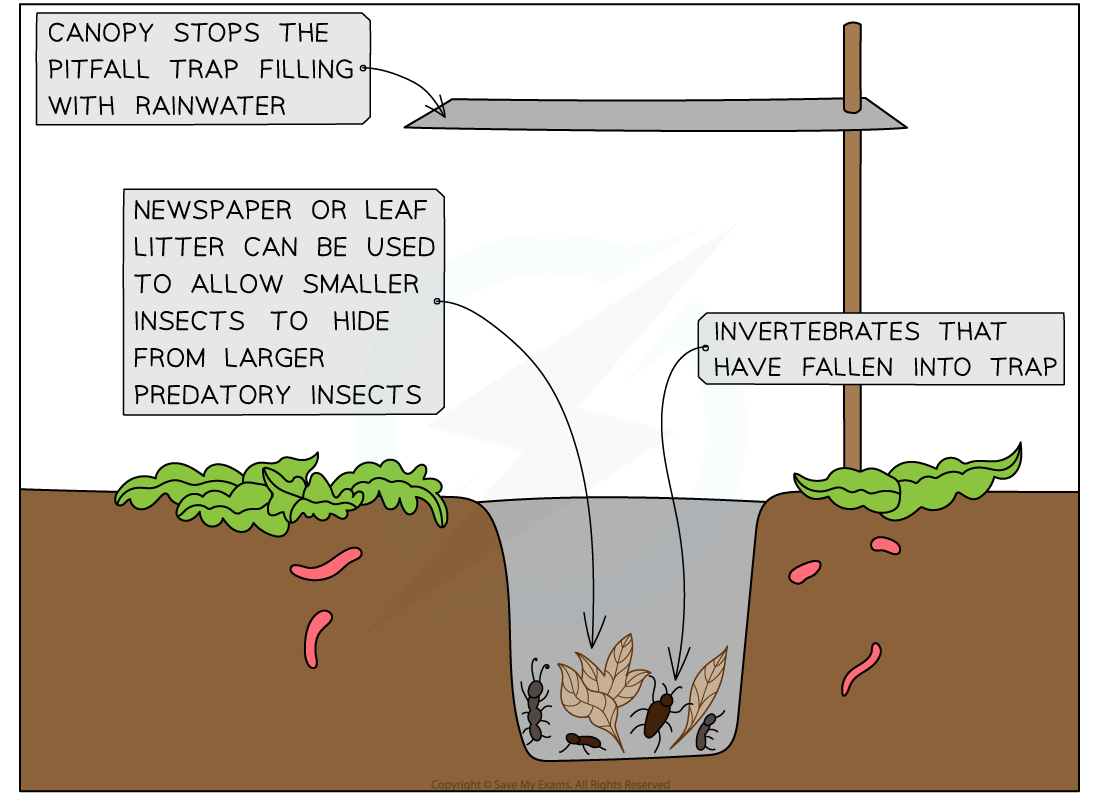
Pitfall traps are used to sample invertebrate populations that are active on the ground
-
They are usually made from cans or jars that are buried so that the lip of the container is level with the ground
-
The container collects ground-dwelling (often nocturnal) insects and other invertebrates as they fall into the trap
-
Some researchers may add antifreeze liquid (ethylene glycol) to the container to kill and preserve the invertebrates, which prevents sample invertebrates from escaping and also stops predatory insects from eating prey insects
-
-
Advantages:
-
Easy, quick and cheap to set up
-
Antifreeze preserves samples so traps can be left for long periods (e.g. a week) to allow for more sample invertebrates to be collected
-
-
Disadvantages:
-
If no chemicals are used to kill the sample invertebrates, predatory insects can eat other samples in the container, or flying insects can escape, which can give unreliable results
-
Identifying invertebrate species requires training and skill
-
Can be time-consuming to visit and collect samples from every trap if a large number of sample sites are used
-
Cannot be used in areas covered in rock or very hard ground (e.g. urban areas)
-
Sweep Nets
-
Sweep nets are strong nets (with a fine mesh) attached to a pole
-
The net is swept vigorously back and forth through vegetation, such as long grass, capturing any invertebrates present there
-
The net can also be swept just above the vegetation to catch any flying invertebrates that have been disturbed
-
The net should then be twisted or folded closed to stop sample invertebrates from escaping
-
-
Advantages:
-
Easy, quick and cheap
-
Volunteers can help researchers to collect a large number of samples
-
Useful for a wide range of insect species
-
-
Disadvantages:
-
This method is not suitable for sampling heavy vegetation, such as trees or thick bushes
-
Sweeping can cause damage to plants being sampled
-
Cannot capture ground-dwelling invertebrates
-
May damage delicate invertebrate specimens
-

Beating Trays
-
Beating trays are usually made from a pale-coloured fabric stretched across a square or rectangular frame
-
As the tree or shrub is shaken or beaten with a stick, invertebrates fall from the foliage and land on the fabric, where they can be easily spotted and collected for identification
-
-
Advantages:
-
Easy, quick and cheap
-
Volunteers can help researchers to collect a large number of samples
-
Useful for a wide range of insect species
-
-
Disadvantages:
-
Beating or shaking can cause damage to plants being sampled
-
Not ideal for sampling flying insects as these may fly away when disturbed or once they land on the tray
-

Kick Sampling
-
This technique is used to catch freshwater invertebrates living in streams or rivers
-
A net is placed on the stream-bed so that the water is flowing into it
-
The stream-bed just upstream of the net is churned up by the researcher (using their foot) for a set period of time
-
The invertebrates are carried by the stream into the net
-
-
Advantages:
-
Easy, quick and cheap
-
-
Disadvantages:
-
Species that are stuck firmly to rocks or the stream-bed will not be sampled
-
This method is difficult to carry out and not very effective in very shallow or slow-flowing waters
-
Can be dangerous in deep or fast-flowing waters – researcher must take appropriate safety precautions
-

Light Traps
-
Light traps are mainly used for sampling nocturnal flying insects, especially moths
-
A light source (e.g. a fluorescent or UV lamp) attracts insects, which are then collected in a trap
-
-
Advantages:
-
Relatively low effort as the insects are attracted to the trap so the researcher just needs to wait
-
Can be adapted to be used in marine environments e.g. for sampling plankton
-
-
Disadvantages:
-
Success rates can greatly vary depending on night-time temperatures and humidity levels
-
Some species may actually be repelled by light at short range, so are not successfully sampled
-
Responses