
Exam code:9FM0
Introduction to Hooke’s law
What is Hooke’s law?
-
Up to now, strings have been modelled as inextensible
-
they cannot stretch (inelastic)
-
we assume that the tension measured at any point along the string is the same constant value
-
-
Things that stretch (or compress, e.g. springs) are called elastic
-
Imagine two elastic strings held taut and at rest, but with one stretched further than the other
-
measuring the tension at different points along one string gives the same value,
-
but that “value” will be higher for the more stretched string than for the less stretched string
-
-
Hooke’s law tells us that the value of tension,
 N, depends on how far it’s been stretched (the extension,
  metres) beyond its natural (unstretched) length (
 metres)
-
The law is
format('truetype')%3Bfont-weight%3Anormal%3Bfont-style%3Anormal%3B%7D%3C%2Fstyle%3E%3C%2Fdefs%3E%3Ctext%20font-family%3D%22Times%20New%20Roman%22%20font-size%3D%2218%22%20font-style%3D%22italic%22%20text-anchor%3D%22middle%22%20x%3D%225.5%22%20y%3D%2230%22%3ET%3C%2Ftext%3E%3Ctext%20font-family%3D%22math17f39f8317fbdb1988ef4c628eb%22%20font-size%3D%2216%22%20text-anchor%3D%22middle%22%20x%3D%2220.5%22%20y%3D%2230%22%3E%3D%3C%2Ftext%3E%3Cline%20stroke%3D%22%23000%22%20stroke-linecap%3D%22square%22%20stroke-width%3D%221%22%20x1%3D%2231.5%22%20x2%3D%2244.5%22%20y1%3D%2223.5%22%20y2%3D%2223.5%22%2F%3E%3Ctext%20font-family%3D%22Times%20New%20Roman%22%20font-size%3D%2218%22%20font-style%3D%22italic%22%20text-anchor%3D%22middle%22%20x%3D%2237.5%22%20y%3D%2216%22%3E%26%23x3BB%3B%3C%2Ftext%3E%3Ctext%20font-family%3D%22Times%20New%20Roman%22%20font-size%3D%2218%22%20font-style%3D%22italic%22%20text-anchor%3D%22middle%22%20x%3D%2237.5%22%20y%3D%2241%22%3El%3C%2Ftext%3E%3Ctext%20font-family%3D%22Times%20New%20Roman%22%20font-size%3D%2218%22%20font-style%3D%22italic%22%20text-anchor%3D%22middle%22%20x%3D%2251.5%22%20y%3D%2230%22%3Ex%3C%2Ftext%3E%3C%2Fsvg%3E)
-
where
 is the modulus of elasticity, with units of Newtons,
-
it measures the stiffness of the material the string (or spring) is made from,
-
the higher
is, the stiffer the string / spring is
-
-
-
Springs can be compressed but elastic strings can’t (they’d go slack)
-
Hooke’s law works for compression of springs too
-
Instead of measuring extension,
measures the length of compression (from its natural length)-
just make sure any tension arrows reverse direction to be compression (thrust) arrows!
-
-
Examiner Tips and Tricks
-
In more algebraic questions, the modulus of elasticity may be given in the form
 Newtons, where
  is a constant
Worked Example
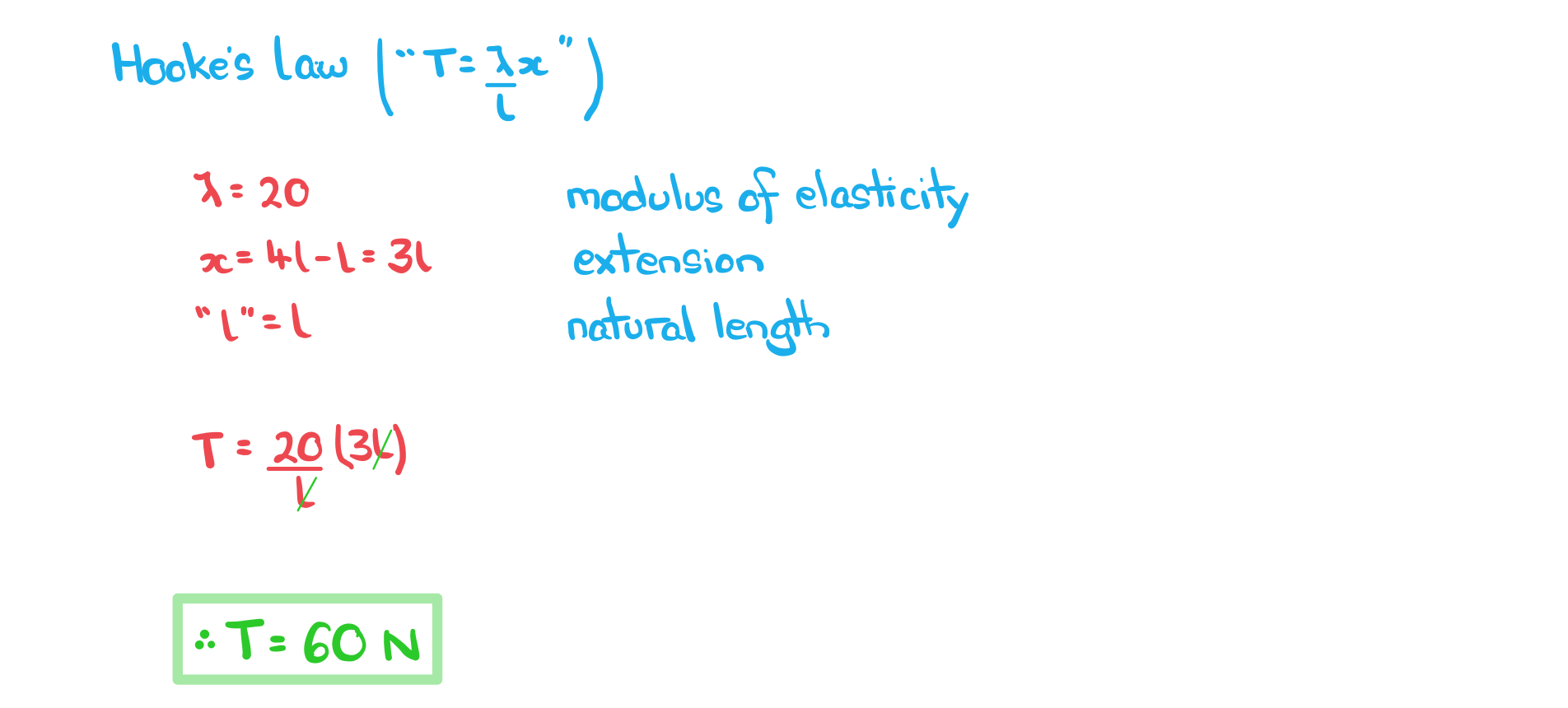
An elastic string of natural length metres and modulus of elasticity 20 N is stretched to a total length of  metres.
Find the tension in the string.
Hooke’s law – equilibrium
How do I use Hooke’s law for particles at rest under gravity?
-
Imagine a particle of mass
 kg attached to the end of a light elastic string of natural length metres, with modulus of elasticity N
 -
The other end of the string is attached to a ceiling at the point O and the particle hangs at rest at the point <
Responses