
Economics-A-level-Aqa
-
1-economic-methodology-and-the-economic-problem4 主题
-
2-individual-economic-decision-making4 主题
-
3-price-determination-in-competitive-markets10 主题
-
types-of-economic-integration
-
protectionist-policies-quotas-and-export-subsidies
-
protectionist-policies-tariffs
-
protectionist-policies-an-introduction
-
the-benefits-and-costs-of-trade
-
international-trade
-
globalisation
-
types-of-supply-side-policies
-
an-introduction-to-supply-side-policies
-
fiscal-policy-budget-balances-and-national-debt
-
types-of-economic-integration
-
4-production-costs-and-revenue11 主题
-
Production & Productivity
-
fiscal-policy-types-of-public-expenditure-and-taxation
-
fiscal-policy-an-introduction
-
regulating-the-financial-system
-
monetary-policy-transmission-mechanisms
-
central-banks-and-monetary-policy
-
commercial-and-investment-banks
-
financial-assets
-
financial-markets
-
conflicts-between-the-macroeconomic-objectives
-
price-level-global-influences
-
Production & Productivity
-
5-perfect-and-imperfectly-competitive-markets-and-monopolies12 主题
-
price-level-deflation
-
price-level-inflation
-
employment-and-unemployment
-
the-economic-cycle
-
the-impact-of-economic-growth
-
economic-growth
-
the-multiplier-and-basic-accelerator-process
-
macroeconomic-equilibrium
-
long-run-aggregate-supply-lras
-
short-run-aggregate-supply-sras
-
aggregate-demand-ad
-
injections-and-withdrawals-into-the-circular-flow
-
price-level-deflation
-
6-the-labour-market7 主题
-
7-income-and-wealth-distribution4 主题
-
8-the-market-mechanism-market-failure-and-government-intervention16 主题
-
government-intervention-price-controls
-
government-intervention-indirect-taxation-and-subsidies
-
government-intervention-an-introduction
-
market-failure-market-imperfections
-
market-failure-merit-and-demerit-goods
-
market-failure-tragedy-of-the-commons
-
market-failure-positive-externalities
-
market-failure-negative-externalities
-
market-failure-public-private-and-quasi-public-goods
-
an-introduction-to-market-failure
-
the-market-price-mechanism
-
government-policies-to-reduce-poverty-and-inequity
-
the-problem-of-poverty
-
the-lorenz-curve-and-gini-coefficient
-
income-and-wealth-distribution
-
discrimination-in-the-labour-market
-
government-intervention-price-controls
-
9-measuring-macroeconomic-performance5 主题
-
10-how-the-macroeconomy-works6 主题
-
11-economic-performance8 主题
-
12-financial-markets-and-monetary-policy6 主题
-
13-fiscal-and-supply-side-policies5 主题
-
14-the-international-economy16 主题
-
using-index-numbers
-
analysing-changes-to-market-equilibrium
-
the-determination-of-market-equilibrium
-
supply-curves-real-world-analysis
-
supply-curves
-
demand-curves-real-world-analysis
-
demand-curves
-
using-behavioural-economics
-
behavioural-economics
-
imperfect-information
-
consumer-behaviour
-
production-possibility-diagrams
-
scarcity-choice-and-the-allocation-of-resources
-
economic-resources
-
economic-activity
-
economic-methodology
-
using-index-numbers
diminishing-returns-and-returns-to-scale
Key Cost Curve Definitions
-
The short-run is that period of time in which at least one factor of production is fixed
-
E.g. It is difficult to change machinery or the number of factories in the short run, but that can be achieved in the long run
-
The variable factor of production that is usually added to production is labour, as it is easy to hire new workers
-
-
The long-run is that period of time in which all of the factors of productions are variable
-
This is also called the planning stage, as firms can plan for increased capacity and production
-
Marginal, Average & Total Returns
|
Concept |
Explanation |
Example |
|---|---|---|
|
Marginal returns |
|
|
|
Total returns |
|
|
|
Average returns |
|
|
Short Run: The Law of Diminishing Marginal Returns
-
The Law of Diminishing Marginal Returns states that as more of a variable factor of production (e.g. labour) is added to fixed factors (e.g. capital), there will initially be an increase in productivity
-
However, a point will be reached where adding additional units of the factor (e.g. hiring an extra worker) begins to decrease productivity due to the relationship between labour and capital
-
-
Consider a farmer who has a fixed amount of land and hires additional workers to cultivate the crops:
-
Initially, each additional worker contributes to a significant increase in crop output
-
However, as more workers are hired, the additional output generated by each new worker starts to decline
-
This is because the fixed amount of land and other resources become increasingly crowded relative to the growing labour force, leading to diminishing returns from each additional worker
-
-
The law of diminishing marginal returns is a short-run concept
Diagram: The Law of Diminishing Marginal Returns
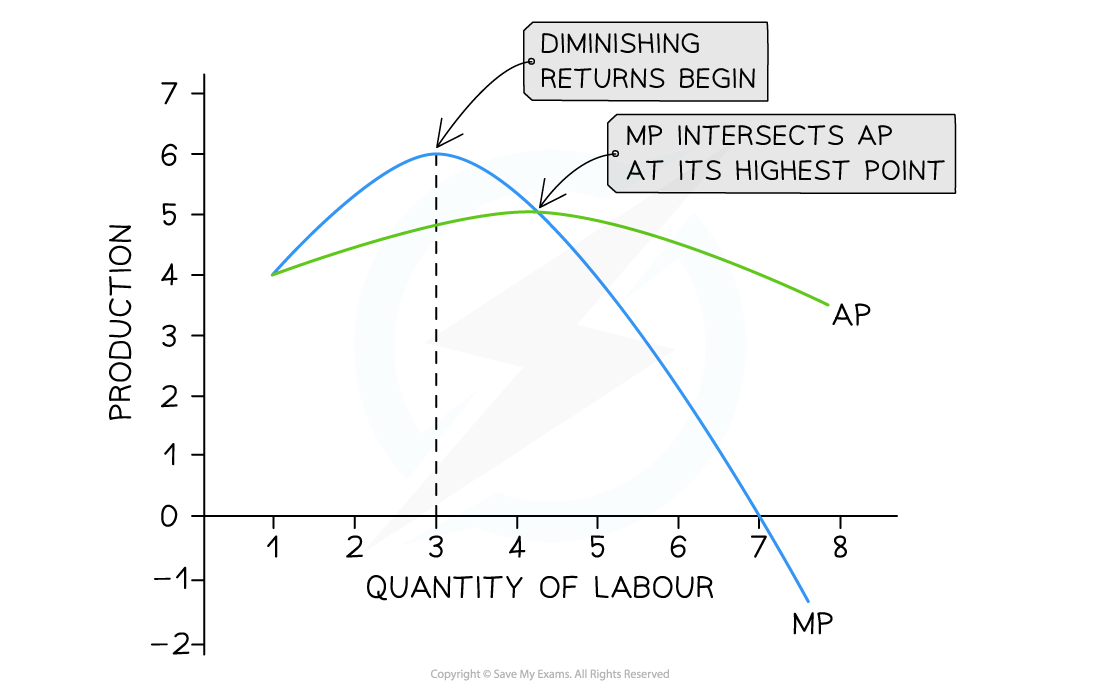
Diagram analysis
-
A small food van selling burgers (product) at a music festival increases productivity up to the addition of a third worker
-
After that, workers get in each other’s way and there is not enough grill space (capital) and the marginal return of each worker no longer increases
-
If more workers are hired, then the marginal return of each additional worker begins to fall
-
Adding additional workers up to the 7th worker will keep increasing the total returns
-
With the hiring of the 7th worker, the marginal return turns negative, which will decrease the total product
Long run: Returns to Scale
-
Long run returns to scale refer to the relationship between inputs and outputs in the long-run
-
It is an analysis of how changes in the scale of production affect the level of output when all inputs can be adjusted
-
-
Analysing long run returns to scale helps firms make decisions about optimal scale and size of production to maximise profitability and efficiency over the long term
-
There are three possibilities regarding long-run returns to scale
1. Increasing returns to scale
If all the inputs are increased by a certain proportion, and the output increases by a larger proportion, there are increasing returns to scale. The firm is experiencing economies of scale, where production becomes more efficient as it grows
2. Constant returns to scale
If all inputs are increased by a certain proportion, and the output increases by the same proportion, there are constant returns to scale. The firm’s level of efficiency remains constant as it scales up production
3. Decreasing returns to scale
If all inputs are increased by a certain proportion, and the output increases by a smaller proportion, there are decreasing returns to scale. The firm is experiencing diseconomies of scale, where production becomes less efficient as it expands
Responses