
Business_A-level_Edexcel
-
1-marketing-and-people
1-1-meeting-customer-needs3 主题 -
1-2-market5 主题
-
1-3-marketing-mix-and-strategy5 主题
-
1-4-managing-people5 主题
-
1-5-entrepreneurs-and-leaders6 主题
-
2-managing-business-activities2-1-raising-finance4 主题
-
2-2-financial-planning4 主题
-
2-3-managing-finance3 主题
-
2-4-resource-management4 主题
-
2-5-external-influences3 主题
-
3-business-decisions-and-strategy3-1-business-objectives-and-strategy4 主题
-
3-2-business-growth4 主题
-
3-3-decision-making-techniques4 主题
-
3-4-influences-on-business-decisions4 主题
-
3-5-assessing-competitiveness3 主题
-
3-6-managing-change3 主题
-
4-global-business4-1-globalisation5 主题
-
4-2-global-markets-and-business-expansion5 主题
-
4-3-global-marketing3 主题
-
4-4-global-industries-and-multinational-corporations3 主题
-
5-exam-technique5-1-the-exam-papers4 主题
-
5-2-business-studies-skills1 主题
-
5-3-structuring-your-responses5 主题
-
6-pre-release-preparation2025-pre-release-music-industry9 主题
3-1-1-corporate-objectives
Developing corporate objectives
-
Aims and objectives serve as a guide for a business’s overall strategy and direction, helping to focus efforts and resources towards a common purpose
-
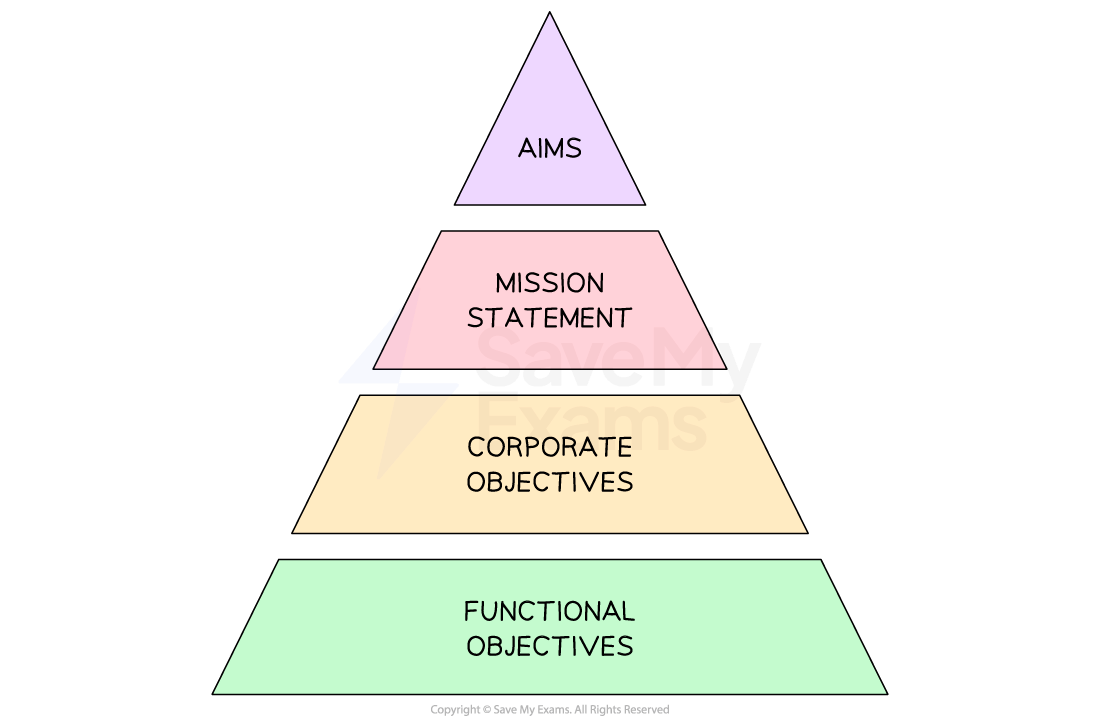
There is a hierarchy of objectives that cascades downwards
The hierarchy of objectives
-
A business’s mission flows from its overall aim and is usually expressed in inspirational terms
-
From this mission, corporate objectives and functional objectives that detail the achievable goals a business wants to meet over a specified period are developed
Components of the hierarchy of objectives
|
Component |
Explanation |
Example |
|---|---|---|
|
Aim |
|
Macmillan Cancer Support: “To do whatever it takes to support people living with cancer” |
|
Mission statement |
|
Age UK: “Making a positive difference by putting older people, and the people around them, at the heart of all we do; working with partner organisations to improve the quality of later life and provide effective, timely support for those who need it the most” |
|
Corporate objective |
|
Mind UK: “Provide 3m employees in low-paid sectors with workplace wellbeing support” |
|
Functional objective |
|
Scope UK: “Working with the Government and disabled people, we will create a Passenger Charter, an information resource to help disabled people find the information they need when using public transport” |
SMART objectives
-
Corporate and functional objectives should be:
-
Specific
-
Measurable
-
Agreed
-
Realistic
-
Time-bound
-
An example of a SMART sales objective

Critical appraisal of mission statements and corporate aims
-
Businesses need to critically assess whether corporate aims and mission statements continue to reflect their current corporate vision
-
The content and expression of business aims will likely change over time to reflect changing social attitudes and norms
-
For example, Apple’s new mission statement — “to make the best products on earth, and to leave the world better than we found it” — emphasises its commitment to sustainability, a key social trend
-
-
Mission statements are sometimes criticised as being little more than an exercise in public relations that does little to inform objective-setting or promote a common organisational goal
-
For example, in 2013, KFC’s mission was “To sell food in a fast, friendly environment that appeals to price conscious, health-minded consumers” — but in the same year, it launched a burger that replaced the bread bun with extra layers of deep-fried chicken
-
-
-
Businesses should decide whether changes to the corporate aim or mission statement need to be made by considering whether:
-
The short- to medium-term strategies adopted by the business support the aim and mission
-
The aim and objectives are realistic and achievable in the current trading environment
-
The mission statement message communicates the aim of the business effectively to stakeholders
-
-
Revising the business aim and revisiting the mission statement should be seen as a natural step for growing businesses
-
It is a chance to involve a variety of stakeholders, including workers and suppliers, in determining the direction of the business
-
Newly identified opportunities and threats can be acknowledged
-
Sharing refreshed priorities, particularly with the media, can generate positive publicity
-
Examiner Tips and Tricks
When assessing the nature or effectiveness of the objectives for a specific business based on a case study provided, you should consider the following:
-
What is the purpose of the objectives?
-
Who is the intended audience?
-
How does the corporate strategy followed by the business compare to the mission in reality?
-
Who is the mission statement aimed at, and how does the strategy affect different groups?
Responses