
Business_A-level_Edexcel
-
1-marketing-and-people
1-1-meeting-customer-needs3 主题 -
1-2-market5 主题
-
1-3-marketing-mix-and-strategy5 主题
-
1-4-managing-people5 主题
-
1-5-entrepreneurs-and-leaders6 主题
-
2-managing-business-activities2-1-raising-finance4 主题
-
2-2-financial-planning4 主题
-
2-3-managing-finance3 主题
-
2-4-resource-management4 主题
-
2-5-external-influences3 主题
-
3-business-decisions-and-strategy3-1-business-objectives-and-strategy4 主题
-
3-2-business-growth4 主题
-
3-3-decision-making-techniques4 主题
-
3-4-influences-on-business-decisions4 主题
-
3-5-assessing-competitiveness3 主题
-
3-6-managing-change3 主题
-
4-global-business4-1-globalisation5 主题
-
4-2-global-markets-and-business-expansion5 主题
-
4-3-global-marketing3 主题
-
4-4-global-industries-and-multinational-corporations3 主题
-
5-exam-technique5-1-the-exam-papers4 主题
-
5-2-business-studies-skills1 主题
-
5-3-structuring-your-responses5 主题
-
6-pre-release-preparation2025-pre-release-music-industry9 主题
2-4-4-quality-management
Quality management methods
-
Quality considers the characteristics and features of a product that satisfy the needs of customers
-
Businesses need to maintain a level of quality that continues to attract and retain customers
-
There are several approaches to managing quality in the production process
Methods of quality management
|
Method |
Explanation |
|---|---|
|
Quality control |
|
|
Quality assurance |
|
|
Quality circles |
|
|
Total quality management |
|
Continuous improvement (kaizen)
-
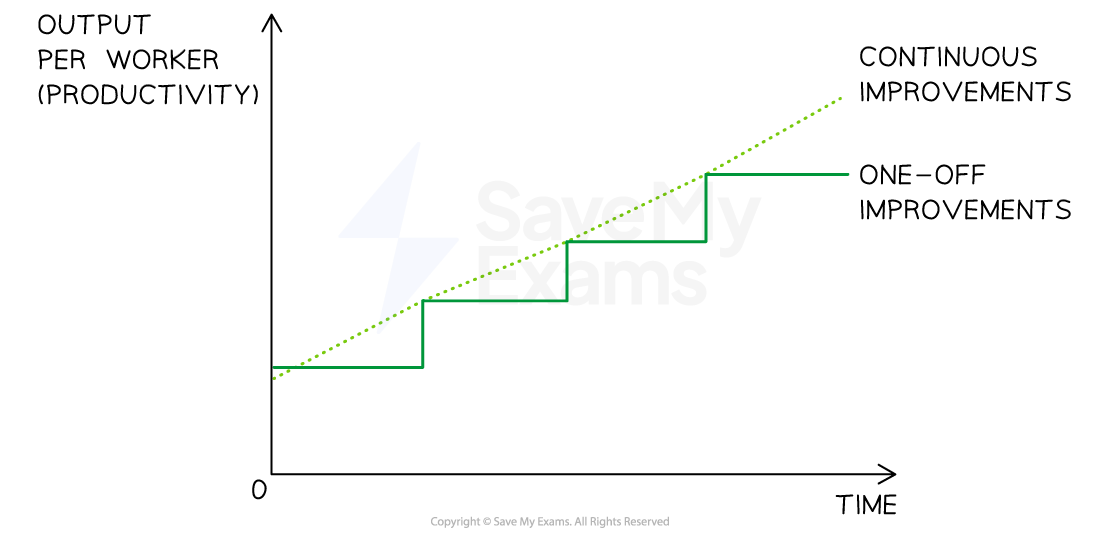
Kaizen involves a business taking continuous steps to improve productivity through the elimination of all types of waste in the production process
-
Changes are small and ongoing rather than significant one-offs, and they are constantly reviewed to ensure that the desired positive impact on productivity is achieved
-
Comparison of kaizen and one-off improvements
-
Elements of kaizen commonly include:
-
Total quality management
-
Just-in-time stock management
-
Teamwork and quality circles
-
Zero defects in manufacturing
-
High levels of automation
-
High levels of cooperation between workers and management
-
-
Kaizen requires a long-term management commitment to change
Competitive advantage from quality management
-
The quality of a business’s products can provide a competitive advantage
-
Unit costs are likely to be low if a business takes a preventative approach through the use of quality assurance or total quality management
-
Low costs may allow a business to reduce its selling price to better compete with or undercut its rivals
-
-
Increased finance may be available to fund marketing activity to improve brand recognition and attract new customers
-
High levels of quality can be used in promotional activity and provide a unique selling point for businesses in competitive markets
-
Successfully developing a unique selling point for quality can ease expansion into new markets as a result of the positive reputation it creates
-
Responses