
Business_A-level_Edexcel
-
1-marketing-and-people
1-1-meeting-customer-needs3 主题 -
1-2-market5 主题
-
1-3-marketing-mix-and-strategy5 主题
-
1-4-managing-people5 主题
-
1-5-entrepreneurs-and-leaders6 主题
-
2-managing-business-activities2-1-raising-finance4 主题
-
2-2-financial-planning4 主题
-
2-3-managing-finance3 主题
-
2-4-resource-management4 主题
-
2-5-external-influences3 主题
-
3-business-decisions-and-strategy3-1-business-objectives-and-strategy4 主题
-
3-2-business-growth4 主题
-
3-3-decision-making-techniques4 主题
-
3-4-influences-on-business-decisions4 主题
-
3-5-assessing-competitiveness3 主题
-
3-6-managing-change3 主题
-
4-global-business4-1-globalisation5 主题
-
4-2-global-markets-and-business-expansion5 主题
-
4-3-global-marketing3 主题
-
4-4-global-industries-and-multinational-corporations3 主题
-
5-exam-technique5-1-the-exam-papers4 主题
-
5-2-business-studies-skills1 主题
-
5-3-structuring-your-responses5 主题
-
6-pre-release-preparation2025-pre-release-music-industry9 主题
2-4-1-production-productivity-and-efficiency
Methods of production
-
Production is the transformation of resources (e.g. raw materials, components and processes) into finished goods or services
-
Goods are physical products, such as bicycles and T-shirts
-
Services are non-physical items, such as hairdressing, tourism and manicures
-
-
Businesses can organise their production processes in a variety of ways
The main methods of production
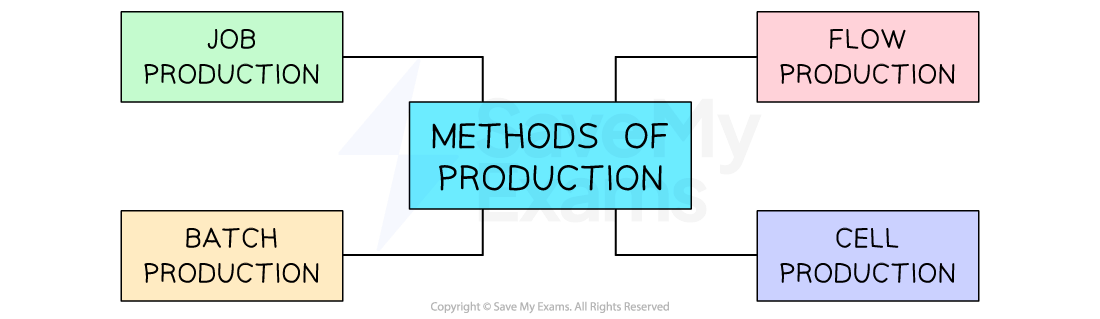
-
The method of production used by a business will depend on a number of factors, including:
-
The level of output required to be produced
-
The nature of the product
-
Whether the product is standardised or customised
-
The level of automation used in production
-
Job production
-
Producing one item at a time, as ordered by the customer
-
Advantages
-
High-quality product
-
Motivated and highly skilled workers
-
Customised products can be produced
-
-
Disadvantages
-
Production is slow
-
Labour costs are high
-
-
Batch production
-
Groups of the same product are produced before moving on to a group of different products
-
Advantages
-
Workers can specialise
-
Production can take place as the previous batch starts running out
-
-
Disadvantages
-
Requires careful coordination to avoid shortages
-
Money is tied up in stock, as completed products need to be stored
-
-
Flow production
-
Continuous manufacturing of standardised products, usually on a production line
-
Advantages
-
Low unit costs due to economies of scale
-
Rapid production
-
Usually highly automated (capital-intensive)
-
-
Disadvantages
-
Customisation is difficult
-
Capital equipment can be expensive to purchase
-
-
Cell production
-
This involves workers being organised into multi-skilled teams, with each team responsible for a particular part of the production process
-
Advantages
-
Cell production is often more efficient than other methods, as workers share their skills and expertise
-
Motivation is usually high, as employees work as a team
-
-
Disadvantages
-
Requires extensive reorganisation of production processes
-
Teams’ efficiency may be reduced by weaker workers
-
-
Worked Example
Blush Cosmetics uses batch production to make its range of soaps and bath bombs, with a variety of unique ingredients and scents. The business sells its products in its own high street store and online and has recently started supplying its products in small quantities to a chain of exclusive hotels.
Explain one likely reason why Blush Cosmetics chooses to use batch production. [4]
Step 1: Identify a reason for the business to use batch production
One reason for Blush Cosmetics to use batch production is that it allows groups of products with varied ingredients to be manufactured. [K]
Step 2: Include a reference to the business scenario
Blush Cosmetics sells a range of bath bombs and soaps that have different fragrances, colours and ingredients. [Ap]
Step 3: Develop the reason using a connective
Blush Cosmetics needs to produce significant levels of output to meet increasing demand and batch production, as well as to provide the opportunity to change ingredients between batches [An], which can allow quite large quantities to be produced for the company’s high street and online stores [An].
Or:
Using batch production can allow Blush Cosmetics to produce smaller quantities of unique products for exclusive hotel customers [Ap], meeting their specific needs [An].
Examiner Tips and Tricks
Carefully consider the needs of the customers to whom a business sells when recommending a suitable method of production.
Where the selling price is a key driver of consumer demand, flow production (where unit costs are minimised) is likely to be very suitable.
Where demand is driven by quality or where customisation is required, job production or batch production is likely to be a better choice.
Calculating productivity
-
Productivity is the output per input (person or machine) per hour (e.g. an IKEA worker is able to produce two Poāng chairs per hour)
-
This is not production, which is the total amount of output produced in a time period (e.g. IKEA produced 300 Poāng chairs in February)
-
Labour productivity
-
The labour productivity of a business is a measure of the output per worker during a specified period of time
-
Labour productivity is calculated using the formula
format('truetype')%3Bfont-weight%3Anormal%3Bfont-style%3Anormal%3B%7D%3C%2Fstyle%3E%3C%2Fdefs%3E%3Ctext%20font-family%3D%22Arial%22%20font-size%3D%2214%22%20text-anchor%3D%22middle%22%20x%3D%2222.5%22%20y%3D%2223%22%3ELabour%3C%2Ftext%3E%3Ctext%20font-family%3D%22Arial%22%20font-size%3D%2214%22%20text-anchor%3D%22middle%22%20x%3D%2283.5%22%20y%3D%2223%22%3Eproductivity%3C%2Ftext%3E%3Ctext%20font-family%3D%22math17f39f8317fbdb1988ef4c628eb%22%20font-size%3D%2214%22%20text-anchor%3D%22middle%22%20x%3D%22131.5%22%20y%3D%2223%22%3E%3D%3C%2Ftext%3E%3Cline%20stroke%3D%22%23000000%22%20stroke-linecap%3D%22square%22%20stroke-width%3D%221%22%20x1%3D%22145.5%22%20x2%3D%22265.5%22%20y1%3D%2218.5%22%20y2%3D%2218.5%22%2F%3E%3Ctext%20font-family%3D%22Arial%22%20font-size%3D%2214%22%20text-anchor%3D%22middle%22%20x%3D%22206.5%22%20y%3D%2213%22%3EOutput%3C%2Ftext%3E%3Ctext%20font-family%3D%22Arial%22%20font-size%3D%2214%22%20text-anchor%3D%22middle%22%20x%3D%22171.5%22%20y%3D%2234%22%3ENumber%3C%2Ftext%3E%3Ctext%20font-family%3D%22Arial%22%20font-size%3D%2214%22%20text-anchor%3D%22middle%22%20x%3D%22206.5%22%20y%3D%2234%22%3Eof%3C%2Ftext%3E%3Ctext%20font-family%3D%22Arial%22%20font-size%3D%2214%22%20text-anchor%3D%22middle%22%20x%3D%22240.5%22%20y%3D%2234%22%3Eworkers%3C%2Ftext%3E%3C%2Fsvg%3E)
Capital productivity
-
Capital productivity is a measure of the output of capital employed (e.g. machinery) during a specified period of time
-
Capital productivity is calculated using the formula
format('truetype')%3Bfont-weight%3Anormal%3Bfont-style%3Anormal%3B%7D%3C%2Fstyle%3E%3C%2Fdefs%3E%3Ctext%20font-family%3D%22Arial%22%20font-size%3D%2214%22%20text-anchor%3D%22middle%22%20x%3D%2222.5%22%20y%3D%2224%22%3ECapital%3C%2Ftext%3E%3Ctext%20font-family%3D%22Arial%22%20font-size%3D%2214%22%20text-anchor%3D%22middle%22%20x%3D%2283.5%22%20y%3D%2224%22%3Eproductivity%3C%2Ftext%3E%3Ctext%20font-family%3D%22math17f39f8317fbdb1988ef4c628eb%22%20font-size%3D%2214%22%20text-anchor%3D%22middle%22%20x%3D%22131.5%22%20y%3D%2224%22%3E%3D%3C%2Ftext%3E%3Cline%20stroke%3D%22%23000000%22%20stroke-linecap%3D%22square%22%20stroke-width%3D%221%22%20x1%3D%22145.5%22%20x2%3D%22276.5%22%20y1%3D%2219.5%22%20y2%3D%2219.5%22%2F%3E%3Ctext%20font-family%3D%22Arial%22%20font-size%3D%2214%22%20text-anchor%3D%22middle%22%20x%3D%22209.5%22%20y%3D%2214%22%3EOutput%3C%2Ftext%3E%3Ctext%20font-family%3D%22Arial%22%20font-size%3D%2214%22%20text-anchor%3D%22middle%22%20x%3D%22171.5%22%20y%3D%2235%22%3ENumber%3C%2Ftext%3E%3Ctext%20font-family%3D%22Arial%22%20font-size%3D%2214%22%20text-anchor%3D%22middle%22%20x%3D%22206.5%22%20y%3D%2235%22%3Eof%3C%2Ftext%3E%3Ctext%20font-family%3D%22Arial%22%20font-size%3D%2214%22%20text-anchor%3D%22middle%22%20x%3D%22246.5%22%20y%3D%2235%22%3Emachines%3C%2Ftext%3E%3C%2Fsvg%3E)
Worked Example
The table shows the number of pairs of luxury wool socks produced by Scotty Socks Ltd in 2021 and 2022.
|
Year |
Units produced |
|---|---|
|
2021 |
46,000 |
|
2022 |
69,000 |
In 2021, Scotty Socks employed 50 staff. In 2022, the number of staff employed by the business increased by 20%.
Calculate the percentage change in labour productivity between 2021 and 2022.
[4]
Step 1: Calculate the labour productivity for 2021
<img alt=”equals space fraction numerator space 46 comma 000 space units over denominator 50 space workers end fraction space space space space space equals space 920 space units space per space worker” data-mathml=”<math style=”font-family:Arial” ><semantics><mstyle mathsize=”14px”><mo>=</mo><
Responses