
Back to 课程

Business_A-level_Edexcel

0% Complete
0/0 Steps
  1. 1-marketing-and-people

    1-1-meeting-customer-needs
    3 主题
  2. 1-2-market
    5 主题
  3. 1-3-marketing-mix-and-strategy
    5 主题
  4. 1-4-managing-people
    5 主题
  5. 1-5-entrepreneurs-and-leaders
    6 主题
  6. 2-managing-business-activities
    2-1-raising-finance
    4 主题
  7. 2-2-financial-planning
    4 主题
  8. 2-3-managing-finance
    3 主题
  9. 2-4-resource-management
    4 主题
  10. 2-5-external-influences
    3 主题
  11. 3-business-decisions-and-strategy
    3-1-business-objectives-and-strategy
    4 主题
  12. 3-2-business-growth
    4 主题
  13. 3-3-decision-making-techniques
    4 主题
  14. 3-4-influences-on-business-decisions
    4 主题
  15. 3-5-assessing-competitiveness
    3 主题
  16. 3-6-managing-change
    3 主题
  17. 4-global-business
    4-1-globalisation
    5 主题
  18. 4-2-global-markets-and-business-expansion
    5 主题
  19. 4-3-global-marketing
    3 主题
  20. 4-4-global-industries-and-multinational-corporations
    3 主题
  21. 5-exam-technique
    5-1-the-exam-papers
    4 主题
  22. 5-2-business-studies-skills
    1 主题
  23. 5-3-structuring-your-responses
    5 主题
  24. 6-pre-release-preparation
    2025-pre-release-music-industry
    9 主题
课 Progress
0% Complete

Sources of external finance

  • External finance is sourced from outside of the business

Key sources of external finance
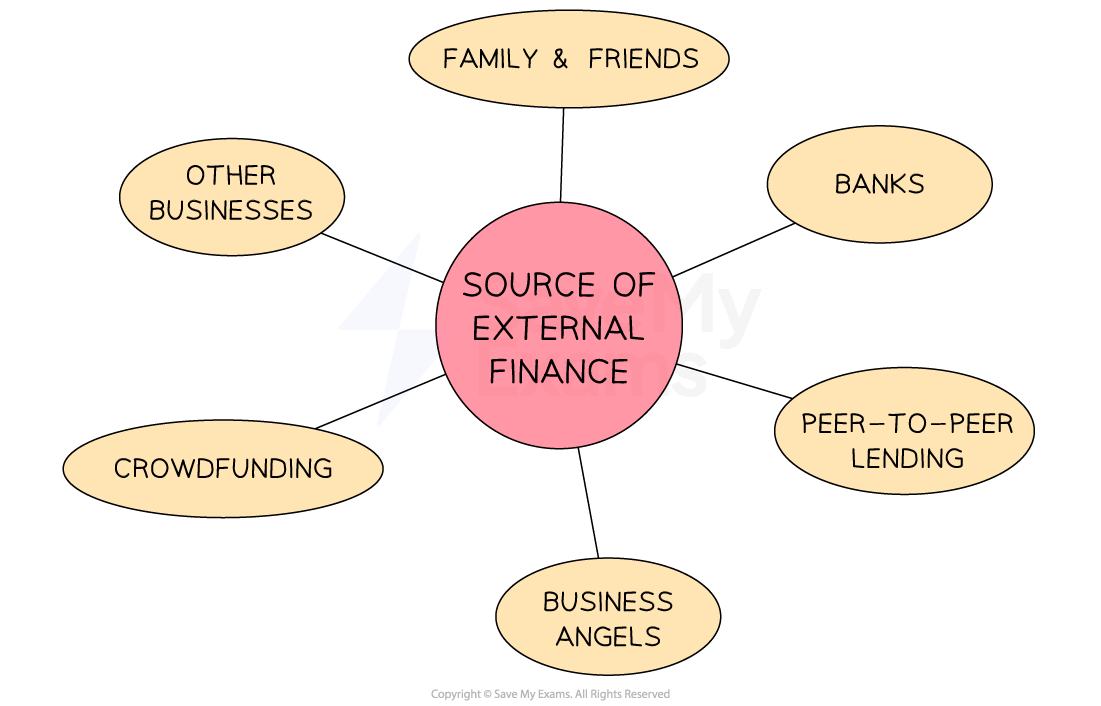
Diagram illustrating sources of external finance, including family and friends, banks, peer-to-peer lending, business angels, crowdfunding and other businesses.
Sources of external finance include family and friends, banks, peer-to-peer funding, business angels, crowdfunding and other businesses

 Family and friends

  • Small business owners approach close acquaintances to invest in or lend money to a business

Advantages and disadvantages of family and friends as a source of finance

Advantages

Disadvantages

  • Usually a very cheap source of funds

  • May have no strings attached (e.g. a share of the business) and can be provided to the business on very flexible terms

  • Relationships may be damaged if the finance is not repaid


Banks

  • Banks provide several different kinds of loans to businesses

    • Small business loans are monies borrowed by a small business from a bank or lender that must be repaid with interest over time

    • Mortgages are long-term loans used to buy property, where the property acts as security until fully repaid

    • An overdraft is a short-term way to borrow money from a bank by spending more than is in a current account, up to an agreed limit

Advantages and disadvantages of lending from banks

Advantages

Disadvantages

  • May offer both short-term finance (e.g. overdrafts) and long-term finance (e.g. loans or mortgages) if a business qualifies

  • Banks are often keen to provide free advice and guidance to businesses that use their services

  • Small sums may be borrowed unsecured

  • A business plan is usually required to access bank finance

  • Banks can be cautious about lending to new, untested businesses

  • Interest and arrangement fees may be applied

  • Businesses must be customers of the bank (i.e. hold a banking account) to access some loans

  • For larger amounts, businesses may need to provide security to be granted a loan


Peer-to-peer funding

  • Individuals with available savings can pool their savings with others’ in a peer investment scheme, such as Funding Circle

Advantages and disadvantages of peer-to-peer funding

Advantages

Disadvantages

  • Loans can usually be made available to businesses very quickly

  • Usually has no strings attached (e.g. a share of the business)

  • Borrowers are charged a small fee to access finance in this way and have to pay interest in the same way as they would for a bank loan

    • The individuals who made the money available in the first place receive some of this interest as compensation

Business angels

  • Some individuals specialise in making investments in start-ups or expanding businesses, e.g. Dragons’ Den investors

Advantages and disadvantages of business angels

Advantages

Disadvantages

  • Business angels tend to be more willing to take a risk than banks

  • Angels often offer advice and guidance to the businesses in which they invest

  • Investment is usually for a determined period of time, so owners regain shares in the future

  • Finding the right business angel (e.g. with appropriate experience, expertise or interest) can be challenging

    • Networking is vital when entrepreneurs seek this kind of investment

  • As business angels own a stake in the business, they may be involved in decision-making and will receive a share of business profits

Crowdfunding

  • Crowdfunding is a way of raising finance by asking a large number of people to each contribute a small amount of money

  • The business owner creates a campaign on a crowdfunding website (such as Crowdfunder or Kickstarter), explaining their idea and how much money they need

  • Members of the public can then choose to invest or donate

Different types of crowdfunding

  • Donation-based

    • People give money to support a cause or project without expecting anything in return

  • Reward-based

    • Backers receive something in return, such as an early version of the product

  • Equity-based

    • People invest in exchange for shares in the business

Advantages and disadvantages of crowdfunding

Advantages

Disadvantages

  • Creates an organic customer base, and the platform provides a form of free marketing

  • A good credit rating is not required, so new businesses that lack a trading record can attract funding

  • Businesses need to provide a persuasive business plan to convince individuals to invest in their product, as these businesses will be competing with many other projects online

  • There is the potential for negative publicity if the project is not successful in attracting enough crowdfunding capital

  • Investors are often attracted by incentives

    • Examples of incentives include samples or early access to a product

      • E.g. in November 2022, well-known Twitter commentator Russ Jones published his long-awaited book funded via Unbound, a crowdfunding publisher

Other businesses

  • It may be possible for a business to access finance via a joint venture with another business, such as a key customer or supplier

  • Some large businesses buy shares in other companies as an investment or with the intention of a takeover

    • E.g. in 2018, Mike Ashley, owner of Sports Direct, acquired a stake of just under 30% of Debenhams, a troubled British high street retailer, to eventually take over the company

Advantages and disadvantages of finance from other businesses

Advantages

Disadvantages

  • May provide access to business processes and market knowledge alongside financing

  • May get access to large amounts of finance

  • Profits need to be shared between businesses

  • Decisions will usually need to be agreed upon by all businesses

Examiner Tips and Tricks

Recently, some sources of finance have been trickier to access. When assessing external sources of finance in your answers, acknowledge that businesses may find accessing these sources more challenging and expensive than in previous years. Many small to medium-sized businesses are often undercapitalised in their early stages. This has restricted their ability to grow.

Peer-to-peer lending, crowdfunding and sources such as business angels have been able to fill some of the gaps left by changes in the banking industry. 

Recognising that a business may not be able to achieve its objectives due to an inability to borrow can be a useful evaluative point.

Methods of finance

  • Businesses have many different methods of finance available to help them achieve their objectives

Key methods of external finance
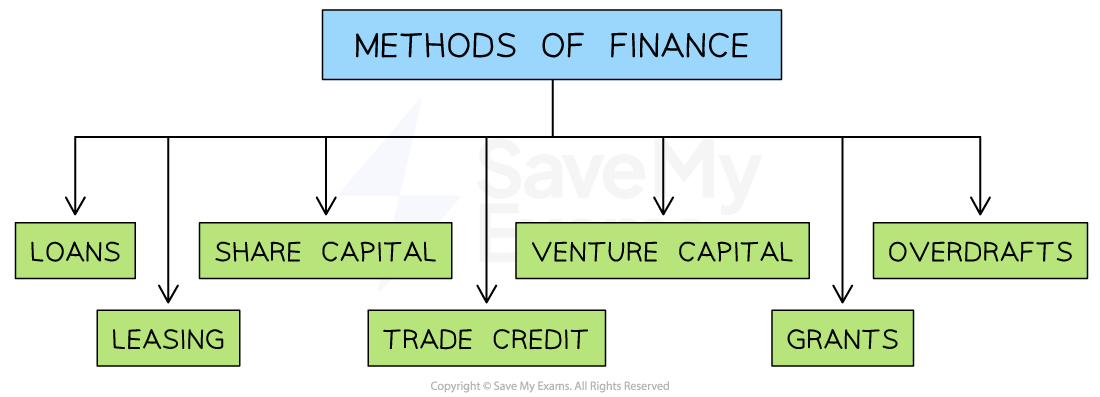
Diagram of finance methods: loans, leasing, share capital, trade credit, venture capital, grants and overdrafts.
Several methods of finance are available to businesses, including loans, share capital, venture capital, overdrafts, leasing, trade credit and grants

Loans

  • A sum of money is borrowed and repaid (with interest) over a determined period of time

  • Bank loans are usually unsecured and are typically repaid over two to ten years

  • Mortgages are long-term secured loans

    • They are typically used by a business to purchase buildings, land or large items of capital equipment

  • Debentures are long-term agreements between a business and a lender to repay a specified amount (with a fixed rate of interest) by a certain date

    • Debenture holders are creditors rather than owners of a business and do not hold voting rights

Benefits and drawbacks of loans

Benefits

Drawbacks

  • Interest rates are fixed for the term of the loan

  • Repayments are made in equal instalments, helping with budgeting

  • Businesses can purchase expensive equipment or property without the need for large amounts of capital

  • Control over decision-making is retained within the business

  • With debentures, interest is fixed, aiding budgeting

  • Interest rates depend on the business’s credit rating

  • Non-current liabilities are increased in the balance sheet

  • With a

Responses

您的邮箱地址不会被公开。 必填项已用 * 标注