
Back to 课程

Business_A-level_Edexcel

0% Complete
0/0 Steps
  1. 1-marketing-and-people

    1-1-meeting-customer-needs
    3 主题
  2. 1-2-market
    5 主题
  3. 1-3-marketing-mix-and-strategy
    5 主题
  4. 1-4-managing-people
    5 主题
  5. 1-5-entrepreneurs-and-leaders
    6 主题
  6. 2-managing-business-activities
    2-1-raising-finance
    4 主题
  7. 2-2-financial-planning
    4 主题
  8. 2-3-managing-finance
    3 主题
  9. 2-4-resource-management
    4 主题
  10. 2-5-external-influences
    3 主题
  11. 3-business-decisions-and-strategy
    3-1-business-objectives-and-strategy
    4 主题
  12. 3-2-business-growth
    4 主题
  13. 3-3-decision-making-techniques
    4 主题
  14. 3-4-influences-on-business-decisions
    4 主题
  15. 3-5-assessing-competitiveness
    3 主题
  16. 3-6-managing-change
    3 主题
  17. 4-global-business
    4-1-globalisation
    5 主题
  18. 4-2-global-markets-and-business-expansion
    5 主题
  19. 4-3-global-marketing
    3 主题
  20. 4-4-global-industries-and-multinational-corporations
    3 主题
  21. 5-exam-technique
    5-1-the-exam-papers
    4 主题
  22. 5-2-business-studies-skills
    1 主题
  23. 5-3-structuring-your-responses
    5 主题
  24. 6-pre-release-preparation
    2025-pre-release-music-industry
    9 主题
课 Progress
0% Complete

Understanding organisational structure terminology

  • Organisational structure outlines the reporting relationships, roles and responsibilities of employees in the organisation

  • Businesses must determine what the best structure is for them to effectively implement their ideas and achieve their objectives

    • They should consider how the structure may affect the management and effectiveness of operations and communications

    • A well-designed organisational structure helps to promote clarity, efficiency and accountability

Terminology used in organisational design

Term

Definition

Explanation

Hierarchy

  • A hierarchy refers to the levels of authority within an organisation

  • It describes the ranking of positions from top to bottom

  • The higher the position in the hierarchy, the more authority and power it holds

  • The hierarchy usually includes top-level management, middle-level management and lower-level employees

Chain of command

  • The chain of command is the formal line of authority that flows down from the top management to lower-level employees

  • It defines who reports to whom and who is responsible for making decisions

  • The chain of command helps establish a clear communication channel and helps to maintain accountability within the organisation

Span of control

  • Span of control refers to the number of employees that a manager or supervisor effectively manages

  • It is based on the principle that a manager can only effectively manage a limited number of employees

  • A narrower span of control means that there are more layers of management

  • A wider span of control means that there are fewer layers of management

Centralised structure

  • Decision-making authority is concentrated at the top of the organisation

  • Senior management make most of the key decisions

  • Centralisation can promote consistency and control

Decentralised structure

  • Decision-making authority is distributed throughout the organisation

  • Lower-level employees have more decision-making power

  • Decentralisation can promote flexibility and innovation

Different types of organisational structure

  • Businesses typically structure their organisation in one of three ways:

    • Tall organisational structures

    • Flat organisational structure

    • Matrix organisational structure

Tall organisational structures

  • Tall structures are characterised by multiple levels of management and a more centralised decision-making process

  • A long chain of command

  • Common in large organisations with complex operations, e.g. government agencies and universities

A tall organisational structure
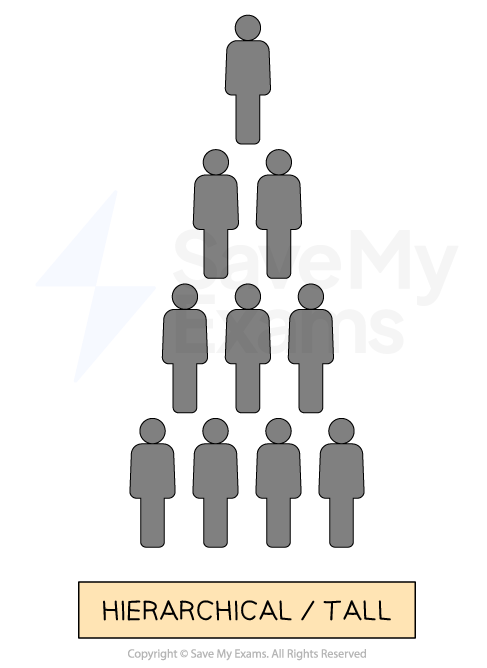
A pyramid of grey silhouettes represents a hierarchical or tall organisational structure, with decreasing numbers of figures from bottom to top.
A tall — or hierarchical — structure with a long chain of command and a narrow span of control

Evaluation of tall structures

Advantages

Disadvantages

  • Provides a clear hierarchy of authority and defined roles and responsibilities

  • Promotes specialisation and expertise within each department or function

  • Offers opportunities for career advancement and promotion within the organisation

  • All of the above increase efficiency and motivation

  • Can create communication barriers between the upper and lower levels of the hierarchy

  • Decision-making can be slow as information must pass through multiple layers of management

  • This can lead to bureaucracy and excessive levels of management

  • All of the above reduce efficiency and motivation

Flat organisational structures

  • Flat structures are characterised by fewer levels of management and a more decentralised decision-making process

  • A short chain of command

  • Common in small organisations or start-ups, e.g. tech start-ups and small businesses

A flat organisational structure
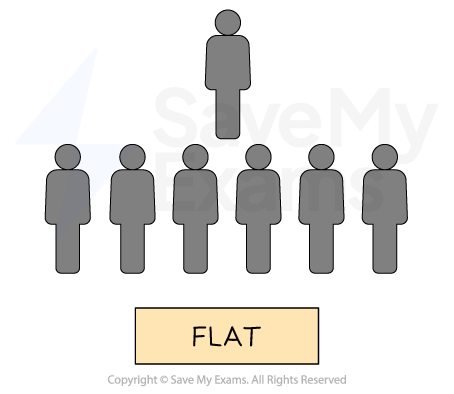
Diagram illustrating a flat organisational structure, with one superior figure above six subordinates arranged in a line below.
A flat organisational structure with a short chain of command and wide span of control

Evaluation of flat structures

Advantages

Disadvantages

  • Promotes a culture of collaboration and open communication

  • Decision-making can be faster and more efficient

  • Encourages creativity and innovation as employees have more autonomy and flexibility

  • All of the above increase efficiency and motivation

  • This can lead to role ambiguity and a lack of a clear hierarchy

  • May not provide clear opportunities for career advancement or promotion

  • This may require employees to take on multiple roles and responsibilities, leading to burnout and overwhelm

  • All of the above reduce efficiency and motivation

Matrix organisational structures

  • Matrix structures are usually built around specific products or projects, e.g. KitKat has its own team within Nestlé

  • They combine the functional areas of a business (human resources, finance, marketing, sales) with a specialist team that operates inside the business

A matrix organisational structure
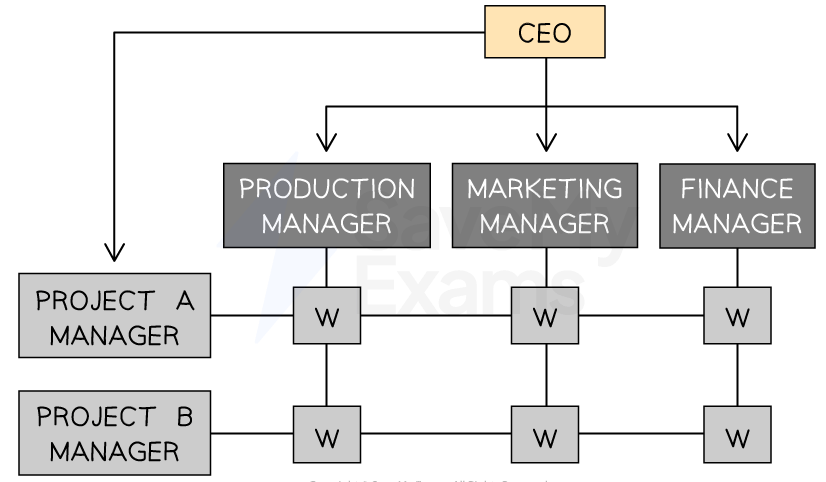
Organisational chart showing a CEO at the top, with production, marketing, and finance managers below, leading to Project A and B managers.
A matrix structure built around specific projects

Evaluation of matrix structures

Advantages

Disadvantages

  • Promotes cross-functional collaboration and communication

  • Allows for specialisation and expertise within each functional area

  • Enables efficient allocation of resources and coordination of multiple projects

  • All of the above increase efficiency and motivation

  • This can lead to conflicts over priorities and resources

  • This can create confusion over roles and responsibilities, particularly when multiple managers are involved

  • Requires a high degree of communication and coordination, which can be challenging

  • All of the above reduce efficiency and motivation

Responses

您的邮箱地址不会被公开。 必填项已用 * 标注