
Business_A-level_Edexcel
-
1-marketing-and-people
1-1-meeting-customer-needs3 主题 -
1-2-market5 主题
-
1-3-marketing-mix-and-strategy5 主题
-
1-4-managing-people5 主题
-
1-5-entrepreneurs-and-leaders6 主题
-
2-managing-business-activities2-1-raising-finance4 主题
-
2-2-financial-planning4 主题
-
2-3-managing-finance3 主题
-
2-4-resource-management4 主题
-
2-5-external-influences3 主题
-
3-business-decisions-and-strategy3-1-business-objectives-and-strategy4 主题
-
3-2-business-growth4 主题
-
3-3-decision-making-techniques4 主题
-
3-4-influences-on-business-decisions4 主题
-
3-5-assessing-competitiveness3 主题
-
3-6-managing-change3 主题
-
4-global-business4-1-globalisation5 主题
-
4-2-global-markets-and-business-expansion5 主题
-
4-3-global-marketing3 主题
-
4-4-global-industries-and-multinational-corporations3 主题
-
5-exam-technique5-1-the-exam-papers4 主题
-
5-2-business-studies-skills1 主题
-
5-3-structuring-your-responses5 主题
-
6-pre-release-preparation2025-pre-release-music-industry9 主题
1-3-4-distribution
Types of distribution channels
-
Distribution channels refer to the various intermediaries through which goods/services move from the manufacturer to the end customer
Common distribution channels
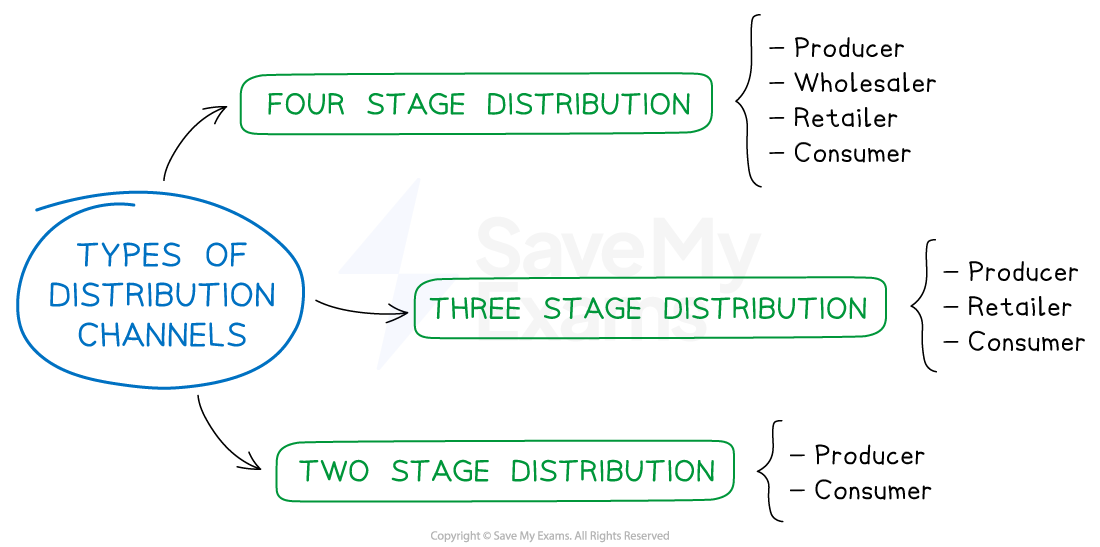
Four-stage distribution channel
-
A traditional channel consists of four stages: producer, wholesaler, retailer and consumer
-
This channel is commonly used for products such as groceries, clothing and electronics
-
For example, The Coca-Cola Company produces the soft drink and then sells it to a wholesaler, which in turn sells it to a retailer
-
The retailer then sells the soft drink to the end customer
-
Three-stage distribution channel
-
The three-stage distribution channel eliminates the wholesaler stage, with the producer selling directly to the retailer
-
This channel is often used for products with high demand or where the cost of distribution is high
-
This channel is often used for products with high profit margins, where the manufacturer can afford to sell directly to the retailer and still make a profit
-
For example, Toshiba produces laptops and sells them directly to retailers such as Currys, which then sell them to the end customer
-
Two-stage distribution channel
-
The two-stage distribution channel eliminates both the wholesaler and retailer stages, with the manufacturer selling directly to the end consumer
-
This channel is commonly used for products that are sold online or through direct sales channels
-
For example, Ryanair sells its service (passenger tickets) directly to the end customer on its website
-
Changes in distribution to reflect social trends
-
Changes in distribution have been impacted by social trends such as the growth of e-commerce and the shift from product-based businesses to service-based businesses
-
By understanding these trends, businesses can adjust their distribution strategies to better meet the needs of their customers and stay competitive in the marketplace
The growth of e-commerce
|
Explanation |
Example |
|---|---|
|
|
The shift from product-based businesses to service-based businesses
|
Explanation |
Example |
|---|---|
|
|
Responses