
Biology_A-level_Cie
-
1-1-the-microscope-in-cell-studies5 主题
-
1-2-cells-as-the-basic-units-of-living-organisms5 主题
-
2-1-testing-for-biological-molecules3 主题
-
2-2-carbohydrates-and-lipids8 主题
-
2-3-proteins6 主题
-
2-4-water2 主题
-
3-1-mode-of-action-of-enzymes5 主题
-
3-2-factors-that-affect-enzyme-action8 主题
-
4-1-fluid-mosaic-membranes4 主题
-
4-2-movement-into-and-out-of-cells12 主题
-
diffusion
-
osmosis
-
active-transport
-
endocytosis-and-exocytosis
-
investigating-transport-processes-in-plants
-
investigating-diffusion
-
surface-area-to-volume-ratios
-
investigating-surface-area
-
estimating-water-potential-in-plants
-
osmosis-in-plant-cells
-
osmosis-in-animals
-
comparing-osmosis-in-plants-and-animals
-
diffusion
-
5-1-replication-and-division-of-nuclei-and-cells6 主题
-
5-2-chromosome-behaviour-in-mitosis2 主题
-
6-1-structure-of-nucleic-acids-and-replication-of-dna4 主题
-
6-2-protein-synthesis5 主题
-
7-1-structure-of-transport-tissues4 主题
-
7-2-transport-mechanisms7 主题
-
8-1-the-circulatory-system7 主题
-
8-2-transport-of-oxygen-and-carbon-dioxide5 主题
-
8-3-the-heart4 主题
-
9-1-the-gas-exchange-system6 主题
-
10-1-infectious-diseases3 主题
-
10-2-antibiotics3 主题
-
11-1-the-immune-system4 主题
-
11-2-antibodies-and-vaccination6 主题
-
12-1-energy5 主题
-
12-2-respiration11 主题
-
aerobic-respiration-the-krebs-cycle
-
aerobic-respiration-role-of-nad-and-fad
-
aerobic-respiration-oxidative-phosphorylation
-
anaerobic-respiration
-
energy-yield-aerobic-and-anaerobic-respiration
-
anaerobic-adaptation-of-rice
-
aerobic-respiration-effect-of-temperature-and-substrate-concentration
-
structure-and-function-of-mitochondria
-
the-four-stages-in-aerobic-respiration
-
aerobic-respiration-glycolysis
-
aerobic-respiration-the-link-reaction
-
aerobic-respiration-the-krebs-cycle
-
13-1-photosynthesis-as-an-energy-transfer-process8 主题
-
13-2-investigation-of-limiting-factors2 主题
-
14-1-homeostasis-in-mammals8 主题
-
14-2-homeostasis-in-plants3 主题
-
15-1-control-and-coordination-in-mammals12 主题
-
the-endocrine-system
-
the-nervous-system
-
neurones
-
sensory-receptor-cells
-
sequence-of-events-resulting-in-an-action-potential
-
transmission-of-nerve-impulses
-
speed-of-conduction-of-impulses
-
the-refractory-period
-
cholinergic-synapses
-
stimulating-contraction-in-striated-muscle
-
ultrastructure-of-striated-muscle
-
sliding-filament-model-of-muscular-contraction
-
the-endocrine-system
-
15-2-control-and-coordination-in-plants3 主题
-
16-1-passage-of-information-from-parents-to-offspring5 主题
-
16-2-the-roles-of-genes-in-determining-the-phenotype7 主题
-
16-3-gene-control3 主题
-
17-1-variation4 主题
-
17-2-natural-and-artificial-selection7 主题
-
17-3-evolution2 主题
-
18-1-classification5 主题
-
18-2-biodiversity7 主题
-
18-3-conservation6 主题
-
19-1-principles-of-genetic-technology11 主题
-
19-2-genetic-technology-applied-to-medicine4 主题
-
19-3-genetically-modified-organisms-in-agriculture2 主题
-
1-1-the-microscope-in-cell-studies
-
1-2-cells-as-the-basic-units-of-living-organisms
-
2-1-testing-for-biological-molecules
-
2-2-carbohydrates-and-lipids
-
2-3-proteins
-
2-4-water
-
3-1-mode-of-action-of-enzymes
-
3-2-factors-that-affect-enzyme-action
-
4-1-fluid-mosaic-membranes
-
4-2-movement-into-and-out-of-cells
-
5-1-replication-and-division-of-nuclei-and-cells
-
5-2-chromosome-behaviour-in-mitosis
-
6-1-structure-of-nucleic-acids-and-replication-of-dna
-
6-2-protein-synthesis
-
7-1-structure-of-transport-tissues
-
7-2-transport-mechanisms
-
8-1-the-circulatory-system
-
8-2-transport-of-oxygen-and-carbon-dioxide
-
8-3-the-heart
-
9-1-the-gas-exchange-system
-
10-1-infectious-diseases
-
10-2-antibiotics
-
11-1-the-immune-system
-
11-2-antibodies-and-vaccination
formation-of-urine
Formation of urine in the nephron
-
The nephron is the functional unit of the kidney
-
The nephrons are responsible for the formation of urine
-
-
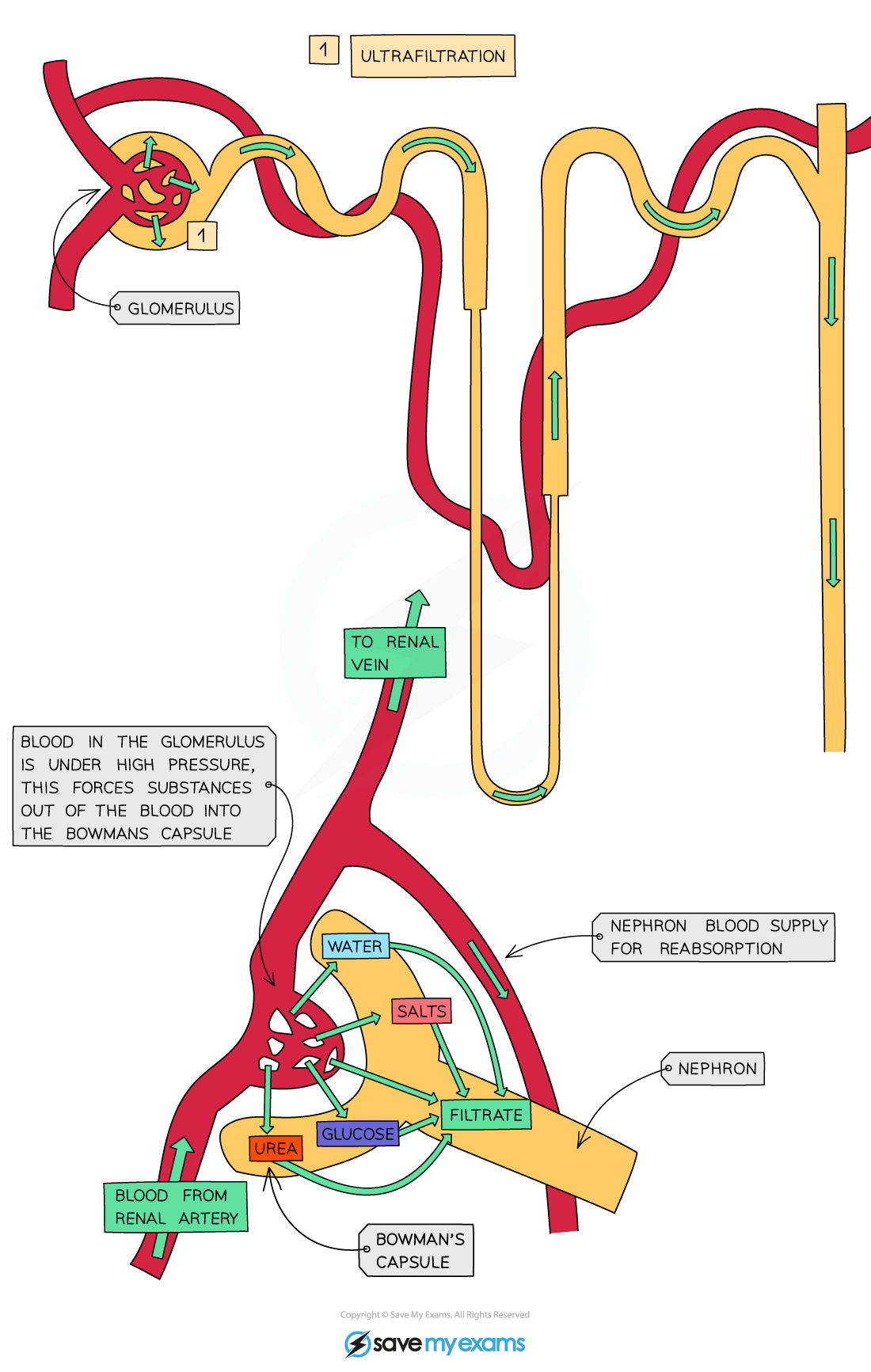
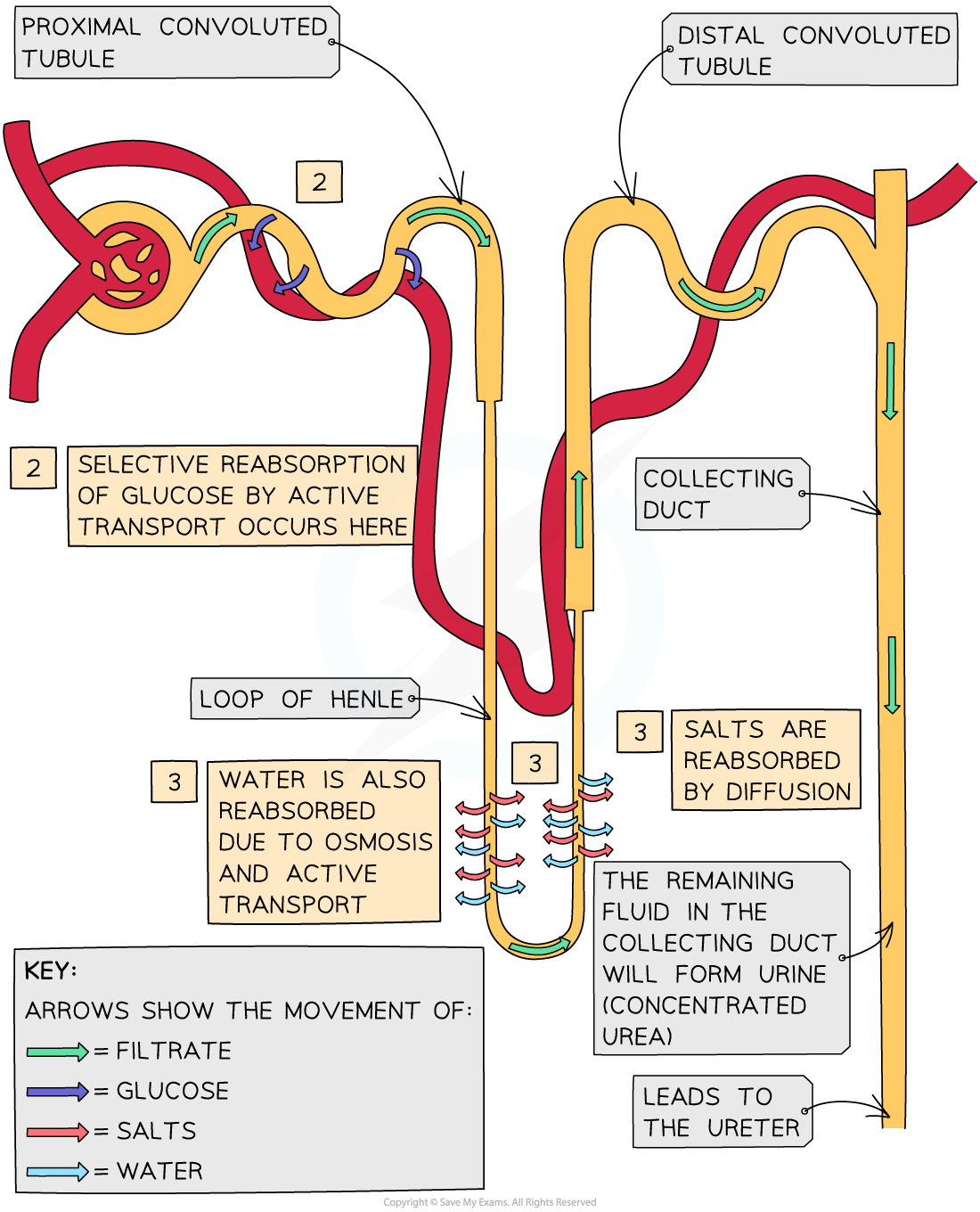
The process of urine formation in the kidneys occurs in two stages:
-
Ultrafiltration
-
Selective reabsorption
|
Stage |
Name of process |
Where process occurs |
Explanation of process |
|---|---|---|---|
|
1 |
Ultrafiltration |
Bowman’s capsule |
Small molecules (including amino acids, water, glucose, urea and inorganic ions) are filtered out of the blood capillaries of the glomerulus and into the Bowman’s capsule to form filtrate known as glomerular filtrate |
|
2 |
Selective reabsorption |
Proximal convoluted tubule |
Useful molecules are taken back (reabsorbed) from the filtrate and returned to the blood as the filtrate flows along the nephron |
-
After the necessary reabsorption of amino acids, water, glucose and inorganic ions is complete, the filtrate eventually leaves the nephron and is now referred to as urine
-
This urine then flows out of the kidneys, along the ureters and into the bladder, where it is temporarily stored
Ultrafiltration
-
Arterioles branch off the renal artery and lead to each nephron, where they form a knot of capillaries (the glomerulus) sitting inside the cup-shaped Bowman’s capsule
-
The capillaries get narrower as they get further into the glomerulus which increases the pressure on the blood moving through them
-
This blood is already at high pressure because it is coming directly from the renal artery which is connected to the aorta)
-
-
This eventually causes the smaller molecules being carried in the blood to be forced out of the capillaries and into the Bowman’s capsule, where they form what is known as the filtrate
-
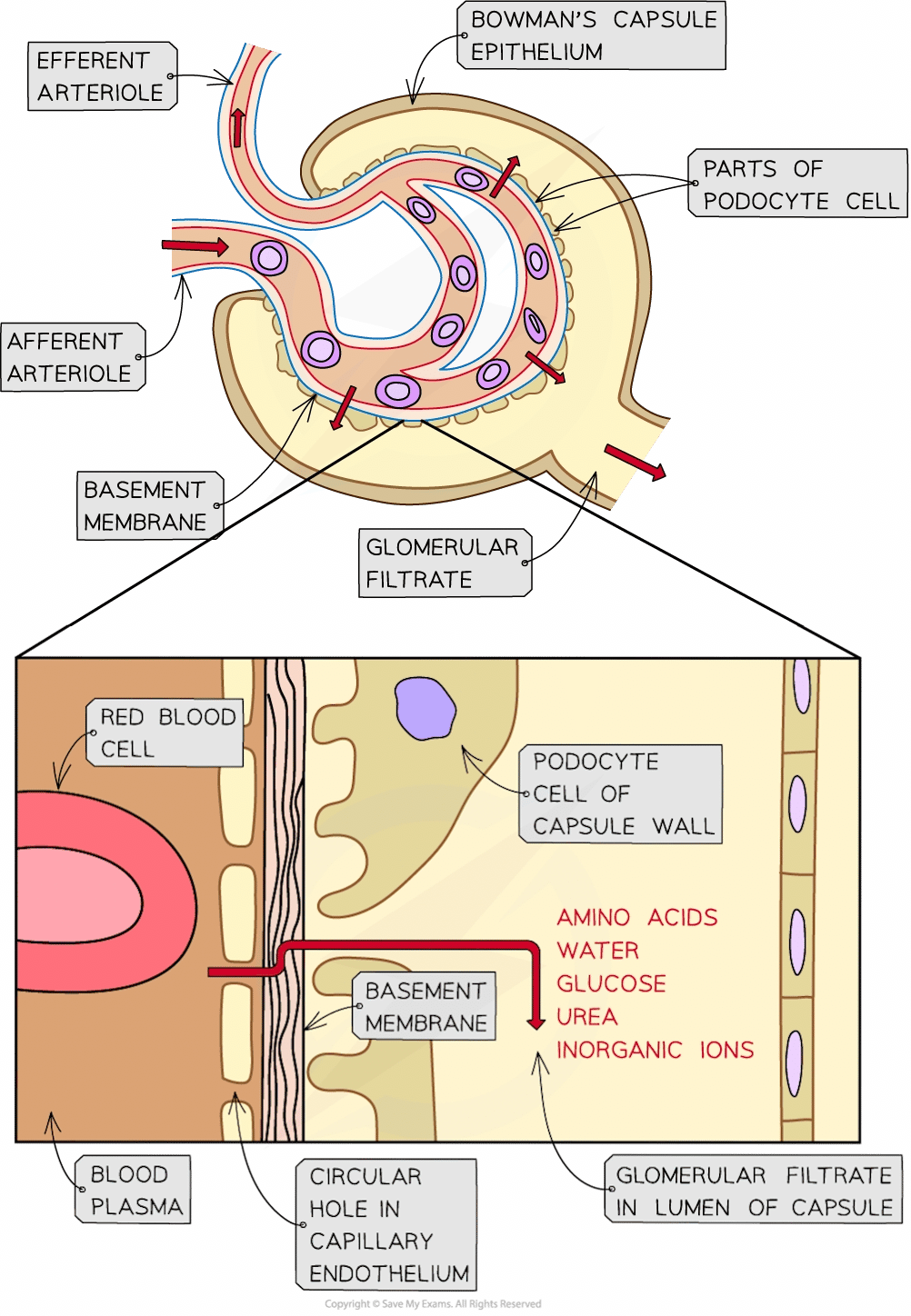
The blood in the glomerular capillaries is separated from the lumen of the Bowman’s capsule by two cell layers with a basement membrane in between them:
-
The first cell layer is the endothelium of the capillary—each capillary endothelial cell is perforated by thousands of tiny membrane-lined circular holes
-
The next layer is the basement membrane—this is made up of a network of collagen and glycoproteins
-
The second cell layer is the epithelium of the Bowman’s capsule—these epithelial cells have many tiny finger-like projections with gaps in between them and are known as podocytes
-
-
As blood passes through the glomerular capillaries, the holes in the capillary endothelial cells and the gaps between the podocytes allows substances dissolved in the blood plasma to pass into the Bowman’s capsule
-
The fluid that filters through from the blood into the Bowman’s capsule is known as the glomerular filtrate
-
The main substances that pass out of the capillaries and form the glomerular filtrate are: amino acids, water, glucose, urea and inorganic ions (mainly Na+, K+ and Cl–)
-
-
Red and white blood cells and platelets remain in the blood as they are too large to pass through the holes in the capillary endothelial cells
-
The basement membrane acts as a filter as it stops large protein molecules from getting through
How ultrafiltration occurs
-
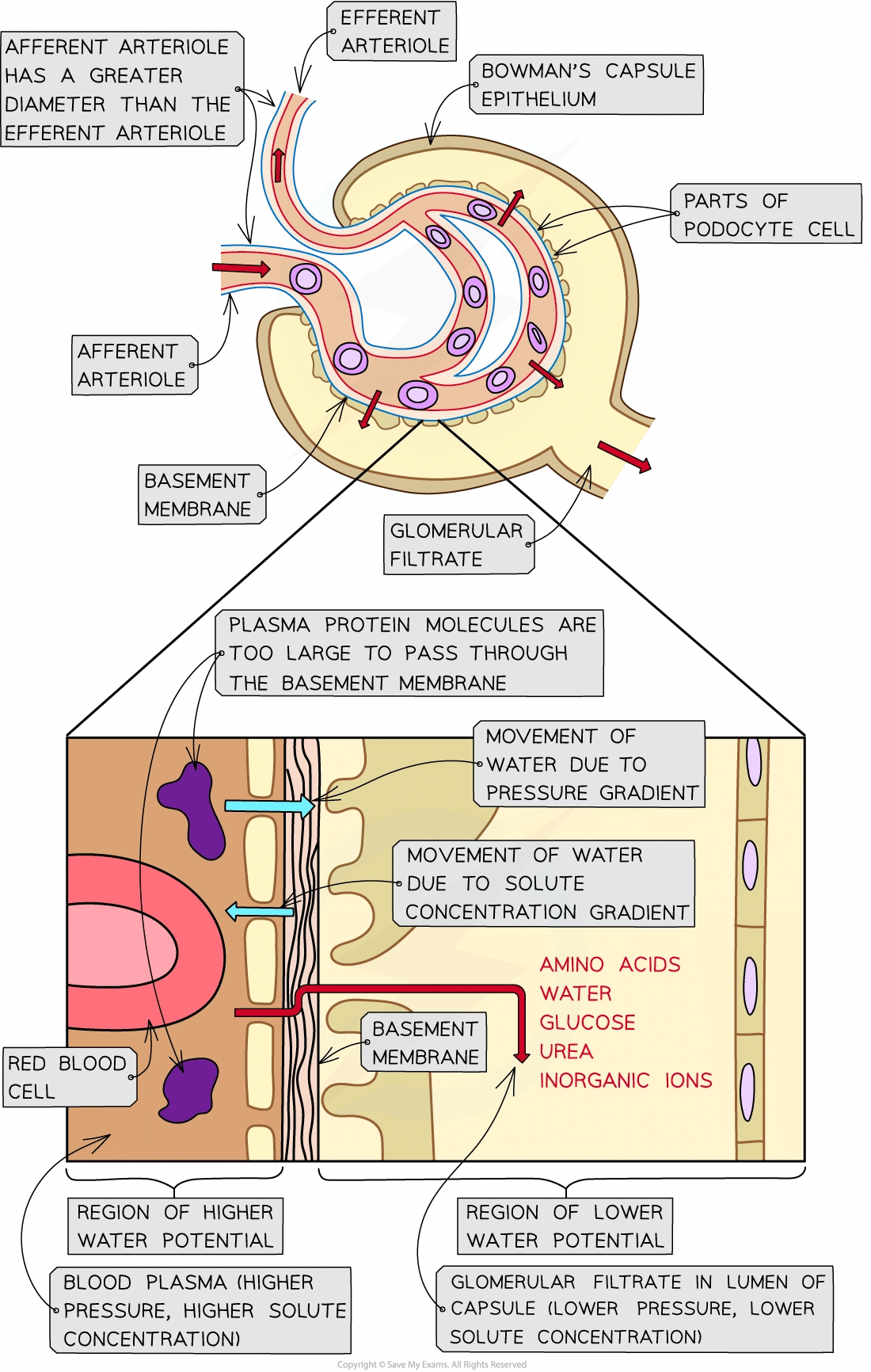
Ultrafiltration occurs due to the differences in water potential between the plasma in the glomerular capillaries and the filtrate in the Bowman’s capsule
-
Water moves down a water potential gradient, from a region of higher water potential to a region of lower water potential
-
Water potential is increased by high pressure and decreased by the presence of solutes
-
|
Factor affecting water potential |
How factor affects water potential in the glomerulus and Bowman’s capsule |
Resulting movement of water |
|---|---|---|
|
Pressure |
As the afferent arteriole is wider than the efferent arteriole, the blood pressure is relatively high in the glomerular capillaries This raises the water potential of the blood plasma in the glomerular capillaries above the water potential of the filtrate in the Bowman’s capsule |
Water moves down the water potential gradient, from the blood plasma in the glomerular capillaries into the Bowman’s capsule |
|
Solute concentration |
Whilst the basement membrane allows most solutes within the blood plasma to filter into the Bowman’s capsule, plasma protein molecules are too big to get through and stay in the blood As a result, the solute concentration in the blood plasma in the glomerular capillaries is higher than that in the filtrate in the Bowman’s capsule This makes the water potential of the blood plasma lower than that of the filtrate in the Bowman’s capsule |
Water moves down the water potential gradient from the Bowman’s capsule into the blood plasma in the glomerular capillaries |
-
Overall, the effect of the pressure gradient outweighs the effect of solute gradient
-
Therefore, the water potential of the blood plasma in the glomerulus is higher than the water potential of the filtrate in the Bowman’s capsule
-
This means that as blood flows through the glomerulus, there is an overall movement of water down the water potential gradient from the blood into the Bowman’s capsule
-
Selective reabsorption
-
Many of the substances that end up in the glomerular filtrate actually need to be kept by the body
-
These substances are reabsorbed into the blood as the filtrate passes along the nephron
-
This process is knowns as selective reabsorption as only certain substances are reabsorbed
-
-
Glucose reabsorption occurs in the proximal convoluted tubule
-
The lining of