
Biology_A-level_Cie
-
1-1-the-microscope-in-cell-studies5 主题
-
1-2-cells-as-the-basic-units-of-living-organisms5 主题
-
2-1-testing-for-biological-molecules3 主题
-
2-2-carbohydrates-and-lipids8 主题
-
2-3-proteins6 主题
-
2-4-water2 主题
-
3-1-mode-of-action-of-enzymes5 主题
-
3-2-factors-that-affect-enzyme-action8 主题
-
4-1-fluid-mosaic-membranes4 主题
-
4-2-movement-into-and-out-of-cells12 主题
-
diffusion
-
osmosis
-
active-transport
-
endocytosis-and-exocytosis
-
investigating-transport-processes-in-plants
-
investigating-diffusion
-
surface-area-to-volume-ratios
-
investigating-surface-area
-
estimating-water-potential-in-plants
-
osmosis-in-plant-cells
-
osmosis-in-animals
-
comparing-osmosis-in-plants-and-animals
-
diffusion
-
5-1-replication-and-division-of-nuclei-and-cells6 主题
-
5-2-chromosome-behaviour-in-mitosis2 主题
-
6-1-structure-of-nucleic-acids-and-replication-of-dna4 主题
-
6-2-protein-synthesis5 主题
-
7-1-structure-of-transport-tissues4 主题
-
7-2-transport-mechanisms7 主题
-
8-1-the-circulatory-system7 主题
-
8-2-transport-of-oxygen-and-carbon-dioxide5 主题
-
8-3-the-heart4 主题
-
9-1-the-gas-exchange-system6 主题
-
10-1-infectious-diseases3 主题
-
10-2-antibiotics3 主题
-
11-1-the-immune-system4 主题
-
11-2-antibodies-and-vaccination6 主题
-
12-1-energy5 主题
-
12-2-respiration11 主题
-
aerobic-respiration-the-krebs-cycle
-
aerobic-respiration-role-of-nad-and-fad
-
aerobic-respiration-oxidative-phosphorylation
-
anaerobic-respiration
-
energy-yield-aerobic-and-anaerobic-respiration
-
anaerobic-adaptation-of-rice
-
aerobic-respiration-effect-of-temperature-and-substrate-concentration
-
structure-and-function-of-mitochondria
-
the-four-stages-in-aerobic-respiration
-
aerobic-respiration-glycolysis
-
aerobic-respiration-the-link-reaction
-
aerobic-respiration-the-krebs-cycle
-
13-1-photosynthesis-as-an-energy-transfer-process8 主题
-
13-2-investigation-of-limiting-factors2 主题
-
14-1-homeostasis-in-mammals8 主题
-
14-2-homeostasis-in-plants3 主题
-
15-1-control-and-coordination-in-mammals12 主题
-
the-endocrine-system
-
the-nervous-system
-
neurones
-
sensory-receptor-cells
-
sequence-of-events-resulting-in-an-action-potential
-
transmission-of-nerve-impulses
-
speed-of-conduction-of-impulses
-
the-refractory-period
-
cholinergic-synapses
-
stimulating-contraction-in-striated-muscle
-
ultrastructure-of-striated-muscle
-
sliding-filament-model-of-muscular-contraction
-
the-endocrine-system
-
15-2-control-and-coordination-in-plants3 主题
-
16-1-passage-of-information-from-parents-to-offspring5 主题
-
16-2-the-roles-of-genes-in-determining-the-phenotype7 主题
-
16-3-gene-control3 主题
-
17-1-variation4 主题
-
17-2-natural-and-artificial-selection7 主题
-
17-3-evolution2 主题
-
18-1-classification5 主题
-
18-2-biodiversity7 主题
-
18-3-conservation6 主题
-
19-1-principles-of-genetic-technology11 主题
-
19-2-genetic-technology-applied-to-medicine4 主题
-
19-3-genetically-modified-organisms-in-agriculture2 主题
-
1-1-the-microscope-in-cell-studies
-
1-2-cells-as-the-basic-units-of-living-organisms
-
2-1-testing-for-biological-molecules
-
2-2-carbohydrates-and-lipids
-
2-3-proteins
-
2-4-water
-
3-1-mode-of-action-of-enzymes
-
3-2-factors-that-affect-enzyme-action
-
4-1-fluid-mosaic-membranes
-
4-2-movement-into-and-out-of-cells
-
5-1-replication-and-division-of-nuclei-and-cells
-
5-2-chromosome-behaviour-in-mitosis
-
6-1-structure-of-nucleic-acids-and-replication-of-dna
-
6-2-protein-synthesis
-
7-1-structure-of-transport-tissues
-
7-2-transport-mechanisms
-
8-1-the-circulatory-system
-
8-2-transport-of-oxygen-and-carbon-dioxide
-
8-3-the-heart
-
9-1-the-gas-exchange-system
-
10-1-infectious-diseases
-
10-2-antibiotics
-
11-1-the-immune-system
-
11-2-antibodies-and-vaccination
biological-molecule-tests
Testing for key biological molecules
-
There are a number of tests that can be carried out quickly and easily in a lab to determine if a sample contains one of the key biological molecules (carbohydrates, proteins and lipids)
-
The following tests are qualitative
-
They do not give a quantitative value as to how much of each type of molecule may be present in a sample
-
The Benedict’s test for reducing sugars
-
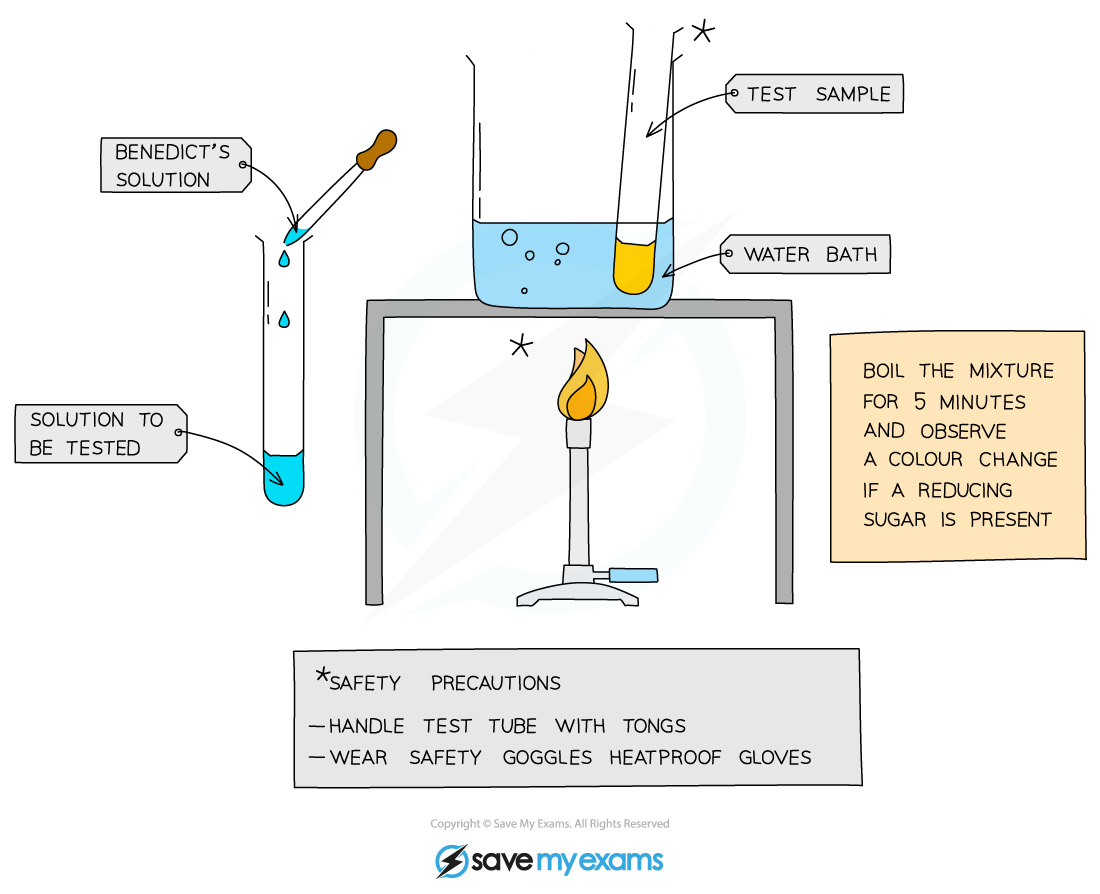
Add Benedict’s reagent (which is blue as it contains copper (II) sulfate ions) to a sample solution in a test tube
-
Heat the test tube in a water bath or beaker of water that has been brought to a boil for a few minutes
-
If a reducing sugar is present, a coloured precipitate will form as copper (II) sulfate is reduced to copper (I) oxide which is insoluble in water
-
A positive test result is, therefore, a colour change somewhere along a colour scale from blue (no reducing sugar) to brown/brick-red (a high concentration of reducing sugar)
-
This test is semi-quantitative as the degree of the colour change can give an indication of how much (the concentration of) reducing sugar present
-
The iodine test for starch
-
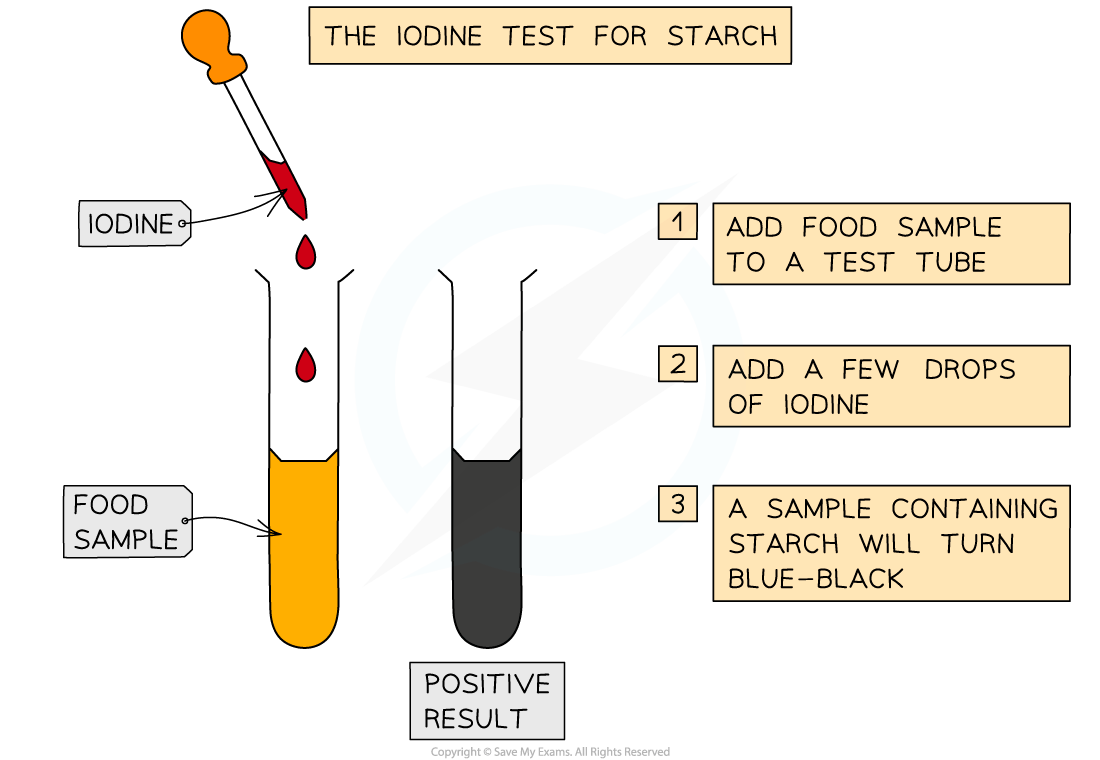
To test for the presence of starch in a sample, add a few drops of orange/brown iodine in potassium iodide solution to the sample
-
The iodine is in potassium iodide solution as iodine is insoluble in water
-
-
If starch is present, iodide ions in the solution interact with the centre of starch molecules, producing a complex with a distinctive blue-black colour
-
This test is useful in experiments for showing that starch in a sample has been digested by enzymes
The emulsion test for lipids
-
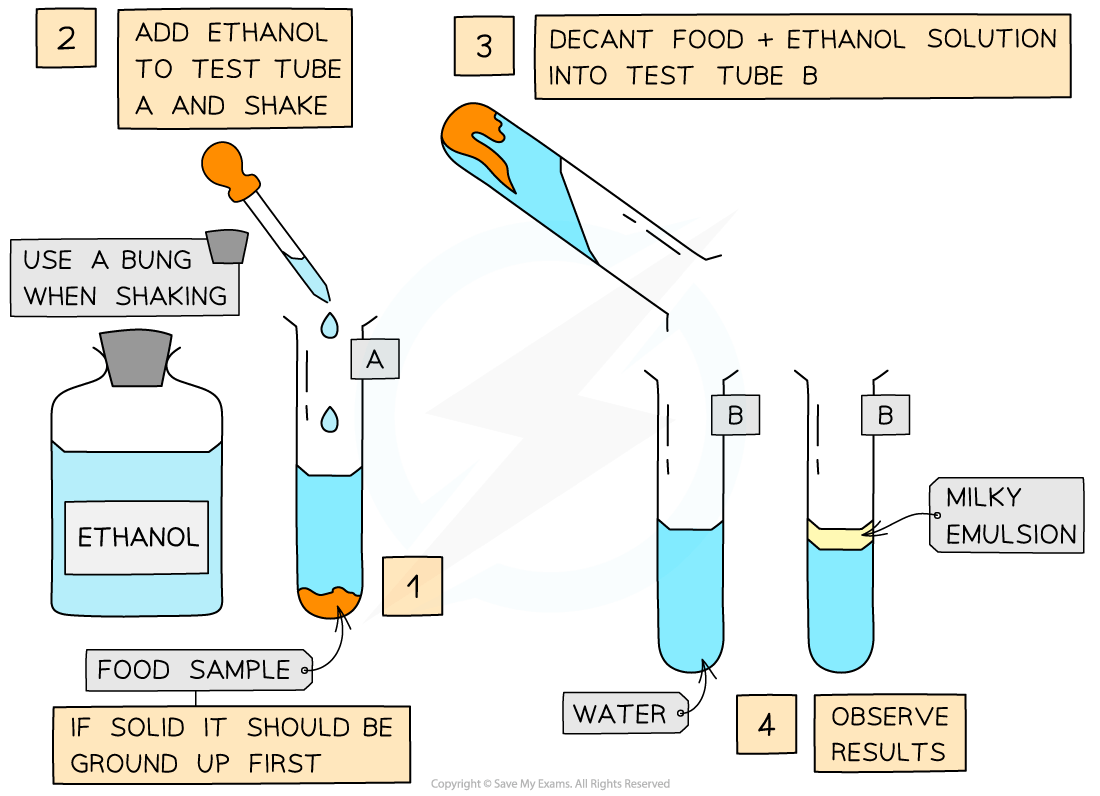
Lipids are nonpolar molecules that do not dissolve in water but will dissolve in organic solvents such as ethanol
-
Add ethanol to the sample to be tested, shake to mix and then add the mixture to a test tube of water
-
If lipids are present, a milky emulsion will form (the solution appears ‘cloudy’); the more lipid present, the more obvious the milky colour of the solution
-
If no lipid is present, the solution remains clear
The biuret test for proteins
-
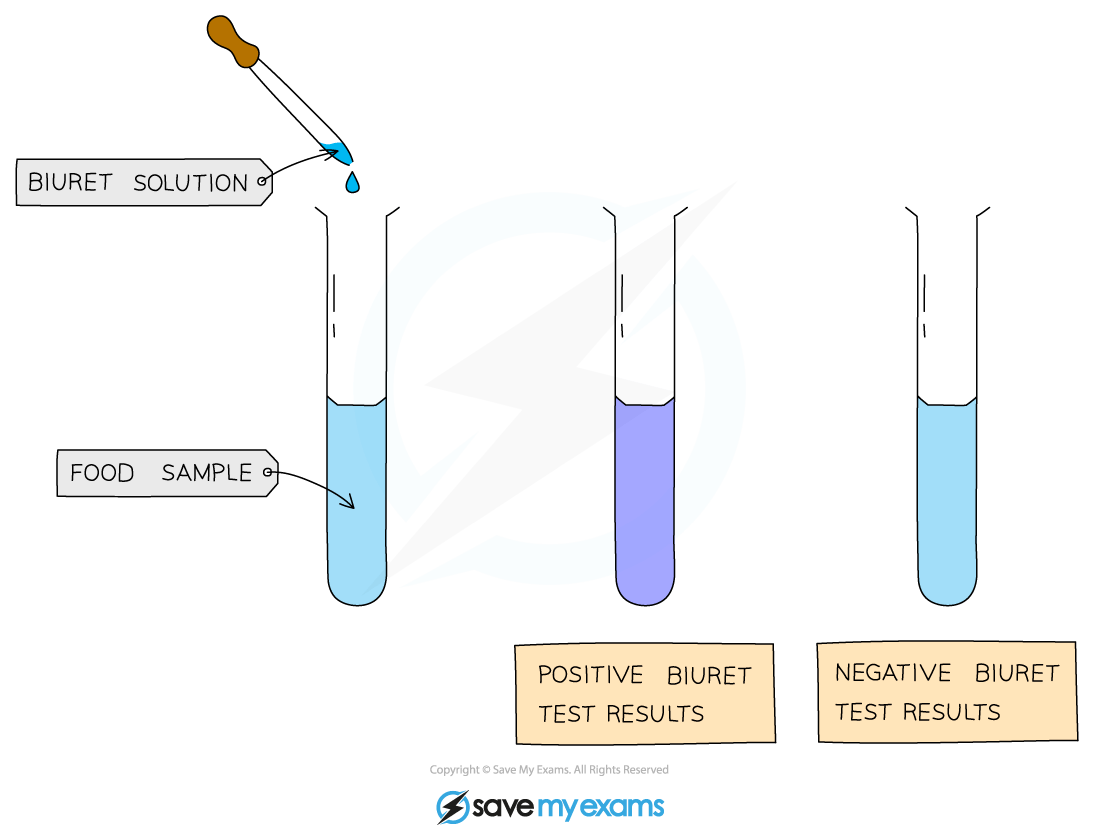
A liquid solution of a sample is treated with sodium or potassium hydroxide to make the solution alkaline
-
A few drops of copper (II) sulfate solution (which is blue) is added to the sample
-
Biuret ‘reagent’ contains an alkali and copper (II) sulfate
-
-
If a colour change is observed from blue to lilac/purple, then protein is present.
-
The colour change can be very subtle, it’s wise to hold the test tubes up against a white tile when making observations)
-
-
If no colour change is observed, no protein is present
-
For this test to work, there must be at least two peptide bonds present in any protein molecules, so if the sample contains amino acids or dipeptides, the result will be negative
-
Examiner Tips and Tricks
A common mistake is just writing the colour change (e.g. “goes brick-red”) without naming the reagent. For full marks, always say what you add (e.g. Benedict’s reagent), what you do (e.g. heat in a water bath), and what result shows a positive test (e.g. a brick-red precipitate). This is how exam mark schemes are often structured.