
Biology_A-level_Aqa
-
1-biological-molecules
1-1-biological-molecules-carbohydrates11 主题-
1-1-1-biological-molecules-key-terms
-
1-1-2-biological-molecules-reactions
-
1-1-3-monosaccharides
-
1-1-4-glucose
-
1-1-5-the-glycosidic-bond
-
1-1-6-chromatography-monosaccharides
-
1-1-7-disaccharides
-
1-1-8-starch-and-glycogen
-
1-1-9-cellulose
-
1-1-10-biochemical-tests-sugars-and-starch
-
1-1-11-finding-the-concentration-of-glucose
-
1-1-1-biological-molecules-key-terms
-
1-2-biological-molecules-lipids3 主题
-
1-3-biological-molecules-proteins5 主题
-
1-4-proteins-enzymes12 主题
-
1-4-1-many-proteins-are-enzymes
-
1-4-2-enzyme-specificity
-
1-4-3-how-enzymes-work
-
1-4-4-required-practical-measuring-enzyme-activity
-
1-4-5-drawing-a-graph-for-enzyme-rate-experiments
-
1-4-6-using-a-tangent-to-find-initial-rate-of-reaction
-
1-4-7-limiting-factors-affecting-enzymes-temperature
-
1-4-8-limiting-factors-affecting-enzymes-ph
-
1-4-10-limiting-factors-affecting-enzymes-enzyme-concentration
-
1-4-11-limiting-factors-affecting-enzymes-substrate-concentration
-
1-4-12-limiting-factors-affecting-enzymes-inhibitors
-
1-4-14-control-of-variables-and-uncertainty
-
1-4-1-many-proteins-are-enzymes
-
1-5-nucleic-acids-structure-and-dna-replication8 主题
-
1-5-2-nucleotide-structure-and-the-phosphodiester-bond
-
1-5-3-dna-structure-and-function
-
1-5-4-rna-structure-and-function
-
1-5-5-ribosomes
-
1-5-6-the-origins-of-research-on-the-genetic-code
-
1-5-8-the-process-of-semi-conservative-replication
-
1-5-9-calculating-the-frequency-of-nucleotide-bases
-
1-5-10-the-watson-crick-model
-
1-5-2-nucleotide-structure-and-the-phosphodiester-bond
-
1-6-atp-water-and-inorganic-ions4 主题
-
2-cell-structure2-1-cell-structure7 主题
-
2-2-the-microscope-in-cell-studies4 主题
-
2-3-cell-division-in-eukaryotic-and-prokaryotic-cells8 主题
-
2-4-cell-membranes-and-transport7 主题
-
2-5-cell-recognition-and-the-immune-system7 主题
-
2-6-vaccines-disease-and-monoclonal-antibodies6 主题
-
3-exchange-and-transport3-1-adaptations-for-gas-exchange6 主题
-
3-2-human-gas-exchange10 主题
-
3-2-1-the-human-gas-exchange-system
-
3-2-2-dissecting-the-gas-exchange-system
-
3-2-3-microscopy-and-gas-exchange-surfaces
-
3-2-4-investigating-gas-exchange
-
3-2-5-the-alveolar-epithelium
-
3-2-6-ventilation-and-gas-exchange
-
3-2-8-the-effects-of-lung-disease
-
3-2-9-pollution-and-smoking-data
-
3-2-10-risk-factor-data
-
3-2-11-correlations-and-causal-relationships
-
3-2-1-the-human-gas-exchange-system
-
3-3-digestion-and-absorption5 主题
-
3-4-mass-transport-in-animals6 主题
-
3-5-the-circulatory-system-in-animals8 主题
-
3-6-mass-transport-in-plants6 主题
-
4-genetics-variation-and-interdependence4-1-dna-genes-and-chromosomes7 主题
-
4-2-dna-and-protein-synthesis6 主题
-
4-3-genetic-diversity-mutations-and-meiosis7 主题
-
4-4-genetic-diversity-and-adaptation6 主题
-
4-5-species-and-taxonomy4 主题
-
4-6-biodiversity9 主题
-
5-energy-transfers-in-and-between-organisms-a-level-only5-1-photosynthesis-a-level-only5 主题
-
5-2-respiration-a-level-only7 主题
-
5-3-energy-and-ecosystems-a-level-only9 主题
-
5-4-nutrient-cycles-a-level-only4 主题
-
6-organisms-respond-to-changes-in-their-environments-a-level-only6-1-response-to-stimuli-a-level-only12 主题
-
6-1-1-survival-and-response
-
6-1-2-growth-factors-in-flowering-plants
-
6-1-3-indoleacetic-acid-iaa
-
6-1-4-taxes-and-kinesis
-
6-1-5-reflex-arcs
-
6-1-6-required-practical-investigating-animal-movement
-
6-1-7-the-pacinian-corpuscle
-
6-1-8-pacinian-corpuscles-generator-potential
-
6-1-9-investigating-touch-and-temperature-receptors
-
6-1-10-the-human-retina
-
6-1-11-myogenic-stimulation-of-the-heart
-
6-1-13-heart-rate
-
6-1-1-survival-and-response
-
6-2-nervous-coordination-a-level-only10 主题
-
6-3-skeletal-muscles-a-level-only6 主题
-
6-4-homeostasis-a-level-only11 主题
-
6-4-1-principles-of-homeostasis
-
6-4-2-negative-feedback
-
6-4-3-glucose-concentration-and-insulin
-
6-4-4-glucose-regulation-glucagon
-
6-4-5-glucose-regulation-adrenaline
-
6-4-6-glucose-regulation-the-liver
-
6-4-7-diabetes
-
6-4-8-required-practical-determining-the-concentration-of-glucose-in-urine
-
6-4-9-nephron-structure
-
6-4-10-nephron-function
-
6-4-11-control-of-blood-water-potential
-
6-4-1-principles-of-homeostasis
-
7-genetics-populations-evolution-and-ecosystems-a-level-only7-1-inheritance-a-level-only6 主题
-
7-2-populations-a-level-only3 主题
-
7-3-evolution-a-level-only5 主题
-
7-4-populations-in-ecosystems-a-level-only7 主题
-
8-the-control-of-gene-expression-a-level-only8-1-genetic-mutations-a-level-only2 主题
-
8-2-regulation-of-gene-expression-a-level-only11 主题
-
8-2-1-totipotent-cells
-
8-2-2-stem-cells
-
8-2-3-the-use-of-stem-cells
-
8-2-4-producing-tissue-cultures-of-explants
-
8-2-5-regulation-of-transcription
-
8-2-6-evaluating-data-about-genetic-expression
-
8-2-7-epigenetics
-
8-2-8-epigenetics-and-disease
-
8-2-9-rna-interference
-
8-2-10-two-types-of-tumours
-
8-2-11-tumour-development
-
8-2-1-totipotent-cells
-
8-3-using-genome-projects-a-level-only4 主题
-
8-4-gene-technologies-a-level-only13 主题
-
8-4-1-recombinant-dna-technology
-
8-4-2-producing-fragments-of-dna
-
8-4-3-investigating-the-specificity-of-restriction-enzymes
-
8-4-4-polymerase-chain-reaction
-
8-4-5-culture-of-transformed-host-cells
-
8-4-6-uses-of-recombinant-dna-technology
-
8-4-7-dna-probes-and-dna-hybridisation
-
8-4-8-screening-patients
-
8-4-9-genetic-counselling-and-personalised-medicine
-
8-4-10-variable-number-tandem-repeats
-
8-4-11-gel-electrophoresis
-
8-4-12-genetic-fingerprinting
-
8-4-13-uses-of-genetic-fingerprinting
-
8-4-1-recombinant-dna-technology
-
exam-guidance-and-skillsessay-guidance3 主题
8-2-11-tumour-development
Tumour development
Cancer and uncontrolled cell division
-
Cancer arises from uncontrolled mitosis due to mutations in genes regulating the cell cycle
-
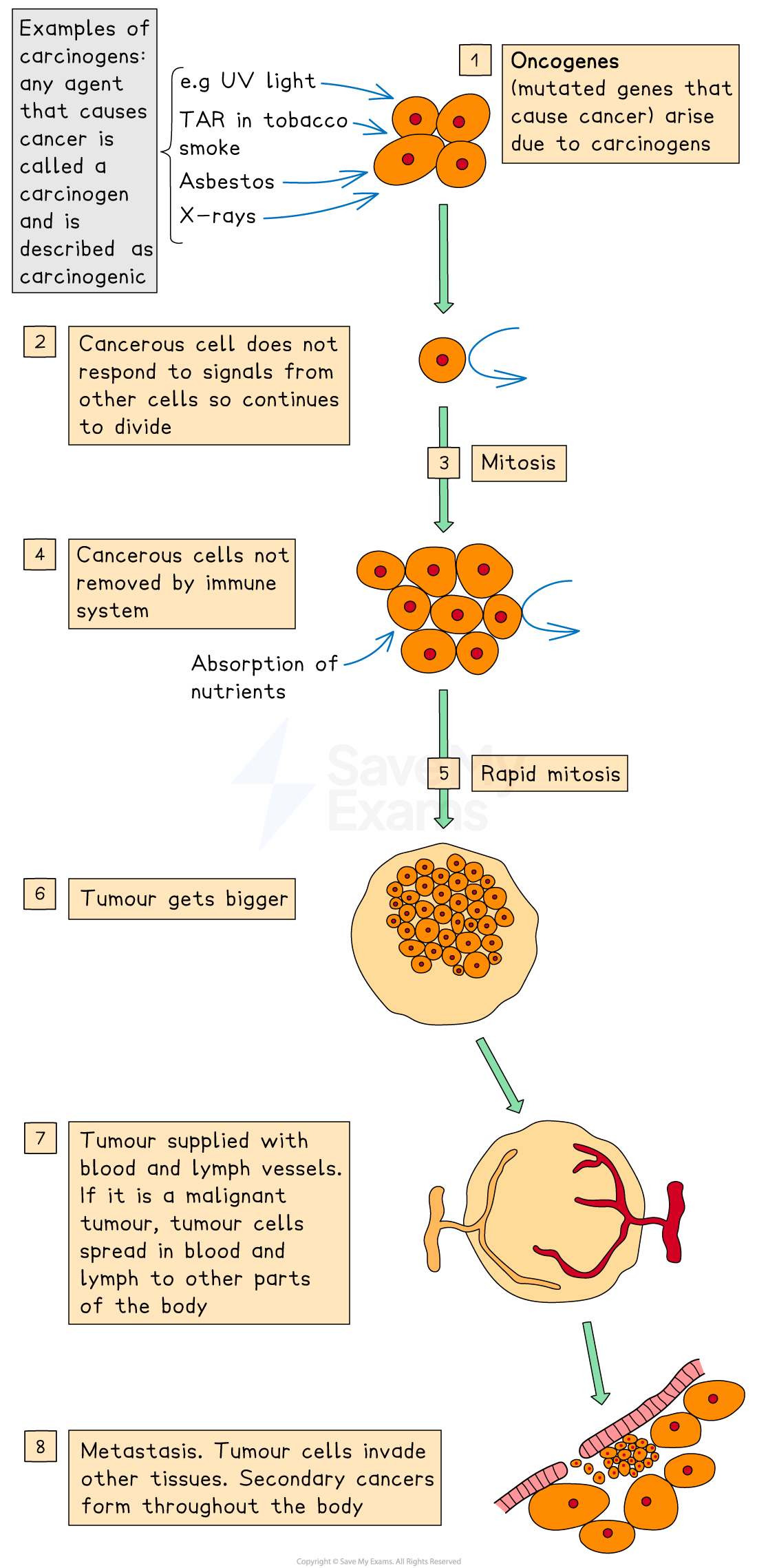
Cancerous cells divide uncontrollably, forming a tumour
-
Mutations in genes that regulate cell division can lead to cancer; these genes may become oncogenes
-
Mutations are common events and don’t lead to cancer most of the time
-
Most mutations either result in early cell death or in the cell being destroyed by the body’s immune system
-
As most cells can be easily replaced, these events usually have no harmful effect on the body
-
-
Harmful mutations that escape these mechanisms can be passed to all descendant cells
-
Carcinogens (e.g. UV, tobacco tar, X-rays) increase mutation risk
Tumour suppressor genes
-
Tumour suppressor genes are normal genes which encode proteins that:
-
Repair DNA
-
Slow the cell cycle at checkpoints
-
Signal apoptosis if damage is irreparable
-
-
Mutations or epigenetic silencing of tumour suppressor genes can lead to tumour formation
-
BRCA-1 is a tumour suppressor gene mainly expressed in breast tissue
-
The BRCA-1 protein repairs damaged DNA or triggers apoptosis if repair fails
-
Reduced BRCA-1 expression leads to breast cancer development
-
Oncogenes
-
Proto-oncogenes code for proteins that stimulate cell growth and differentiation
-
Mutation (due to carcinogens) can convert proto-oncogenes into oncogenes
-
Causes constant activation of proteins that stimulate cell growth and division
-
This speeds up the cell cycle
-
-
If proteins that induce apoptosis are also affected, tumours can form
-
-
Oncogene activation can occur via:
-
inversion or translocation mutations on a proto-oncogene leading to:
-
increased gene expression
-
protein production cannot be switched off
-
-
Abnormal methylation
-
Abnormal methylation of DNA affects gene expression:
-
Increased methylation of tumour suppressor genes silences them as transcription factors are unable to bind
-
tumour suppressor proteins are therefore not synthesized and tumour formation occurs
-
RNA interference by siRNAs targeting tumour suppressor genes for breakdown can also lead to tumour development for the same reason
-
-
Reduced methylation of proto-oncogenes increases expression as the gene becomes accessible
-
transcription factors then bind and protein synthesis is activated
-
the gene behaves like an oncogene, even without a mutation
-
-
Oestrogen-dependent breast tumours
-
Oestrogen is a steroid hormone that upregulates transcription of certain genes through the stimulation of the ERα oestrogen receptor
-
High concentrations of oestrogen can lead to the development of breast cancer
-
High concentrations can be a result of over-expression of the oestrogen gene or from supplementary oestrogen taken in medication
-
-
~70% of breast tumours are oestrogen receptor-positive
-
Oestrogen enters cells, binds to oestrogen receptors in the nucleus which activates transcription
-
This stimulates the expression of cell cycle genes that lead to growth and replication
-
-
The drug tamoxifen is a competitive inhibitor of oestrogen:
-
It binds ERα receptor and prevents gene activation
-
This inhibits tumour growth as the oestrogen receptor cannot bind to the promoter
-
Examiner Tips and Tricks
In exams, you may be asked to evaluate data linking genetic and environmental factors to cancer. This often involves interpreting control group studies and understanding how risk factors lead to mutations or altered gene expression. You should apply your knowledge of oncogenes, tumour suppressor genes, and epigenetic/post-transcriptional mechanisms to explain cancer development, prevention, and treatment.