
Biology_A-level_Aqa
-
1-biological-molecules
1-1-biological-molecules-carbohydrates11 主题-
1-1-1-biological-molecules-key-terms
-
1-1-2-biological-molecules-reactions
-
1-1-3-monosaccharides
-
1-1-4-glucose
-
1-1-5-the-glycosidic-bond
-
1-1-6-chromatography-monosaccharides
-
1-1-7-disaccharides
-
1-1-8-starch-and-glycogen
-
1-1-9-cellulose
-
1-1-10-biochemical-tests-sugars-and-starch
-
1-1-11-finding-the-concentration-of-glucose
-
1-1-1-biological-molecules-key-terms
-
1-2-biological-molecules-lipids3 主题
-
1-3-biological-molecules-proteins5 主题
-
1-4-proteins-enzymes12 主题
-
1-4-1-many-proteins-are-enzymes
-
1-4-2-enzyme-specificity
-
1-4-3-how-enzymes-work
-
1-4-4-required-practical-measuring-enzyme-activity
-
1-4-5-drawing-a-graph-for-enzyme-rate-experiments
-
1-4-6-using-a-tangent-to-find-initial-rate-of-reaction
-
1-4-7-limiting-factors-affecting-enzymes-temperature
-
1-4-8-limiting-factors-affecting-enzymes-ph
-
1-4-10-limiting-factors-affecting-enzymes-enzyme-concentration
-
1-4-11-limiting-factors-affecting-enzymes-substrate-concentration
-
1-4-12-limiting-factors-affecting-enzymes-inhibitors
-
1-4-14-control-of-variables-and-uncertainty
-
1-4-1-many-proteins-are-enzymes
-
1-5-nucleic-acids-structure-and-dna-replication8 主题
-
1-5-2-nucleotide-structure-and-the-phosphodiester-bond
-
1-5-3-dna-structure-and-function
-
1-5-4-rna-structure-and-function
-
1-5-5-ribosomes
-
1-5-6-the-origins-of-research-on-the-genetic-code
-
1-5-8-the-process-of-semi-conservative-replication
-
1-5-9-calculating-the-frequency-of-nucleotide-bases
-
1-5-10-the-watson-crick-model
-
1-5-2-nucleotide-structure-and-the-phosphodiester-bond
-
1-6-atp-water-and-inorganic-ions4 主题
-
2-cell-structure2-1-cell-structure7 主题
-
2-2-the-microscope-in-cell-studies4 主题
-
2-3-cell-division-in-eukaryotic-and-prokaryotic-cells8 主题
-
2-4-cell-membranes-and-transport7 主题
-
2-5-cell-recognition-and-the-immune-system7 主题
-
2-6-vaccines-disease-and-monoclonal-antibodies6 主题
-
3-exchange-and-transport3-1-adaptations-for-gas-exchange6 主题
-
3-2-human-gas-exchange10 主题
-
3-2-1-the-human-gas-exchange-system
-
3-2-2-dissecting-the-gas-exchange-system
-
3-2-3-microscopy-and-gas-exchange-surfaces
-
3-2-4-investigating-gas-exchange
-
3-2-5-the-alveolar-epithelium
-
3-2-6-ventilation-and-gas-exchange
-
3-2-8-the-effects-of-lung-disease
-
3-2-9-pollution-and-smoking-data
-
3-2-10-risk-factor-data
-
3-2-11-correlations-and-causal-relationships
-
3-2-1-the-human-gas-exchange-system
-
3-3-digestion-and-absorption5 主题
-
3-4-mass-transport-in-animals6 主题
-
3-5-the-circulatory-system-in-animals8 主题
-
3-6-mass-transport-in-plants6 主题
-
4-genetics-variation-and-interdependence4-1-dna-genes-and-chromosomes7 主题
-
4-2-dna-and-protein-synthesis6 主题
-
4-3-genetic-diversity-mutations-and-meiosis7 主题
-
4-4-genetic-diversity-and-adaptation6 主题
-
4-5-species-and-taxonomy4 主题
-
4-6-biodiversity9 主题
-
5-energy-transfers-in-and-between-organisms-a-level-only5-1-photosynthesis-a-level-only5 主题
-
5-2-respiration-a-level-only7 主题
-
5-3-energy-and-ecosystems-a-level-only9 主题
-
5-4-nutrient-cycles-a-level-only4 主题
-
6-organisms-respond-to-changes-in-their-environments-a-level-only6-1-response-to-stimuli-a-level-only12 主题
-
6-1-1-survival-and-response
-
6-1-2-growth-factors-in-flowering-plants
-
6-1-3-indoleacetic-acid-iaa
-
6-1-4-taxes-and-kinesis
-
6-1-5-reflex-arcs
-
6-1-6-required-practical-investigating-animal-movement
-
6-1-7-the-pacinian-corpuscle
-
6-1-8-pacinian-corpuscles-generator-potential
-
6-1-9-investigating-touch-and-temperature-receptors
-
6-1-10-the-human-retina
-
6-1-11-myogenic-stimulation-of-the-heart
-
6-1-13-heart-rate
-
6-1-1-survival-and-response
-
6-2-nervous-coordination-a-level-only10 主题
-
6-3-skeletal-muscles-a-level-only6 主题
-
6-4-homeostasis-a-level-only11 主题
-
6-4-1-principles-of-homeostasis
-
6-4-2-negative-feedback
-
6-4-3-glucose-concentration-and-insulin
-
6-4-4-glucose-regulation-glucagon
-
6-4-5-glucose-regulation-adrenaline
-
6-4-6-glucose-regulation-the-liver
-
6-4-7-diabetes
-
6-4-8-required-practical-determining-the-concentration-of-glucose-in-urine
-
6-4-9-nephron-structure
-
6-4-10-nephron-function
-
6-4-11-control-of-blood-water-potential
-
6-4-1-principles-of-homeostasis
-
7-genetics-populations-evolution-and-ecosystems-a-level-only7-1-inheritance-a-level-only6 主题
-
7-2-populations-a-level-only3 主题
-
7-3-evolution-a-level-only5 主题
-
7-4-populations-in-ecosystems-a-level-only7 主题
-
8-the-control-of-gene-expression-a-level-only8-1-genetic-mutations-a-level-only2 主题
-
8-2-regulation-of-gene-expression-a-level-only11 主题
-
8-2-1-totipotent-cells
-
8-2-2-stem-cells
-
8-2-3-the-use-of-stem-cells
-
8-2-4-producing-tissue-cultures-of-explants
-
8-2-5-regulation-of-transcription
-
8-2-6-evaluating-data-about-genetic-expression
-
8-2-7-epigenetics
-
8-2-8-epigenetics-and-disease
-
8-2-9-rna-interference
-
8-2-10-two-types-of-tumours
-
8-2-11-tumour-development
-
8-2-1-totipotent-cells
-
8-3-using-genome-projects-a-level-only4 主题
-
8-4-gene-technologies-a-level-only13 主题
-
8-4-1-recombinant-dna-technology
-
8-4-2-producing-fragments-of-dna
-
8-4-3-investigating-the-specificity-of-restriction-enzymes
-
8-4-4-polymerase-chain-reaction
-
8-4-5-culture-of-transformed-host-cells
-
8-4-6-uses-of-recombinant-dna-technology
-
8-4-7-dna-probes-and-dna-hybridisation
-
8-4-8-screening-patients
-
8-4-9-genetic-counselling-and-personalised-medicine
-
8-4-10-variable-number-tandem-repeats
-
8-4-11-gel-electrophoresis
-
8-4-12-genetic-fingerprinting
-
8-4-13-uses-of-genetic-fingerprinting
-
8-4-1-recombinant-dna-technology
-
exam-guidance-and-skillsessay-guidance3 主题
7-3-7-types-of-speciation
Reproductive separation
-
For evolution to occur, the new species population must be genetically and reproductively separated from the pre-existing species population
-
When this happens, there can no longer be an exchange of genes between the two populations
-
-
Reproductive isolation occurs when changes in alleles or phenotypes prevent certain individuals from breeding successfully with others in the same population
-
These changes reduce gene flow and can lead to speciation
-
Examples include:
-
seasonal isolation: individuals reproduce at different times of year
-
mechanical isolation: changes in genitalia prevent successful mating
-
behavioural isolation: changes in courtship behaviour prevent the attraction of mates
-
Genetic isolation
-
When two populations become reproductively isolated, they stop exchanging genes
-
As a result, allele frequencies change independently in each group over time
-
If these genetic differences accumulate to the point where individuals can no longer interbreed and produce fertile offspring
-
This means that speciation has occurred

Allopatric & sympatric speciation
Allopatric speciation
-
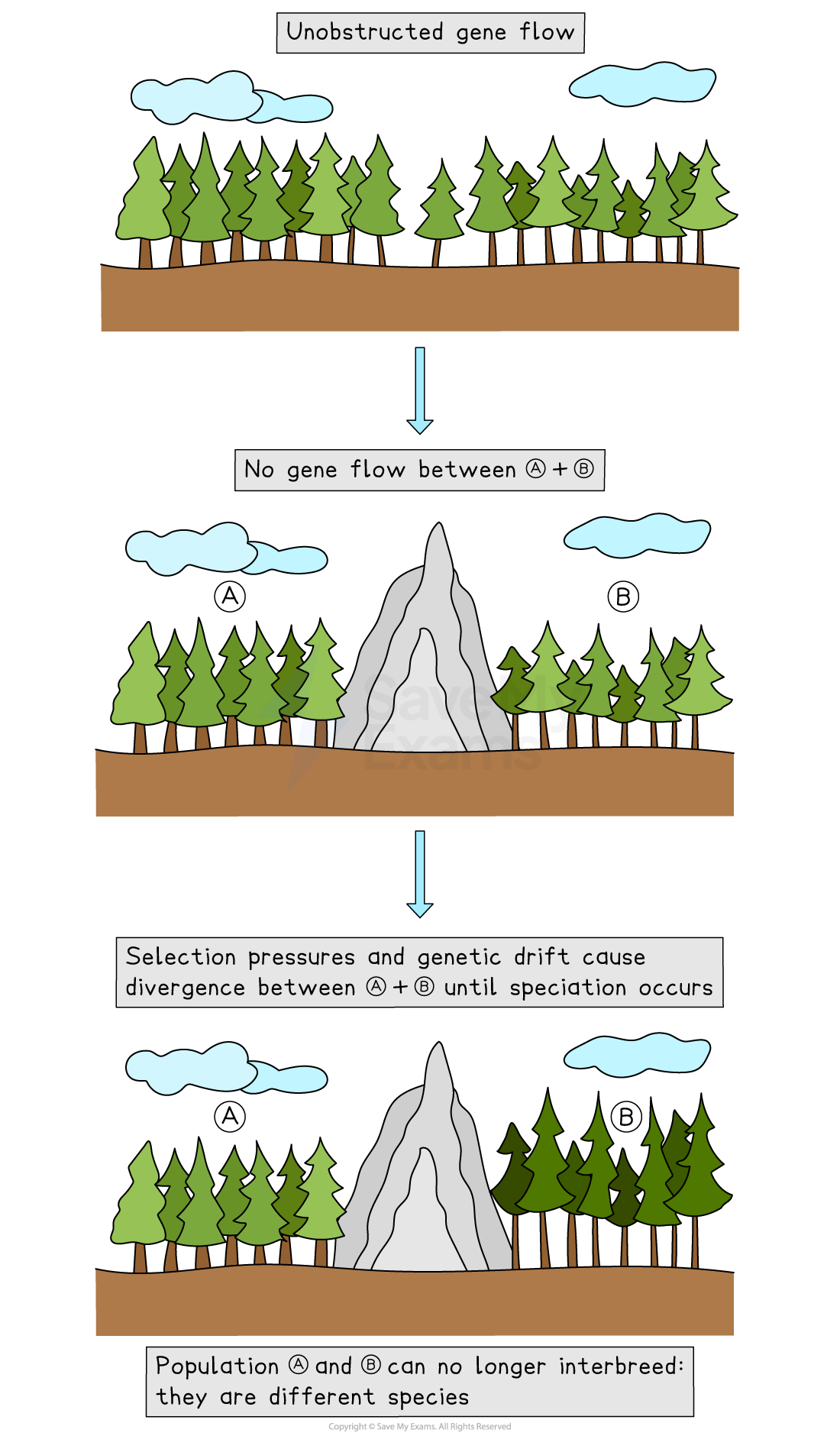
Allopatric speciation happens when a population is split by a geographical barrier
-
Barriers can be natural (e.g. mountains, rivers) or man-made (e.g. roads)
-
The separated groups are reproductively isolated, so no gene flow occurs
-
Different selection pressures act on each group, changing allele frequencies through natural selection
-
Over time, these changes lead to differences in phenotypes, including physical, behavioural and physiological traits
-
Eventually, the two populations become genetically distinct and can no longer interbreed – they are now separate species
Example: allopatric speciation in trees
-
A population of trees is split by the formation of a new mountain range
-
The two groups can no longer interbreed
-
Each group faces different environmental conditions
-
Over many generations, they evolve into two separate species
Sympatric speciation
-
Sympatric speciation happens without a geographical barrier
-
The population lives in the same area, but splits into two groups with no gene flow between them
-
This separation is caused by:
-
ecological separation – groups live in different environments within the same area (e.g. soil pH affects flowering time in plants)
-
behavioural separation – groups develop different behaviours (e.g. courtship, feeding, or communication), preventing mating
-
Example: sympatric speciation in fish
-
A single fish species lives in a lake
-
Some fish feed at the bottom, others stay in the open water
-
These groups live in different environments and show different feeding behaviours
-
Over time, selection pressures favour different traits:
-
Long jaws for bottom-feeders
-
Short jaws for mid-water feeders
-
-
The groups also evolve different courtship behaviours
-
Eventually, they can no longer interbreed – they are now separate species
Examiner Tips and Tricks
When explaining sympatric speciation, clearly separate the factor that causes the initial separation (e.g. feeding behaviour) from the factor that prevents breeding after genetic changes (e.g. courtship behaviour). Don’t confuse the two — they occur at different stages in the speciation process.
Genetic drift
-
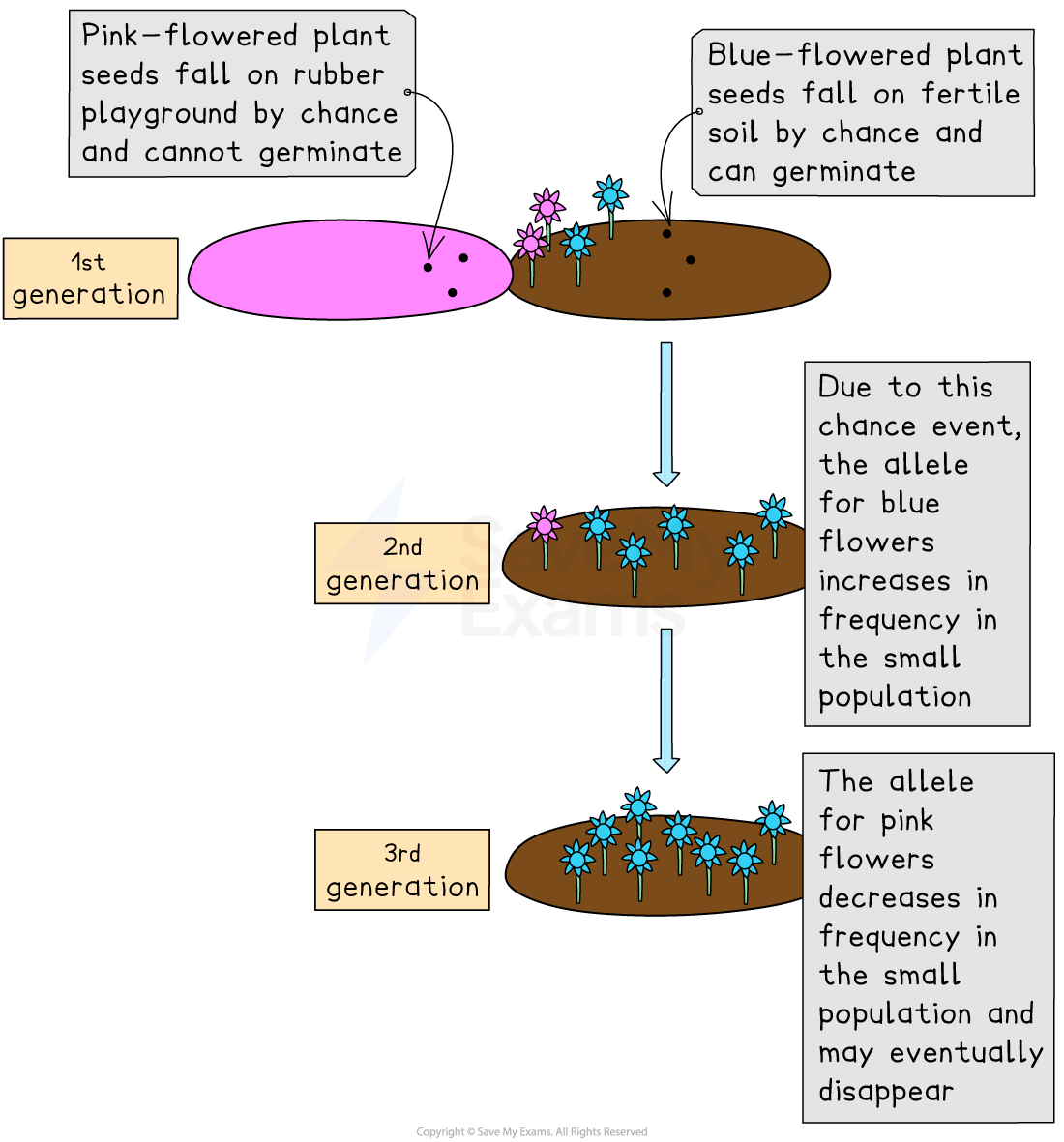
Genetic drift is when chance (instead of environmental selection pressures) affects which individuals in a population survive, breed and pass on their alleles
-
For example, when a population is significantly small, chance can affect which alleles get passed onto the next generation
-
Over time, some alleles can be lost or favoured purely by chance
-
When there is a gradual change in allele frequencies in a small population due to chance and not natural selection, genetic drift is occurring
-
-
In large populations, genetic drift is less likely to have an effect because any chance variations in allele frequencies usually even out across the whole population
-
Natural selection has a much more influential role in the evolution of large populations
-
Example: genetic drift in plants
-
In a small population of plants growing near a playground with a rubber floor:
-
Half of the plants have alleles for blue flowers
-
Half of the plants have alleles for pink flowers
-
-
By chance, most pink-flowered seeds land on rubber and fail to germinate
Blue-flowered seeds land on fertile soil and grow
-
Over generations, pink alleles may disappear due to this random event, not selection
Examiner Tips and Tricks
Make sure you can explain that genetic drift has a greater impact in small populations because chance events can significantly alter allele frequencies — there’s less genetic diversity to buffer against random loss of alleles, so evolutionary change happens more quickly and unpredictably