
Biology_A-level_Aqa
-
1-biological-molecules
1-1-biological-molecules-carbohydrates11 主题-
1-1-1-biological-molecules-key-terms
-
1-1-2-biological-molecules-reactions
-
1-1-3-monosaccharides
-
1-1-4-glucose
-
1-1-5-the-glycosidic-bond
-
1-1-6-chromatography-monosaccharides
-
1-1-7-disaccharides
-
1-1-8-starch-and-glycogen
-
1-1-9-cellulose
-
1-1-10-biochemical-tests-sugars-and-starch
-
1-1-11-finding-the-concentration-of-glucose
-
1-1-1-biological-molecules-key-terms
-
1-2-biological-molecules-lipids3 主题
-
1-3-biological-molecules-proteins5 主题
-
1-4-proteins-enzymes12 主题
-
1-4-1-many-proteins-are-enzymes
-
1-4-2-enzyme-specificity
-
1-4-3-how-enzymes-work
-
1-4-4-required-practical-measuring-enzyme-activity
-
1-4-5-drawing-a-graph-for-enzyme-rate-experiments
-
1-4-6-using-a-tangent-to-find-initial-rate-of-reaction
-
1-4-7-limiting-factors-affecting-enzymes-temperature
-
1-4-8-limiting-factors-affecting-enzymes-ph
-
1-4-10-limiting-factors-affecting-enzymes-enzyme-concentration
-
1-4-11-limiting-factors-affecting-enzymes-substrate-concentration
-
1-4-12-limiting-factors-affecting-enzymes-inhibitors
-
1-4-14-control-of-variables-and-uncertainty
-
1-4-1-many-proteins-are-enzymes
-
1-5-nucleic-acids-structure-and-dna-replication8 主题
-
1-5-2-nucleotide-structure-and-the-phosphodiester-bond
-
1-5-3-dna-structure-and-function
-
1-5-4-rna-structure-and-function
-
1-5-5-ribosomes
-
1-5-6-the-origins-of-research-on-the-genetic-code
-
1-5-8-the-process-of-semi-conservative-replication
-
1-5-9-calculating-the-frequency-of-nucleotide-bases
-
1-5-10-the-watson-crick-model
-
1-5-2-nucleotide-structure-and-the-phosphodiester-bond
-
1-6-atp-water-and-inorganic-ions4 主题
-
2-cell-structure2-1-cell-structure7 主题
-
2-2-the-microscope-in-cell-studies4 主题
-
2-3-cell-division-in-eukaryotic-and-prokaryotic-cells8 主题
-
2-4-cell-membranes-and-transport7 主题
-
2-5-cell-recognition-and-the-immune-system7 主题
-
2-6-vaccines-disease-and-monoclonal-antibodies6 主题
-
3-exchange-and-transport3-1-adaptations-for-gas-exchange6 主题
-
3-2-human-gas-exchange10 主题
-
3-2-1-the-human-gas-exchange-system
-
3-2-2-dissecting-the-gas-exchange-system
-
3-2-3-microscopy-and-gas-exchange-surfaces
-
3-2-4-investigating-gas-exchange
-
3-2-5-the-alveolar-epithelium
-
3-2-6-ventilation-and-gas-exchange
-
3-2-8-the-effects-of-lung-disease
-
3-2-9-pollution-and-smoking-data
-
3-2-10-risk-factor-data
-
3-2-11-correlations-and-causal-relationships
-
3-2-1-the-human-gas-exchange-system
-
3-3-digestion-and-absorption5 主题
-
3-4-mass-transport-in-animals6 主题
-
3-5-the-circulatory-system-in-animals8 主题
-
3-6-mass-transport-in-plants6 主题
-
4-genetics-variation-and-interdependence4-1-dna-genes-and-chromosomes7 主题
-
4-2-dna-and-protein-synthesis6 主题
-
4-3-genetic-diversity-mutations-and-meiosis7 主题
-
4-4-genetic-diversity-and-adaptation6 主题
-
4-5-species-and-taxonomy4 主题
-
4-6-biodiversity9 主题
-
5-energy-transfers-in-and-between-organisms-a-level-only5-1-photosynthesis-a-level-only5 主题
-
5-2-respiration-a-level-only7 主题
-
5-3-energy-and-ecosystems-a-level-only9 主题
-
5-4-nutrient-cycles-a-level-only4 主题
-
6-organisms-respond-to-changes-in-their-environments-a-level-only6-1-response-to-stimuli-a-level-only12 主题
-
6-1-1-survival-and-response
-
6-1-2-growth-factors-in-flowering-plants
-
6-1-3-indoleacetic-acid-iaa
-
6-1-4-taxes-and-kinesis
-
6-1-5-reflex-arcs
-
6-1-6-required-practical-investigating-animal-movement
-
6-1-7-the-pacinian-corpuscle
-
6-1-8-pacinian-corpuscles-generator-potential
-
6-1-9-investigating-touch-and-temperature-receptors
-
6-1-10-the-human-retina
-
6-1-11-myogenic-stimulation-of-the-heart
-
6-1-13-heart-rate
-
6-1-1-survival-and-response
-
6-2-nervous-coordination-a-level-only10 主题
-
6-3-skeletal-muscles-a-level-only6 主题
-
6-4-homeostasis-a-level-only11 主题
-
6-4-1-principles-of-homeostasis
-
6-4-2-negative-feedback
-
6-4-3-glucose-concentration-and-insulin
-
6-4-4-glucose-regulation-glucagon
-
6-4-5-glucose-regulation-adrenaline
-
6-4-6-glucose-regulation-the-liver
-
6-4-7-diabetes
-
6-4-8-required-practical-determining-the-concentration-of-glucose-in-urine
-
6-4-9-nephron-structure
-
6-4-10-nephron-function
-
6-4-11-control-of-blood-water-potential
-
6-4-1-principles-of-homeostasis
-
7-genetics-populations-evolution-and-ecosystems-a-level-only7-1-inheritance-a-level-only6 主题
-
7-2-populations-a-level-only3 主题
-
7-3-evolution-a-level-only5 主题
-
7-4-populations-in-ecosystems-a-level-only7 主题
-
8-the-control-of-gene-expression-a-level-only8-1-genetic-mutations-a-level-only2 主题
-
8-2-regulation-of-gene-expression-a-level-only11 主题
-
8-2-1-totipotent-cells
-
8-2-2-stem-cells
-
8-2-3-the-use-of-stem-cells
-
8-2-4-producing-tissue-cultures-of-explants
-
8-2-5-regulation-of-transcription
-
8-2-6-evaluating-data-about-genetic-expression
-
8-2-7-epigenetics
-
8-2-8-epigenetics-and-disease
-
8-2-9-rna-interference
-
8-2-10-two-types-of-tumours
-
8-2-11-tumour-development
-
8-2-1-totipotent-cells
-
8-3-using-genome-projects-a-level-only4 主题
-
8-4-gene-technologies-a-level-only13 主题
-
8-4-1-recombinant-dna-technology
-
8-4-2-producing-fragments-of-dna
-
8-4-3-investigating-the-specificity-of-restriction-enzymes
-
8-4-4-polymerase-chain-reaction
-
8-4-5-culture-of-transformed-host-cells
-
8-4-6-uses-of-recombinant-dna-technology
-
8-4-7-dna-probes-and-dna-hybridisation
-
8-4-8-screening-patients
-
8-4-9-genetic-counselling-and-personalised-medicine
-
8-4-10-variable-number-tandem-repeats
-
8-4-11-gel-electrophoresis
-
8-4-12-genetic-fingerprinting
-
8-4-13-uses-of-genetic-fingerprinting
-
8-4-1-recombinant-dna-technology
-
exam-guidance-and-skillsessay-guidance3 主题
5-1-6-limiting-factors-of-photosynthesis
Factors that limit the rate of photosynthesis
-
In order to carry out photosynthesis at the highest possible rate, plants need a constant supply of reactants, as well as suitable environmental conditions
-
If conditions are not ideal then the rate of photosynthesis will be limited
-
The main environmental factors that can limit the rate of photosynthesis are:
-
light intensity
-
carbon dioxide concentration
-
temperature
-
-
These are known as limiting factors of photosynthesis
-
If any one of these factors is below the optimum level for the plant, the rate of photosynthesis will be reduced, even if the other two factors are at their optimum
Light intensity
-
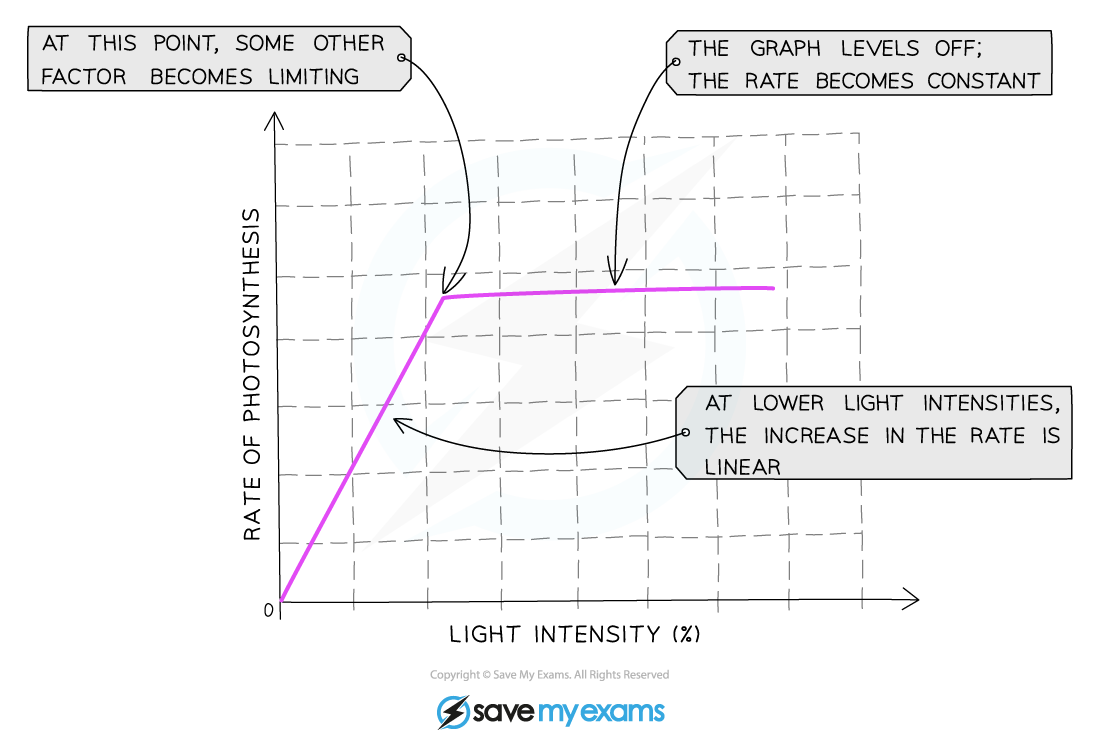
The rate of photosynthesis increases as light intensity increases:
-
At high light intensity more electrons undergo photoionisation and more ATP NADPH are produced
-
The Calvin cycle can progress at a faster rate and more organic compounds can be produced
-
-
If light intensity continues to increase, the rate of photosynthesis will eventually level off, or reach a plateau
-
At this point light intensity is no longer a limiting factor, and another factor is limiting the rate of photosynthesis, e.g. temperature or carbon dioxide concentration
-
Worked Example
The graph below shows the effect of reducing light intensity on some of the products of photosynthesis.

Explain the effect of reduced light intensity on levels of GP, RuBP and TP.
[2]
Answer:
-
Reduction in ATP AND NADPH/reduced NAD from the light-dependent reactions; [1 mark]
-
GP cannot be converted into triose phosphate SO GP builds up / triose phosphate cannot be converted into RuBP; [1 mark]
Examiner Tips and Tricks
Always refer to the limiting factor of light as light intensity; never just state ‘light’ as a limiting factor.
Carbon dioxide concentration
-
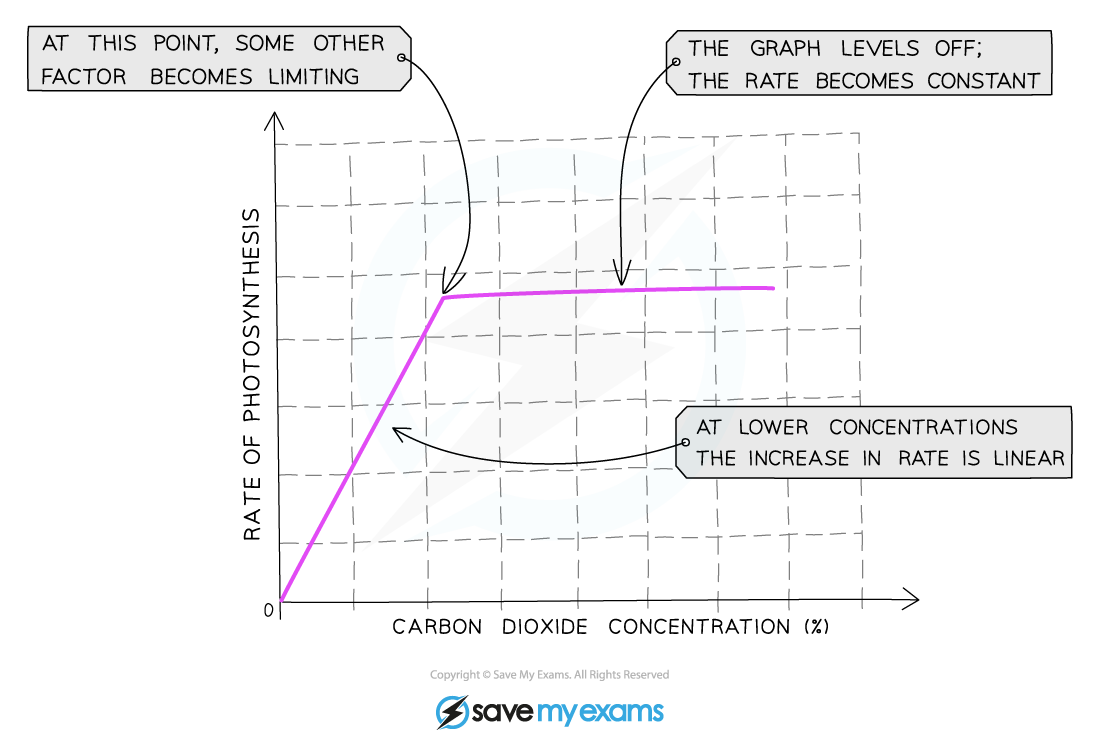
The rate of photosynthesis increases as carbon dioxide concentration increases:
-
When more CO2 is present, more can combine with RuBP during carbon fixation
-
More GP will be produced, which can be converted into triose phosphate and then into organic compounds
-
-
This trend will continue until another factor becomes limiting
Worked Example
The graph below shows the effect of reducing carbon dioxide concentration on some of the products of photosynthesis.
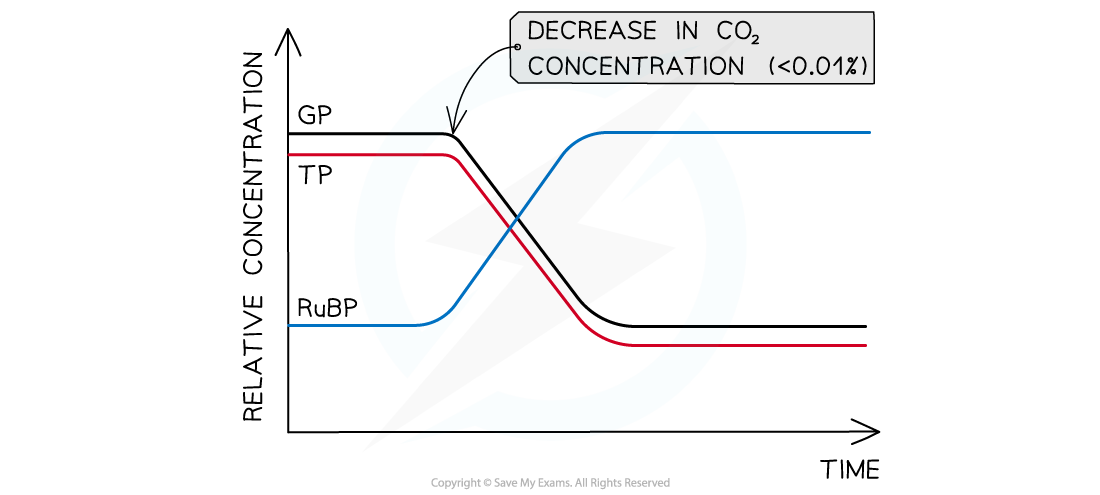
Explain the effect of reduced carbon dioxide concentration on levels of GP, RuBP and TP.
[2]
Answer:
-
Carbon dioxide does not combine with RuBP; [1 mark]
-
RuBP is not converted into GP SO RuBP builds up / GP cannot be converted into triose phosphate; [1 mark]
Examiner Tips and Tricks
Always refer to carbon dioxide concentration, and never the ‘amount’ of carbon dioxide, or just ‘carbon dioxide’ alone.
Temperature
-
The rate of photosynthesis increases as temperature increases
-
Photosynthesis is an enzyme-controlled reaction, so an increase in kinetic energy will increase reaction rate
-
Examples of enzymes in photosynthesis include:
-
rubisco
-
ATP synthase
-
-
-
This trend continues up to a certain temperature, beyond which enzymes begin to denature and the rate of reaction decreases
-
For most metabolic reactions, temperature has a large effect on reaction rate
-
For photosynthesis, temperature has no significant effect on the light-dependent reactions, as these are driven by energy from light rather than the kinetic energy of the reacting molecules

-
Temperature can also impact rate of photosynthesis for other reasons, e.g.:
-
increasing temperature causes stomata on the leaf to close in order to reduce water loss; this reduced gas exchange and so influence availability of CO2
-
the light-dependent reaction relies on a proton gradient forming across the thylakoid membrane; changes in temperature may affect the permeability of the thylakoid membrane
-
Agricultural practices and limiting factors
-
An understanding of the effect of