
Biology_A-level_Aqa
-
1-biological-molecules
1-1-biological-molecules-carbohydrates11 主题-
1-1-1-biological-molecules-key-terms
-
1-1-2-biological-molecules-reactions
-
1-1-3-monosaccharides
-
1-1-4-glucose
-
1-1-5-the-glycosidic-bond
-
1-1-6-chromatography-monosaccharides
-
1-1-7-disaccharides
-
1-1-8-starch-and-glycogen
-
1-1-9-cellulose
-
1-1-10-biochemical-tests-sugars-and-starch
-
1-1-11-finding-the-concentration-of-glucose
-
1-1-1-biological-molecules-key-terms
-
1-2-biological-molecules-lipids3 主题
-
1-3-biological-molecules-proteins5 主题
-
1-4-proteins-enzymes12 主题
-
1-4-1-many-proteins-are-enzymes
-
1-4-2-enzyme-specificity
-
1-4-3-how-enzymes-work
-
1-4-4-required-practical-measuring-enzyme-activity
-
1-4-5-drawing-a-graph-for-enzyme-rate-experiments
-
1-4-6-using-a-tangent-to-find-initial-rate-of-reaction
-
1-4-7-limiting-factors-affecting-enzymes-temperature
-
1-4-8-limiting-factors-affecting-enzymes-ph
-
1-4-10-limiting-factors-affecting-enzymes-enzyme-concentration
-
1-4-11-limiting-factors-affecting-enzymes-substrate-concentration
-
1-4-12-limiting-factors-affecting-enzymes-inhibitors
-
1-4-14-control-of-variables-and-uncertainty
-
1-4-1-many-proteins-are-enzymes
-
1-5-nucleic-acids-structure-and-dna-replication8 主题
-
1-5-2-nucleotide-structure-and-the-phosphodiester-bond
-
1-5-3-dna-structure-and-function
-
1-5-4-rna-structure-and-function
-
1-5-5-ribosomes
-
1-5-6-the-origins-of-research-on-the-genetic-code
-
1-5-8-the-process-of-semi-conservative-replication
-
1-5-9-calculating-the-frequency-of-nucleotide-bases
-
1-5-10-the-watson-crick-model
-
1-5-2-nucleotide-structure-and-the-phosphodiester-bond
-
1-6-atp-water-and-inorganic-ions4 主题
-
2-cell-structure2-1-cell-structure7 主题
-
2-2-the-microscope-in-cell-studies4 主题
-
2-3-cell-division-in-eukaryotic-and-prokaryotic-cells8 主题
-
2-4-cell-membranes-and-transport7 主题
-
2-5-cell-recognition-and-the-immune-system7 主题
-
2-6-vaccines-disease-and-monoclonal-antibodies6 主题
-
3-exchange-and-transport3-1-adaptations-for-gas-exchange6 主题
-
3-2-human-gas-exchange10 主题
-
3-2-1-the-human-gas-exchange-system
-
3-2-2-dissecting-the-gas-exchange-system
-
3-2-3-microscopy-and-gas-exchange-surfaces
-
3-2-4-investigating-gas-exchange
-
3-2-5-the-alveolar-epithelium
-
3-2-6-ventilation-and-gas-exchange
-
3-2-8-the-effects-of-lung-disease
-
3-2-9-pollution-and-smoking-data
-
3-2-10-risk-factor-data
-
3-2-11-correlations-and-causal-relationships
-
3-2-1-the-human-gas-exchange-system
-
3-3-digestion-and-absorption5 主题
-
3-4-mass-transport-in-animals6 主题
-
3-5-the-circulatory-system-in-animals8 主题
-
3-6-mass-transport-in-plants6 主题
-
4-genetics-variation-and-interdependence4-1-dna-genes-and-chromosomes7 主题
-
4-2-dna-and-protein-synthesis6 主题
-
4-3-genetic-diversity-mutations-and-meiosis7 主题
-
4-4-genetic-diversity-and-adaptation6 主题
-
4-5-species-and-taxonomy4 主题
-
4-6-biodiversity9 主题
-
5-energy-transfers-in-and-between-organisms-a-level-only5-1-photosynthesis-a-level-only5 主题
-
5-2-respiration-a-level-only7 主题
-
5-3-energy-and-ecosystems-a-level-only9 主题
-
5-4-nutrient-cycles-a-level-only4 主题
-
6-organisms-respond-to-changes-in-their-environments-a-level-only6-1-response-to-stimuli-a-level-only12 主题
-
6-1-1-survival-and-response
-
6-1-2-growth-factors-in-flowering-plants
-
6-1-3-indoleacetic-acid-iaa
-
6-1-4-taxes-and-kinesis
-
6-1-5-reflex-arcs
-
6-1-6-required-practical-investigating-animal-movement
-
6-1-7-the-pacinian-corpuscle
-
6-1-8-pacinian-corpuscles-generator-potential
-
6-1-9-investigating-touch-and-temperature-receptors
-
6-1-10-the-human-retina
-
6-1-11-myogenic-stimulation-of-the-heart
-
6-1-13-heart-rate
-
6-1-1-survival-and-response
-
6-2-nervous-coordination-a-level-only10 主题
-
6-3-skeletal-muscles-a-level-only6 主题
-
6-4-homeostasis-a-level-only11 主题
-
6-4-1-principles-of-homeostasis
-
6-4-2-negative-feedback
-
6-4-3-glucose-concentration-and-insulin
-
6-4-4-glucose-regulation-glucagon
-
6-4-5-glucose-regulation-adrenaline
-
6-4-6-glucose-regulation-the-liver
-
6-4-7-diabetes
-
6-4-8-required-practical-determining-the-concentration-of-glucose-in-urine
-
6-4-9-nephron-structure
-
6-4-10-nephron-function
-
6-4-11-control-of-blood-water-potential
-
6-4-1-principles-of-homeostasis
-
7-genetics-populations-evolution-and-ecosystems-a-level-only7-1-inheritance-a-level-only6 主题
-
7-2-populations-a-level-only3 主题
-
7-3-evolution-a-level-only5 主题
-
7-4-populations-in-ecosystems-a-level-only7 主题
-
8-the-control-of-gene-expression-a-level-only8-1-genetic-mutations-a-level-only2 主题
-
8-2-regulation-of-gene-expression-a-level-only11 主题
-
8-2-1-totipotent-cells
-
8-2-2-stem-cells
-
8-2-3-the-use-of-stem-cells
-
8-2-4-producing-tissue-cultures-of-explants
-
8-2-5-regulation-of-transcription
-
8-2-6-evaluating-data-about-genetic-expression
-
8-2-7-epigenetics
-
8-2-8-epigenetics-and-disease
-
8-2-9-rna-interference
-
8-2-10-two-types-of-tumours
-
8-2-11-tumour-development
-
8-2-1-totipotent-cells
-
8-3-using-genome-projects-a-level-only4 主题
-
8-4-gene-technologies-a-level-only13 主题
-
8-4-1-recombinant-dna-technology
-
8-4-2-producing-fragments-of-dna
-
8-4-3-investigating-the-specificity-of-restriction-enzymes
-
8-4-4-polymerase-chain-reaction
-
8-4-5-culture-of-transformed-host-cells
-
8-4-6-uses-of-recombinant-dna-technology
-
8-4-7-dna-probes-and-dna-hybridisation
-
8-4-8-screening-patients
-
8-4-9-genetic-counselling-and-personalised-medicine
-
8-4-10-variable-number-tandem-repeats
-
8-4-11-gel-electrophoresis
-
8-4-12-genetic-fingerprinting
-
8-4-13-uses-of-genetic-fingerprinting
-
8-4-1-recombinant-dna-technology
-
exam-guidance-and-skillsessay-guidance3 主题
3-5-4-the-cardiac-cycle
The cardiac cycle
-
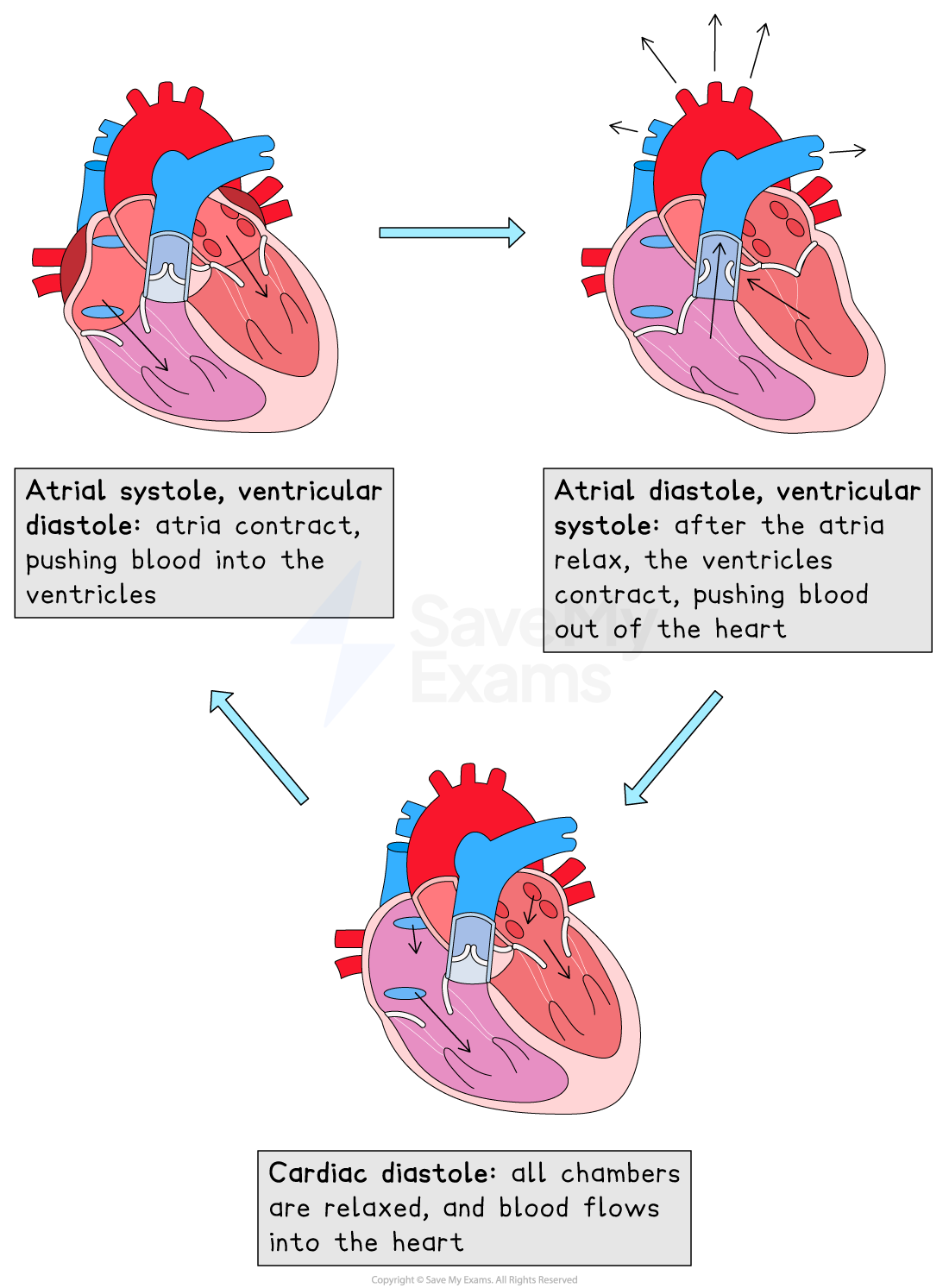
The cardiac cycle is the series of events that take place in one heart beat, including muscle contraction and relaxation
-
The contraction of the heart is called systole, while the relaxation of the heart is called diastole
-
-
Volume changes occur in the heart during the cardiac cycle
-
Contraction of the heart muscle causes a decrease in volume in the corresponding chamber of the heart, which then increases again when the muscle relaxes
-
-
Volume changes lead to corresponding pressure changes
-
When volume decreases, pressure increases
-
When volume increases, pressure decreases
-
The events of the cardiac cycle
Atrial systole
-
The walls of the atria contract
-
Atrial volume decreases
-
Atrial pressure increases
-
-
The pressure in the atria rises above that in the ventricles, forcing the atrioventricular (AV) valves open
-
Blood is forced into the ventricles
-
There is a slight increase in ventricular pressure and chamber volume as the ventricles receive the blood from the atria
-
-
The ventricles are relaxed at this point; ventricular diastole coincides with atrial systole
Ventricular systole
-
The walls of the ventricles contract
-
Ventricular volume decreases
-
Ventricular pressure increases
-
-
The pressure in the ventricles rises above that in the atria
-
The AV valves are forced to close, preventing back flow of blood
-
-
The pressure in the ventricles rises above that in the aorta and pulmonary artery
-
The semilunar (SL) valves are forced open so blood is forced into the arteries and out of the heart
-
-
During this period:
-
the atria are relaxing; atrial diastole coincides with ventricular systole
-
the blood flow to the heart continues, so the relaxed atria begin to fill with blood again
-
Diastole
-
The ventricles and atria are both relaxed
-
The pressure in the ventricles drops below that in the aorta and pulmonary artery, forcing the SL valves to close
-
The atria continue to fill with blood
-
Blood returns to the heart via the vena cava and pulmonary vein
-
-
Pressure in the atria rises above that in the ventricles, forcing the AV valves open
-
Blood flows passively into the ventricles without need for atrial systole
-
The cycle then begins again with atrial systole
Valve movements during the cardiac cycle
-
Pressure changes cause the valves to open and close in different regions of the heart
-
Valves open when the pressure of blood behind them is greater than the pressure in front of them
-
They close when the pressure of blood in front of them is greater than the pressure behind them
-
|
Stage in cardiac cycle |
Atrioventricular valves |
Semilunar valves |
|---|---|---|
|
Atrial systole |
Open |
Closed |
|
Ventricular systole |
Closed |
Open |
|
Diastole |
Open |
Closed |
Analysing data relating to the cardiac cycle
-
The changes that occur during the cardiac cycle can be shown on a graph, e.g.:
-
The lines on the graph below represent the pressure of the left atrium, aorta, and the left ventricle
-
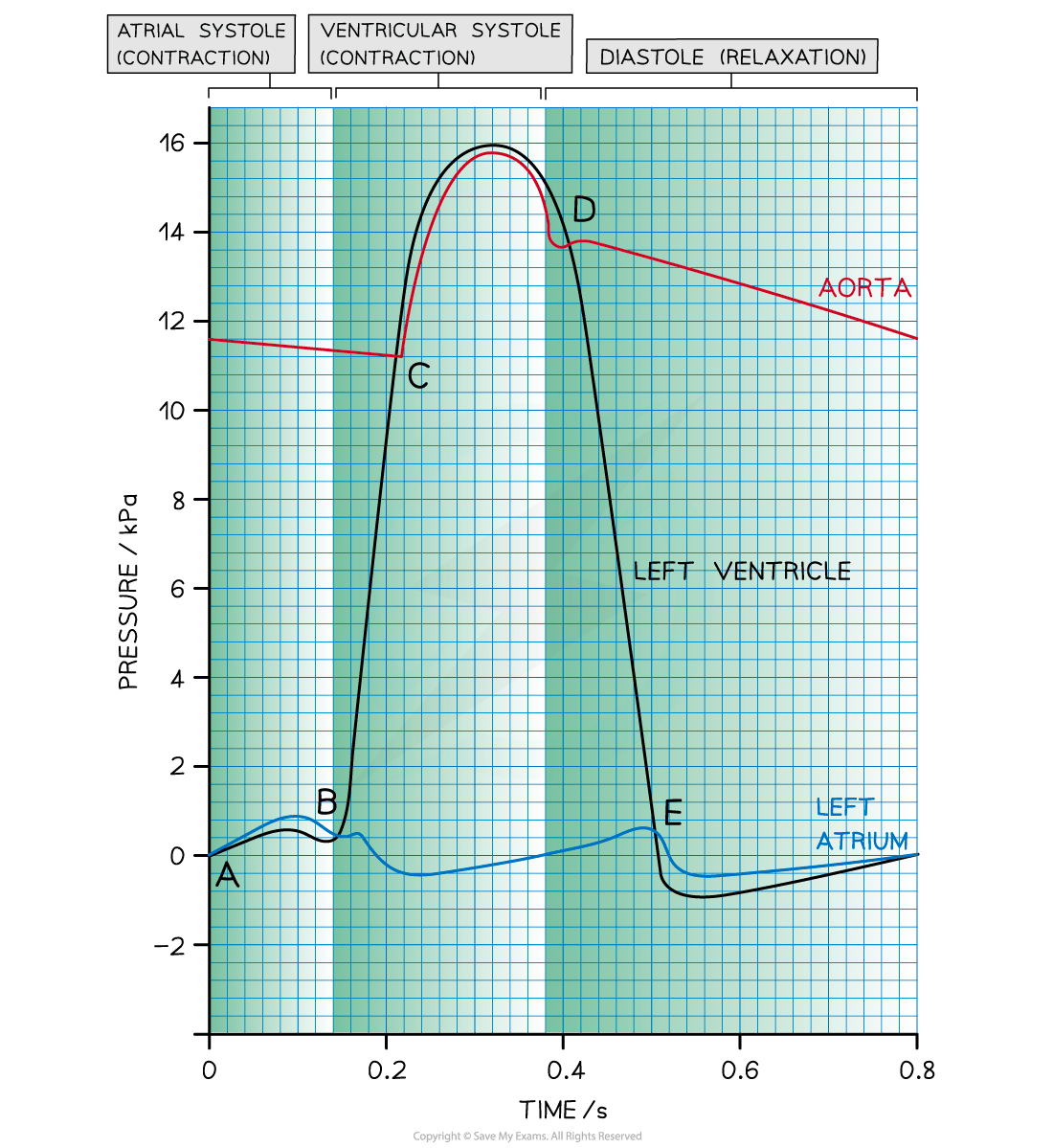
Interpreting the cardiac cycle graph
-
Point A: the end of diastole
-
The atrium has filled with blood during the preceding diastole
-
Pressure is higher in the atrium than in the ventricle, so the AV valve is open
-
-
Point A-B: atrial systole
-
Left atrium contracts, causing an increase in atrial pressure and forcing blood into the left ventricle
-
Ventricular pressure increases slightly as it fills with blood
-
Pressure is higher in the atrium than in the ventricle, so the AV valve is open
-
-
Point B: beginning of ventricular systole
-
Left ventricle contracts causing the ventricular pressure to increase
-
Pressure in the left atrium drops as the muscle relaxes
-
Pressure in the ventricle exceeds pressure in the atrium, so the AV valve shuts
-
-
Point C: ventricular systole
-
The ventricle continues to contract
-
Pressure in the left ventricle exceeds that in the aorta
-
Aortic valve opens and blood is forced into the aorta
-
-
Point D: beginning of diastole
-
Left ventricle has been emptied of blood
-
Muscles in the walls of the left ventricle relax and pressure falls below that in the newly filled aorta
-
Aortic valve closes
-
-
Point D-E: early diastole
-
The ventricle remains relaxed and ventricular pressure continues to decrease
-
In the meantime, blood is flowing into the relaxed atrium from the pulmonary vein, causing an increase in pressure
-
-
Point E: diastole
-
The relaxed left atrium fills with blood, causing the pressure in the atrium to exceed that in the newly emptied ventricle
-
AV valve opens
-
-
After point E: late diastole
-
There is a short period of time during which the left ventricle expands due to relaxing muscles
-
This increases the internal volume of the left ventricle and decreases the ventricular pressure
-
At the same time, blood is flowing slowly through the newly opened AV valve into the left ventricle, causing a brief decrease in pressure in the left atrium
-
The pressure in both the atrium and ventricle then increases slowly as they continue to fill with blood
-
Worked Example
The graph below shows the cardiac cycle.
Calculate the heart rate of this person. Give your answer in beats per minute.

Answer:
Step 1: work out the length of one heart beat
-
It takes 0.7 seconds for completion of one cardiac cycle, which is one heart beat
1 cycle = 0.7 seconds
Step 2: calculate how many heart beats occur per second
-
Determine the number of times 0.7 fits into 1 second
1 format('truetype')%3Bfont-weight%3Anormal%3Bfont-style%3Anormal%3B%7D%3C%2Fstyle%3E%3C%2Fdefs%3E%3Ctext%20font-family%3D%22math13cec07e9ba5f5bb252d13f5f43%22%20font-size%3D%2216%22%20text-anchor%3D%22middle%22%20x%3D%229.5%22%20y%3D%2216%22%3E%26%23xF7%3B%3C%2Ftext%3E%3C%2Fsvg%3E) 0.7 = 1.43 beats per second
0.7 = 1.43 beats per second
Step 3: calculate how many heart beats occur per minute
-
1 minute = 60 seconds
1.43 x 60 = 85.71 beats beats / min
Examiner Tips and Tricks
Make sure that you can point out the times on a cardiac cycle graph at which different valves are opening and closing.